


 Views: 2
Glaucoma Medicine: What Is the Best Eye Drop for Glaucoma?
If you are searching for glaucoma medicine eye drops, it is important to understand that glaucoma treatment is not simply about reducing eye pressure temporarily. The goal is to control intraocular pressure and prevent further damage to the optic nerve.


Dedicated Support at Every Step!
Our Doctors are available 24 hours a day, 7 days a week to help you!

Some people also search for homeopathic medicine for glaucoma, Ayurvedic medicine for glaucoma, or Patanjali medicine for glaucoma. However, there is no reliable scientific evidence that homeopathic or Ayurvedic medicines can reverse established optic nerve damage or replace proven glaucoma treatment.
Table of Contents
What Is Glaucoma?
Glaucoma is a group of eye diseases that damage the optic nerve, which carries visual information from the eye to the brain.
The damage is often associated with increased intraocular pressure, although glaucoma can also develop when eye pressure is within the normal range.
Glaucoma can develop gradually and may not cause noticeable symptoms in its early stages. This is why it is sometimes called a "silent" cause of vision loss.
There are several types of glaucoma, including:
- Open-angle glaucoma
- Angle-closure glaucoma
- Normal-tension glaucoma
- Congenital glaucoma
- Secondary glaucoma
The appropriate treatment depends on the type and severity of glaucoma.
No Cost EMI, Hassle-free Insurance Approval
What Are the Symptoms of Glaucoma?
Early glaucoma may have no obvious symptoms.
As the disease progresses, a person may experience:
- Gradual loss of peripheral vision
- Difficulty seeing objects from the side
- Blurred vision
- Eye pain in some types of glaucoma
- Redness of the eye
- Headache
- Halos around lights
- Nausea or vomiting during an acute attack
- Sudden changes in vision
Acute angle-closure glaucoma can be an emergency. Severe eye pain, sudden blurred vision, halos around lights, headache, nausea, or vomiting require urgent ophthalmic evaluation.
Is There Any Medicine for Glaucoma?
Yes. Medicines are an important part of glaucoma treatment for many patients.
However, there is no single best medicine for glaucoma that works for everyone.
Glaucoma medicines primarily work by lowering intraocular pressure. The ophthalmologist chooses treatment based on:
- Type of glaucoma
- Eye pressure
- Amount of optic nerve damage
- Visual field results
- Age and overall health
- Other medicines being used
- Response to previous treatment
- Presence of side effects
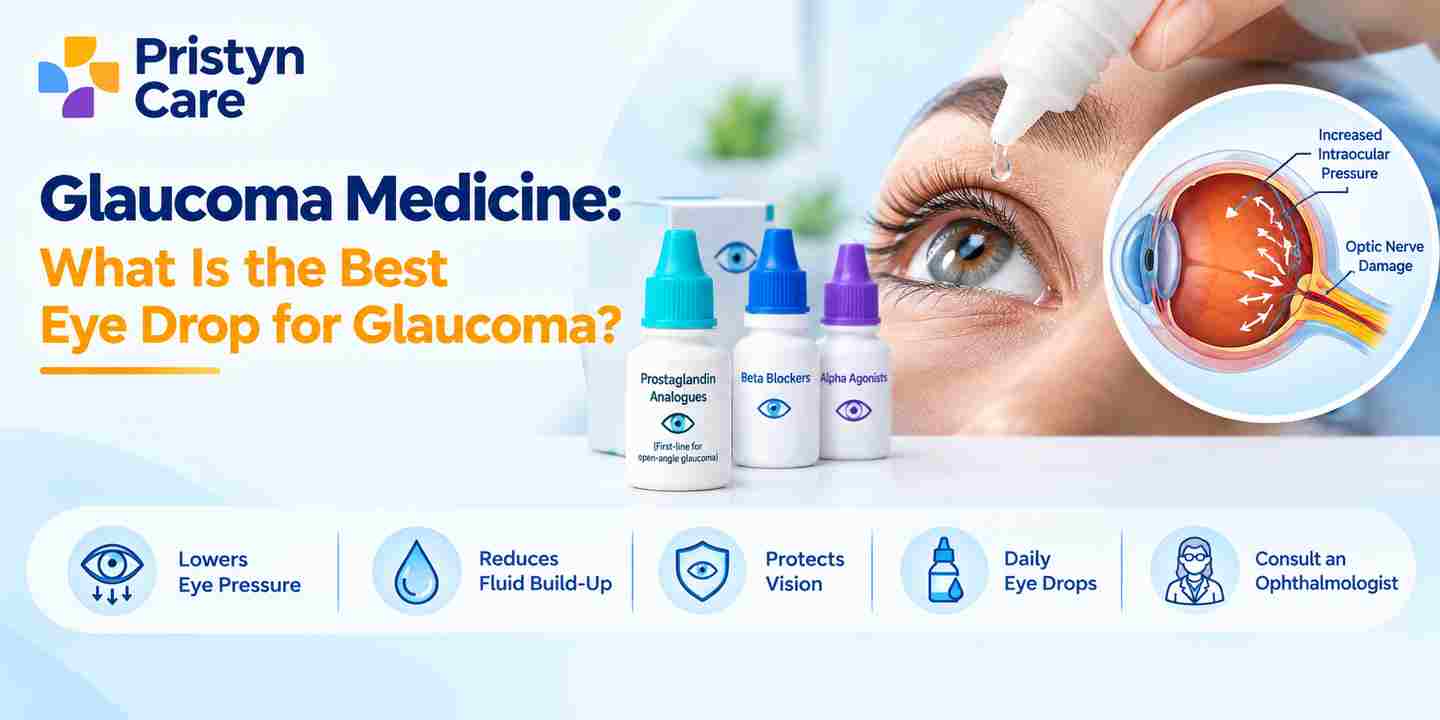
Common Glaucoma Medicines
| Medicine category | How it helps | Common examples |
| Prostaglandin analogues | Increase drainage of fluid from the eye | Latanoprost, bimatoprost, travoprost |
| Beta blockers | Reduce production of fluid inside the eye | Timolol |
| Alpha agonists | Reduce fluid production and may improve drainage | Brimonidine |
| Carbonic anhydrase inhibitors | Reduce fluid production | Dorzolamide, brinzolamide |
| Rho kinase inhibitors | Improve fluid drainage | Netarsudil |
| Miotics | Improve fluid drainage in selected cases | Pilocarpine |
| Combination drops | Combine two or more mechanisms | Various combinations |
The exact medicine and dose should be determined by an ophthalmologist.
Glaucoma Medicine Eye Drops
Glaucoma medicine eye drops are commonly prescribed to lower intraocular pressure.
Depending on the patient's condition, an ophthalmologist may prescribe one or more types of eye drops.
1. Prostaglandin Eye Drops
Prostaglandin analogues are commonly used as a first-line treatment for many patients with open-angle glaucoma or ocular hypertension.
They primarily work by improving the drainage of fluid from the eye.
Examples include:
- Latanoprost
- Bimatoprost
- Travoprost
2. Beta-Blocker Eye Drops
Timolol is a commonly used beta-blocker eye drop.
It reduces the production of aqueous humour, which can help lower eye pressure.
These medicines may not be suitable for everyone, particularly people with certain heart or breathing conditions.
3. Alpha-Agonist Eye Drops
Brimonidine can reduce aqueous humour production and may also improve fluid drainage.
It may be prescribed alone or in combination with another glaucoma medicine.
4. Carbonic Anhydrase Inhibitor Eye Drops
Dorzolamide and brinzolamide are examples of topical carbonic anhydrase inhibitors.
They reduce the production of fluid inside the eye and can help lower intraocular pressure.
5. Combination Eye Drops
Some patients require more than one medicine to adequately control eye pressure.
Combination drops may contain two different glaucoma medicines in a single bottle.
What Is the Best Eye Drop for Glaucoma?
There is no single eye drop that is the best for every glaucoma patient.
For many people with open-angle glaucoma, a prostaglandin analogue may be prescribed because of its effectiveness in lowering eye pressure and convenient dosing.
However, the "best" glaucoma eye drop depends on the individual patient.
Do not change, stop, or start glaucoma eye drops without consulting an ophthalmologist.
Even if your vision appears normal, glaucoma can continue damaging the optic nerve without obvious symptoms.
Can Glaucoma Be Cured With Eye Drops?
Eye drops can control glaucoma but generally cannot reverse optic nerve damage that has already occurred.
Their primary purpose is to reduce the risk of further damage by controlling intraocular pressure.
This means glaucoma treatment is usually about long-term disease control rather than taking medicine for a short period and stopping once symptoms improve.
Regular follow-up is important because the ophthalmologist may need to adjust treatment over time.
Homeopathic Medicine for Glaucoma
Homeopathic medicine for glaucoma is frequently searched online by people looking for a natural alternative to prescription eye drops.
However, there is no good-quality scientific evidence that homeopathic medicines can reliably lower eye pressure enough to prevent glaucoma progression or reverse optic nerve damage.
Glaucoma can cause irreversible vision loss. Therefore, replacing prescribed glaucoma treatment with homeopathic remedies may allow the disease to progress without adequate pressure control.
If you are interested in complementary treatments, discuss them with your ophthalmologist rather than stopping prescribed treatment.
Can Homeopathy Cure Glaucoma?
There is no established evidence that homeopathy can cure glaucoma or restore optic nerve damage caused by glaucoma.
Importantly, glaucoma may continue progressing even when a person has no pain or obvious change in vision.
Therefore, relying only on homeopathic treatment can delay appropriate diagnosis and pressure-lowering treatment.
Ayurvedic Medicine for Glaucoma
Ayurvedic medicine for glaucoma is another commonly searched treatment option.
Although Ayurveda may include approaches intended to support general eye health, there is currently no established Ayurvedic medicine proven to reverse glaucoma-related optic nerve damage or reliably replace standard glaucoma treatment.
A person diagnosed with glaucoma should continue the treatment recommended by their ophthalmologist.
Ayurvedic products should also not be applied directly to the eye unless specifically recommended by a qualified eye-care professional.
Patanjali Medicine for Glaucoma
People may also search for Patanjali medicine for glaucoma as a natural treatment option.
However, there is no scientifically established Patanjali medicine that can reliably cure glaucoma, reverse optic nerve damage, or replace prescription pressure-lowering treatment.
If you have glaucoma, do not discontinue prescribed eye drops in favour of an over-the-counter, herbal, or Ayurvedic product without speaking with your ophthalmologist.
Can Glaucoma Be Treated Without Eye Drops?
Yes, depending on the type and severity of glaucoma.
Eye drops are only one treatment option. Some patients may require:
- Laser treatment
- Oral medicines for short-term or selected situations
- Glaucoma surgery
- Drainage devices
- Minimally invasive glaucoma surgery in appropriate cases
The objective remains the same: maintaining eye pressure at a level that protects the optic nerve.
When Are Glaucoma Eye Drops Not Enough?
Eye drops may not adequately control glaucoma in some patients.
An ophthalmologist may consider another treatment when:
- Eye pressure remains above the target range
- Glaucoma continues to progress
- Multiple eye drops are required
- The patient has difficulty using drops regularly
- Medication causes significant side effects
- The glaucoma is advanced
- The angle is closed or severely narrowed
- There is an acute glaucoma attack
Treatment is individualized based on the patient's disease and risk of vision loss.
Laser Treatment for Glaucoma
Laser treatment can be an option for selected types of glaucoma.
Depending on the condition, procedures may include:
Laser Trabeculoplasty
Laser trabeculoplasty can improve fluid drainage in certain patients with open-angle glaucoma.
Laser Peripheral Iridotomy
Laser peripheral iridotomy is commonly used for angle-closure mechanisms to create an opening in the iris and improve fluid movement.
Laser treatment does not necessarily mean that eye drops will never be required again. Some patients continue to need medicines after laser treatment.
Glaucoma Surgery
When medicines and/or laser treatment do not adequately control glaucoma, surgery may be recommended.
Depending on the condition, surgical options can include:
- Trabeculectomy
- Glaucoma drainage device implantation
- Minimally invasive glaucoma surgery
- Other procedures selected according to the type and severity of glaucoma
The purpose of these procedures is to improve aqueous humour drainage and reduce eye pressure.
Medicine vs Other Glaucoma Treatments
| Treatment | Main purpose | Can lower eye pressure? | Reverses existing optic nerve damage? |
| Glaucoma eye drops | Control eye pressure | Yes | No |
| Oral glaucoma medicine | Rapid/selected pressure control | Yes | No |
| Laser treatment | Improve fluid drainage | Yes | No |
| Glaucoma surgery | Create/improve fluid drainage | Yes | No |
| Homeopathic medicine | Alternative treatment | Not proven | No evidence |
| Ayurvedic medicine | Alternative/complementary treatment | Not reliably established | No evidence |
Can Glaucoma Be Permanently Cured?
Currently, glaucoma is generally considered a chronic condition that requires ongoing management.
Treatment can often control eye pressure and significantly reduce the risk of further vision loss, but it cannot generally restore optic nerve tissue that has already been permanently damaged.
This is why early diagnosis and consistent treatment are so important.
Even after successful treatment, regular eye examinations may be necessary.
Can Lost Vision From Glaucoma Come Back?
Vision loss caused by glaucoma is generally permanent because the optic nerve damage cannot usually be reversed.
However, controlling eye pressure can help protect the remaining vision.
This makes early detection particularly important.
People at increased risk of glaucoma should follow the screening schedule recommended by their ophthalmologist.
What Happens If Glaucoma Is Left Untreated?
Untreated glaucoma can progressively damage the optic nerve.
Over time, this may result in:
- Loss of peripheral vision
- Increasing visual field defects
- Severe vision impairment
- Permanent blindness in advanced cases
Because early glaucoma may not cause noticeable symptoms, waiting for vision problems before seeking treatment can be risky.

Free Glaucoma Surgery Cost Calculator

How Is Glaucoma Diagnosed?
An ophthalmologist may use several tests to diagnose and monitor glaucoma, including:
- Eye pressure measurement
- Dilated eye examination
- Optic nerve evaluation
- Visual field testing
- Optical coherence tomography (OCT)
- Gonioscopy
- Corneal thickness measurement when appropriate
No single test is sufficient for every patient. The ophthalmologist considers the overall clinical picture.
How Should Glaucoma Eye Drops Be Used?
Correct eye-drop technique can help ensure that the medicine reaches the eye and can reduce unnecessary systemic absorption.
General steps include:
- Wash your hands.
- Tilt your head back and look upward.
- Gently pull down the lower eyelid.
- Place the prescribed number of drops into the eye.
- Avoid touching the bottle tip to the eye or eyelashes.
- Close the eye gently.
- If advised, gently press near the inner corner of the eye for a short period.
- If using more than one eye drop, follow the prescribed interval between different medicines.
Always follow the instructions provided by your ophthalmologist.
Do Not Stop Glaucoma Eye Drops Without Medical Advice
Glaucoma often does not cause noticeable symptoms even when it is progressing.
If you experience side effects, difficulty using the drops, or problems with the cost or availability of a medicine, speak with your ophthalmologist about alternatives instead of stopping treatment on your own.
When Should You See an Eye Doctor?
You should arrange an eye examination if you:
- Have been diagnosed with glaucoma
- Have a family history of glaucoma
- Have persistent changes in vision
- Notice progressive peripheral vision loss
- Have unexplained eye pain
- Have repeatedly elevated eye pressure
- Have difficulty tolerating glaucoma eye drops
- Are using glaucoma medicine but your eye pressure remains high
Seek Urgent Medical Attention If:
- Severe eye pain develops suddenly
- Vision suddenly becomes blurred
- You see halos around lights
- The eye becomes markedly red
- You develop severe headache with eye symptoms
- Nausea or vomiting occurs along with sudden eye symptoms
These can occur with acute angle-closure glaucoma, which requires urgent treatment.
Frequently Asked Questions
1. What is the best medicine for glaucoma?
There is no single best glaucoma medicine for everyone. Prostaglandin analogues, beta blockers, alpha agonists, carbonic anhydrase inhibitors, and combination drops may be used depending on the patient's condition.
2. What are the common glaucoma medicine eye drops?
Common glaucoma eye drops include latanoprost, bimatoprost, travoprost, timolol, brimonidine, dorzolamide, and brinzolamide. The appropriate medicine should be prescribed by an ophthalmologist.
3. Can eye drops cure glaucoma permanently?
Eye drops can lower eye pressure and help prevent further optic nerve damage, but they generally cannot reverse established glaucoma damage.
4. Can homeopathic medicine cure glaucoma?
There is no strong scientific evidence that homeopathic medicine can cure glaucoma, reverse optic nerve damage, or reliably prevent glaucoma progression.
5. Is there an Ayurvedic medicine for glaucoma?
No Ayurvedic medicine has been reliably established as a replacement for proven glaucoma treatment. Ayurvedic products should not be used instead of prescribed glaucoma medicines without medical guidance.
6. Can Patanjali medicine cure glaucoma?
There is no scientifically established Patanjali medicine that can cure glaucoma or reverse established optic nerve damage.
7. Can glaucoma be treated without surgery?
Yes. Depending on the type and severity, glaucoma may be managed with eye drops, oral medicines in selected situations, and laser treatment. Some patients eventually require surgery.
8. Can glaucoma cause blindness?
Yes. Untreated or inadequately controlled glaucoma can cause progressive and permanent vision loss, including blindness.
9. Can glaucoma vision loss be reversed?
Vision loss caused by optic nerve damage from glaucoma is generally permanent. Treatment focuses on protecting the remaining vision.
10. Should I stop glaucoma eye drops if my vision is normal?
No. Glaucoma can progress without noticeable symptoms. Do not stop prescribed glaucoma medicine unless your ophthalmologist advises you to do so.


Conclusion
If you are searching for glaucoma medicine eye drops, the right medicine depends on the type and severity of glaucoma, your eye pressure, optic nerve health, and response to treatment. Common prescription options include prostaglandin analogues, beta blockers, alpha agonists, carbonic anhydrase inhibitors, and combination eye drops.
Searches for homeopathic medicine for glaucoma, Ayurvedic medicine for glaucoma, and Patanjali medicine for glaucoma are common, but there is no reliable evidence that these treatments can reverse glaucoma or replace proven pressure-lowering treatment.
Because glaucoma can cause permanent vision loss without obvious early symptoms, timely diagnosis, regular eye-pressure monitoring, and adherence to the treatment prescribed by an ophthalmologist are essential.
Medical Disclaimer: This information is intended for educational purposes only and should not be considered a substitute for consultation with a qualified ophthalmologist. Do not start, stop, or replace glaucoma medicines without medical advice.
Social share:



Related Calculators

Dedicated Support at Every Step!
Our Doctors are available 24 hours a day, 7 days a week to help you!


