


 Views: 0
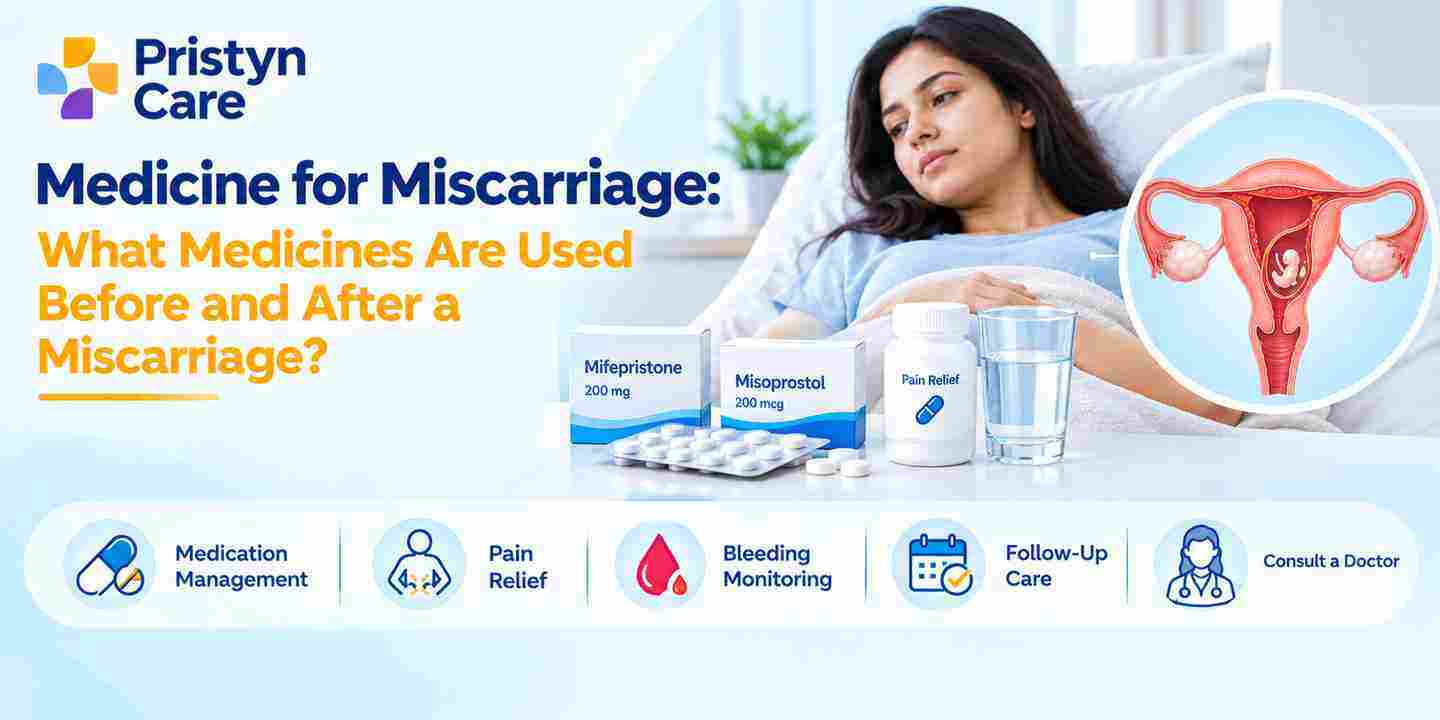
Medicine for Miscarriage: What Medicines Are Used Before and After a Miscarriage?
Miscarriage is the loss of a pregnancy before the fetus is able to survive outside the uterus. It can happen for many reasons, and in many cases, it is not caused by anything the pregnant person did.

.jpg/1756293297805_ban-Icon.png)

Dedicated Support at Every Step!
Our Doctors are available 24 hours a day, 7 days a week to help you!

People commonly search for medicine for miscarriage, pregnancy miscarriage medicine, miscarriage pain medicine, or what medicine to take after miscarriage. However, there is no single medicine that is appropriate for every situation.
The right treatment depends on whether a miscarriage is only suspected, has been confirmed, or has already occurred, as well as how far the pregnancy has progressed and whether there is heavy bleeding, infection, or retained pregnancy tissue.
If you are currently pregnant and experiencing bleeding, abdominal pain, dizziness, fainting, or severe cramps, contact a gynecologist promptly rather than starting a medicine on your own.
Table of Contents
What Is a Miscarriage?
A miscarriage is the spontaneous loss of a pregnancy before fetal viability.
Symptoms can include:
- Vaginal bleeding or spotting
- Abdominal cramps
- Lower back pain
- Passing tissue or clots
- A decrease in pregnancy symptoms in some cases
However, bleeding or cramping during pregnancy does not always mean that a miscarriage has occurred.
Some pregnancies continue normally despite early bleeding. Therefore, symptoms alone cannot confirm a miscarriage.
No Cost EMI, Hassle-free Insurance Approval
Is There Medicine for Miscarriage?
There is no single miscarriage medicine that can be taken in every case.
Treatment depends on what is happening.
| Situation | Possible Medical Approach |
| Pregnancy with bleeding but miscarriage not confirmed | Evaluation and monitoring |
| Threatened miscarriage | Observation and treatment based on the underlying cause |
| Pregnancy that has stopped developing but tissue remains | Expectant, medical, or procedural management depending on the case |
| Confirmed miscarriage with retained tissue | Medical or surgical management may be recommended |
| Heavy bleeding | Urgent medical assessment and treatment |
| Infection after miscarriage | Appropriate antibiotics and medical treatment |
| Pain after miscarriage | Suitable pain-relieving medication |
| Recurrent pregnancy loss | Evaluation for possible underlying causes |
The first step is usually to confirm the pregnancy status and diagnosis rather than immediately taking medicine.
Medicine for Pregnancy to Avoid Miscarriage
The search term "medicine for pregnancy to avoid miscarriage" can be particularly concerning because not every miscarriage can be prevented with medication.
Many early miscarriages occur because of chromosomal abnormalities in the developing pregnancy. Taking random tablets, hormones, supplements, or herbal products cannot reliably prevent these miscarriages.
Depending on the individual situation, a doctor may recommend treatment for a specific risk factor.
For example, progesterone treatment may be considered in certain patients with early pregnancy bleeding and a history of previous miscarriage, depending on clinical assessment and local guidelines.
This does not mean progesterone is appropriate for every pregnant person with bleeding.
Do Not Self-Medicate During Pregnancy
Avoid starting medicines solely because they are advertised online as preventing miscarriage.
This includes:
- Hormonal medicines
- Herbal preparations
- Ayurvedic products
- Homeopathic products
- Unprescribed supplements
- Painkillers that may not be appropriate during pregnancy
A gynecologist should determine whether medication is appropriate.
Can Medicine Stop a Miscarriage?
If a miscarriage is already occurring because the pregnancy has stopped developing, medicine generally cannot make a nonviable pregnancy become viable again.
However, some situations that cause bleeding during pregnancy are not miscarriages and may be treatable.
This is why medical evaluation is important before assuming that bleeding means miscarriage.
A doctor may use:
- Pregnancy history
- Physical examination
- Ultrasound
- Serial hCG blood tests when appropriate
- Other investigations based on symptoms
What Medicine Is Used After a Miscarriage?
After a confirmed miscarriage, treatment depends on whether the uterus has emptied completely and whether there are complications.
Possible approaches include:
1. Expectant Management
In some cases, the body naturally passes the pregnancy tissue without medication or surgery.
A doctor may recommend monitoring if the patient is clinically stable and this approach is appropriate.
2. Medical Management
Certain prescription medicines can be used to help the uterus expel retained pregnancy tissue when clinically appropriate.
The exact medication, dose, route, and timing depend on the pregnancy duration, diagnosis, medical history, and local clinical protocols.
These medicines should be taken only under medical guidance.
3. Surgical Management
If there is heavy bleeding, infection, significant retained tissue, or medical management is unsuccessful or unsuitable, a gynecologist may recommend a procedure to remove remaining pregnancy tissue.
The appropriate method depends on the individual case.
What Medicine to Take After Miscarriage?
People often search for "what medicine to take after miscarriage."
There is no standard medicine list that is suitable for everyone.
Depending on the circumstances, a doctor may prescribe or recommend medicines for:
- Pain
- Infection when present
- Nausea
- Anemia or iron deficiency caused by blood loss
- Other medical conditions identified during evaluation
Follow-up may also be needed to confirm that the miscarriage has completed and that pregnancy hormone levels are returning appropriately.
Do not take antibiotics, hormones, or other prescription medicines without medical advice.
Miscarriage Pain Medicine
Cramping and abdominal pain can occur during and after a miscarriage.
A doctor may recommend an appropriate pain reliever based on:
- Pregnancy status
- Amount of bleeding
- Medical history
- Kidney and liver health
- Other medicines being taken
- Allergies
Pain that is severe, worsening, or associated with heavy bleeding should not simply be treated with painkillers at home.
It may indicate retained tissue, infection, ectopic pregnancy, or another condition requiring urgent assessment.
Is Severe Pain During Early Pregnancy Always a Miscarriage?
No.
Severe abdominal or pelvic pain during early pregnancy can have several causes.
One important possibility is ectopic pregnancy, in which the pregnancy develops outside the uterus.
An ectopic pregnancy can become life-threatening if it ruptures.
Seek Emergency Medical Care If You Have:
- Severe or one-sided abdominal pain
- Heavy vaginal bleeding
- Fainting or severe dizziness
- Shoulder-tip pain with abdominal symptoms
- Extreme weakness
- Rapidly worsening pain
Do not assume these symptoms are simply a miscarriage.
Miscarriage Medicine Price
The price of miscarriage treatment or medicines varies considerably because treatment depends on the diagnosis and the type of management required.
The overall cost may depend on:
- Doctor consultation
- Ultrasound or other tests
- Blood tests
- Prescribed medicines
- Follow-up visits
- Medical management
- Procedure or surgery, if required
- Hospitalization in complicated cases
Because there is no single miscarriage medicine, quoting one fixed medicine price can be misleading.
Can Miscarriage Be Treated at Home?
A confirmed early miscarriage may sometimes be managed without hospitalization when the patient is medically stable and a doctor has determined that home-based expectant or medical management is appropriate.
However, self-managing unexplained bleeding during pregnancy is not recommended.
Before taking any medicine, it is important to establish:
- Whether the pregnancy is inside the uterus.
- Whether the pregnancy is viable.
- Whether a miscarriage has actually occurred.
- Whether pregnancy tissue remains.
- Whether there is significant bleeding or infection.
 Doctor available
4.5/5

38+ Years Experience Overall
Doctor available
4.5/5
32+ Years Experience Overall
Doctor available
4.5/5
32+ Years Experience Overall
Doctor available
4.9/5
24+ Years Experience Overall
Doctor available
4.5/5
21+ Years Experience Overall
Doctor available
4.5/5
17+ Years Experience Overall
Doctor available
4.5/5
16+ Years Experience Overall
Doctor available
4.5/5
16+ Years Experience Overall
Doctor available
4.5/5
16+ Years Experience Overall
Doctor available
5.0/5
15+ Years Experience Overall
Doctor available
4.5/5
20+ Years Experience Overall
Doctor available
4.5/5
14+ Years Experience Overall
Doctor available
5.0/5
12+ Years Experience Overall
Doctor available
5.0/5
41+ Years Experience Overall
Doctor available
4.5/5
36+ Years Experience Overall
Doctor available
4.8/5
34+ Years Experience Overall
Doctor available
4.5/5
33+ Years Experience Overall
Doctor available
4.5/5
33+ Years Experience Overall
.jpg/1719467422422_ban-Icon.png) Doctor available
Doctor available
4.5/5
25+ Years Experience Overall
Doctor available
4.5/5
24+ Years Experience Overall
Doctor available
5.0/5
23+ Years Experience Overall
Doctor available
4.5/5
23+ Years Experience Overall
 Doctor available
4.5/5
22+ Years Experience Overall
Doctor available
4.5/5
20+ Years Experience Overall
Doctor available
5.0/5
18+ Years Experience Overall
Doctor available
4.5/5
18+ Years Experience Overall
Doctor available
4.5/5
17+ Years Experience Overall
Doctor available
4.5/5
16+ Years Experience Overall
Doctor available
5.0/5
16+ Years Experience Overall
Doctor available
MBBS, MS - Obstetrics & Gynaecology, DNB, MRCOG (Part 1) FIRM
₹1200₹600Consultation Fee
4.5/5
16+ Years Experience Overall
Doctor available
5.0/5
15+ Years Experience Overall
Doctor available
4.5/5
15+ Years Experience Overall
Doctor available
4.5/5
15+ Years Experience Overall
Doctor available.jpg/1659710531266_ban-Icon.png)
4.5/5
15+ Years Experience Overall
Doctor available.jpg/1721735880936_ban-Icon.png)
5.0/5
15+ Years Experience Overall
Doctor available
5.0/5
15+ Years Experience Overall
Doctor available.jpg/1712404409865_ban-Icon.png)
MBBS, DIPLOMA IN OBSTETRICS AND GYNAECOLOGY FELLOWSHIP IN GYNAECOLOGICAL LAPROSCOPIC SURGERIES.
₹1200₹600Consultation Fee
5.0/5
14+ Years Experience Overall
Doctor available
4.8/5
14+ Years Experience Overall
Doctor available
4.5/5
14+ Years Experience Overall
Doctor available
MBBS, FAGE, DNB, MD(AIIMS DELHI ), FICMCH, FMAS, DIPLOMA IN ADVANCED ART (GERMANY)
FREEConsultation Fee
5.0/5
14+ Years Experience Overall
Doctor available
4.5/5
12+ Years Experience Overall
Doctor available
5.0/5
11+ Years Experience Overall
Doctor available
4.9/5
11+ Years Experience Overall
Doctor available
4.5/5
11+ Years Experience Overall
Doctor available
4.5/5
9+ Years Experience Overall
Doctor available
4.5/5
8+ Years Experience Overall
Doctor available
4.5/5
7+ Years Experience Overall
What Happens If Pregnancy Tissue Remains After Miscarriage?
Sometimes the uterus does not completely empty after a miscarriage.
This is called incomplete miscarriage or retained pregnancy tissue.
Possible symptoms include:
- Continued or heavy bleeding
- Persistent abdominal cramps
- Pelvic pain
- Fever
- Foul-smelling vaginal discharge
- Continued pregnancy symptoms in some cases
Treatment may involve observation, prescribed medical management, or a procedure depending on the amount of retained tissue and the patient's symptoms.
When Is a Procedure Needed After Miscarriage?
A gynecologist may recommend a procedure when:
- There is heavy or persistent bleeding
- Significant pregnancy tissue remains
- There is infection
- Medical management has not worked
- The patient is medically unstable
- Immediate completion of the miscarriage is clinically necessary
The procedure may involve removing retained pregnancy tissue from the uterus.
The exact technique depends on the patient's condition and gestational age.
Can Medicines Prevent All Miscarriages?
No.
Unfortunately, not all miscarriages can be prevented.
Many early miscarriages are related to chromosomal abnormalities that occur during the development of the pregnancy.
However, appropriate prenatal care can help identify and manage certain health conditions and pregnancy complications.
If you have experienced repeated miscarriages, your doctor may recommend an evaluation for potential causes.
Recurrent Miscarriage
Experiencing more than one miscarriage can be emotionally and physically difficult.
Depending on the history, a gynecologist may investigate factors such as:
- Chromosomal factors
- Uterine abnormalities
- Thyroid disorders
- Diabetes
- Certain autoimmune conditions
- Hormonal or reproductive factors
- Other medical conditions
Treatment is based on the cause when one is identified.
Taking a miscarriage-prevention medicine without knowing the reason for recurrent pregnancy loss is not recommended.
Can Progesterone Prevent Miscarriage?
Progesterone is an important pregnancy hormone, and progesterone treatment may be recommended in specific clinical situations.
It is not a universal medicine for preventing miscarriage.
Whether it is appropriate depends on factors such as:
- Current pregnancy status
- Vaginal bleeding
- Previous miscarriage history
- Gestational age
- Ultrasound findings
- Medical history
Only a qualified gynecologist should determine whether progesterone treatment is appropriate.
Do Vitamins Prevent Miscarriage?
Prenatal vitamins are important for pregnancy health, but they should not be promoted as medicines that can prevent every miscarriage.
For example, folic acid is routinely recommended around conception and during early pregnancy because it helps reduce the risk of neural tube defects.
However, taking vitamins does not guarantee that a miscarriage will not occur.
Follow the prenatal supplement plan recommended by your doctor.

Free Miscarriage Surgery Cost Calculator

Can Ayurvedic or Homeopathic Medicine Prevent Miscarriage?
Some alternative medicines may be marketed for pregnancy support or miscarriage prevention.
However, pregnancy is a situation in which safety matters particularly strongly.
There is not enough reliable evidence to assume that an Ayurvedic or homeopathic product can prevent miscarriage, and some herbal products may contain ingredients that are not safe during pregnancy.
Do not replace obstetric care with alternative medicines.
What Should You Do If You Think You Are Having a Miscarriage?
If you are pregnant and notice bleeding or cramping:
- Contact your gynecologist.
- Note the amount and duration of bleeding.
- Follow the recommended ultrasound or blood tests.
- Do not start miscarriage medicines without medical advice.
- Seek urgent care for severe pain, heavy bleeding, fainting, dizziness, or fever.
Early evaluation is particularly important because ectopic pregnancy must be ruled out when clinically appropriate.
Emotional Recovery After Miscarriage
Miscarriage is not only a physical experience.
People may experience:
- Sadness
- Guilt
- Anger
- Anxiety about future pregnancies
- Difficulty sleeping
- Emotional numbness
It is important to remember that having a miscarriage does not necessarily mean that you caused it.
If grief or anxiety becomes overwhelming, speaking with a mental-health professional or a pregnancy-loss support service can be helpful.
Frequently Asked Questions
1. What medicine is used for miscarriage?
There is no single medicine for every miscarriage. Depending on the situation, treatment may involve observation, prescription medical management, or a procedure to remove retained pregnancy tissue.
2. Can medicine prevent miscarriage during pregnancy?
Some treatments may be appropriate in specific situations, but no medicine can prevent every miscarriage. A doctor should determine whether medication is appropriate.
3. What medicine should I take after a miscarriage?
The appropriate medicines depend on your symptoms and whether the miscarriage is complete. A doctor may recommend pain relief or other treatment when necessary.
4. What medicine is used for miscarriage pain?
An appropriate pain reliever may be recommended depending on the patient's medical history and clinical situation. Severe or worsening pain requires medical evaluation.
5. What is the price of miscarriage medicine?
There is no single miscarriage medicine with one fixed price. Cost depends on the medicine, tests, consultation, and whether medical or surgical treatment is required.
6. Can a miscarriage be stopped with medicine?
If a pregnancy is viable and the bleeding is caused by a treatable condition, medical treatment may sometimes help. But once a pregnancy has stopped developing, medicine cannot restore viability.
7. Can miscarriage be treated without surgery?
Yes. Depending on the situation, expectant or medical management may be appropriate. Surgery is not required in every miscarriage.
8. How do I know if I am having a miscarriage?
Bleeding and cramping can occur with miscarriage, but they can also occur in pregnancies that continue normally. Ultrasound and other medical evaluation may be needed to confirm what is happening.
9. Can I take medicine on my own if I am bleeding during pregnancy?
No. Unexplained bleeding during pregnancy should be evaluated before taking medication. Self-medication can be unsafe and may delay diagnosis of conditions such as ectopic pregnancy.
10. Does every miscarriage require a procedure?
No. Some miscarriages complete naturally, while others may be managed with prescribed medicines. A procedure may be necessary when there is heavy bleeding, infection, significant retained tissue, or another clinical reason.


Conclusion
Searching for medicine for miscarriage, medicine to avoid miscarriage, miscarriage pain medicine, or what medicine to take after miscarriage can be confusing because the right treatment depends entirely on what is happening with the pregnancy.
Bleeding during pregnancy does not automatically mean that a miscarriage has occurred. A medical evaluation may be needed to confirm the pregnancy's location and viability and determine the cause of the symptoms.
After a confirmed miscarriage, management may involve expectant management, prescription medical treatment, or a procedure, depending on the individual's condition.
Most importantly, do not self-medicate during pregnancy or after unexplained bleeding. Heavy bleeding, severe abdominal pain, fainting, dizziness, fever, or rapidly worsening symptoms require prompt medical attention.
Disclaimer: This information is for educational purposes only and should not replace consultation with a qualified gynecologist or obstetrician. Medicines used during pregnancy or after miscarriage should be taken only on appropriate medical advice. If you are currently pregnant and experiencing significant bleeding or severe pain, seek medical care promptly.
Social share:


Related Calculators

Dedicated Support at Every Step!
Our Doctors are available 24 hours a day, 7 days a week to help you!


