


 Views: 0
Medicine for Breast Cyst: Can Medicines Cure a Breast Cyst Without Surgery?
A breast cyst is a fluid-filled sac that can develop within the breast tissue. Breast cysts are common, particularly during the reproductive years, and many are benign.




Dedicated Support at Every Step!
Our Doctors are available 24 hours a day, 7 days a week to help you!

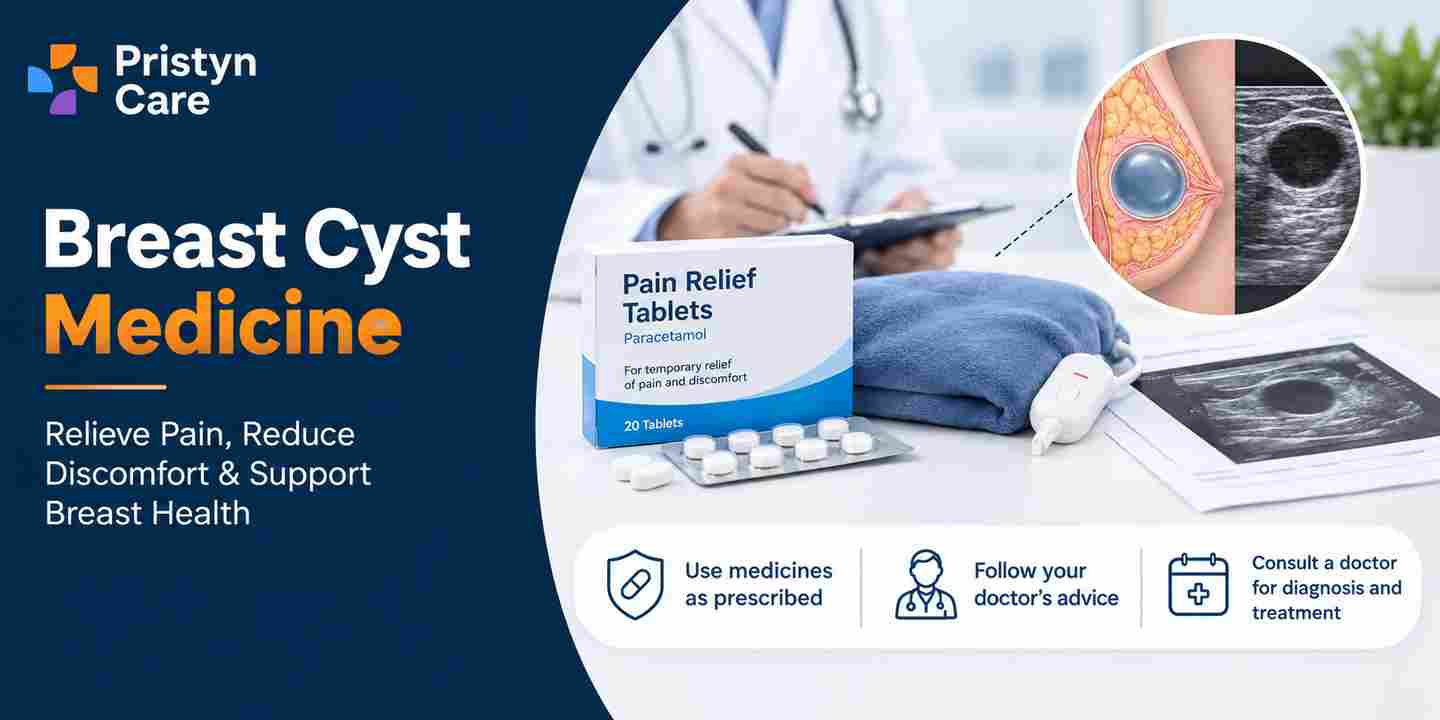
The answer depends on the type of breast cyst and the symptoms it causes. There is no specific medicine that reliably dissolves a simple breast cyst. Many small, painless cysts do not require treatment and may change or disappear naturally.
When a cyst becomes large or painful, a doctor may recommend draining the fluid with a needle, usually with ultrasound guidance. If imaging shows a complex or suspicious cyst, further evaluation may be necessary.
Therefore, the first step is usually not choosing a medicine, but confirming what type of breast lump or cyst is present.
Table of Contents
What Is a Breast Cyst?
A breast cyst is a fluid-filled sac that develops within the breast.
Cysts can vary considerably in size. Some are so small that they are discovered only during breast imaging, while larger cysts may feel like a smooth or round lump.
Breast cysts are generally benign, meaning they are not cancerous.
However, not every breast lump is a cyst.
This is why a newly discovered lump should be assessed rather than assuming that it can be treated with medicine.
No Cost EMI, Hassle-free Insurance Approval
What Causes Breast Cysts?
Breast cysts commonly develop because of changes in the breast tissue and hormonal fluctuations.
They are particularly common before menopause.
Possible factors associated with breast cysts include:
- Hormonal fluctuations
- Changes in breast tissue
- Age-related changes
- Menstrual-cycle-related changes
- Multiple cysts developing within the breasts
Some women may develop cysts repeatedly.
The presence of a cyst does not necessarily mean that there is an underlying serious disease.
What Are the Symptoms of a Breast Cyst?
A small breast cyst may not cause any symptoms.
A larger cyst may cause:
- A palpable lump
- Breast tenderness
- Localized pain
- A feeling of fullness
- Swelling
- Discomfort that changes with the menstrual cycle
Some women notice that breast tenderness becomes more pronounced before menstruation.
A cyst may also feel different in size at different times.
Is There Any Medicine for Breast Cyst?
There is no specific medicine that reliably dissolves or permanently removes a simple breast cyst.
Treatment depends on whether the cyst:
- Is small or large
- Causes pain
- Is simple or complex on imaging
- Is recurring
- Has suspicious features
- Causes significant anxiety or discomfort
Possible management approaches include:
| Treatment | Main purpose |
| Observation | Appropriate for many uncomplicated, painless cysts |
| Pain-relieving medicine | Helps manage breast discomfort |
| Supportive measures | May improve tenderness |
| Ultrasound-guided aspiration | Removes fluid from a symptomatic cyst |
| Further testing | Evaluates complex or suspicious cysts |
| Surgical removal | Considered in selected recurrent or concerning cases |
The important point is that medicine generally manages symptoms rather than physically removing the cyst.
What Is the Best Medicine for Breast Cyst?
If the cyst is small and does not cause discomfort, medication may not be necessary.
If the cyst causes pain or tenderness, a doctor may recommend an appropriate pain reliever depending on your medical history.
However, pain medicine does not remove the fluid-filled cyst.
If the cyst is large and painful, draining the cyst may provide more direct relief than continuing to take pain medicine.
Can Medicine Shrink a Breast Cyst?
For a typical simple breast cyst, medicines are not generally used to dissolve the cyst.
Some breast cysts naturally become smaller or disappear, particularly as hormonal changes occur.
Therefore, if imaging confirms that a lump is a simple cyst and it is not causing significant symptoms, observation may be all that is required.
If the cyst grows, becomes painful, or develops unusual imaging characteristics, it should be reassessed.
Medicine for Breast Cyst Pain
A breast cyst can become uncomfortable when it becomes larger or when surrounding breast tissue becomes tender.
Appropriate pain-relieving medicine may help manage:
- Breast tenderness
- Localized discomfort
- Pain associated with a larger cyst
A supportive, well-fitting bra and warm or cold compresses may also provide comfort for some people.
However, pain relief does not treat the underlying cyst.
If the pain is persistent or the lump is increasing in size, medical evaluation is more appropriate than repeatedly taking painkillers.
Can Hormonal Medicine Treat Breast Cysts?
Because breast cysts can be influenced by hormonal changes, it may seem logical to use hormonal medicine to prevent or shrink them.
However, hormonal treatment is not routinely used simply to treat ordinary breast cysts because the potential risks and side effects may outweigh the benefits.
If someone has severe, recurrent breast cysts or significant cyclical breast symptoms, a doctor may evaluate the overall hormonal and breast history before considering any medication.
Do not start hormonal medicines specifically for a breast cyst without medical advice.
Can a Breast Cyst Go Away on Its Own?
Yes.
Many simple breast cysts require no treatment and may shrink or disappear naturally.
Some cysts can fluctuate in size in response to hormonal changes.
However, a lump should not automatically be assumed to be a harmless cyst simply because it feels smooth or movable.
Breast imaging can help determine whether the lump is a simple fluid-filled cyst or something that requires further evaluation.
Can a Breast Cyst Be Treated Without Surgery?
Yes.
Most breast cysts do not require surgery.
Depending on the findings, treatment may involve:
- Observation
- Monitoring
- Pain management
- Ultrasound-guided aspiration
For a large, painful, simple cyst, aspiration can remove the accumulated fluid without an operation.
Surgery is generally reserved for selected situations, such as recurrent cysts with concerning features or cases where further tissue evaluation or removal is considered necessary.
When Does a Breast Cyst Need Aspiration?
A doctor may consider aspiration when a cyst:
- Is large
- Is painful
- Causes significant discomfort
- Is easily accessible for drainage
- Needs to be evaluated further
- Repeatedly becomes symptomatic
Aspiration involves inserting a fine needle into the cyst and removing the fluid.
When appropriate, ultrasound guidance can help the doctor accurately target the cyst.
The procedure can both relieve symptoms and provide useful information about the cyst.
 Doctor available
Dr. Jonnalagadda Prashanta Varnika
MBBS, DNB-General Surgery & M.Ch-Plastic Surgery
₹1200₹600Consultation Fee

4.5/5

15+ Years Experience Overall
Doctor available
4.5/5
13+ Years Experience Overall
Doctor available
4.5/5
24+ Years Experience Overall
Doctor available
4.5/5
16+ Years Experience Overall
Doctor available
4.5/5
16+ Years Experience Overall
Doctor available
M.B.B.S, M.S. (General Surgery), M.Ch. (Plastic Surgery), DrNB (Plastic Surgery)
₹2000₹1000Consultation Fee
4.6/5
16+ Years Experience Overall
Doctor available
MBBS, MS - General Surgery, M.Ch. - Plastic Surgery
₹2000₹1000Consultation Fee
4.5/5
15+ Years Experience Overall
Doctor available
4.6/5
14+ Years Experience Overall
Doctor available
4.8/5
12+ Years Experience Overall
Doctor available
4.5/5
26+ Years Experience Overall
Doctor available.jpg/1660737456431_ban-Icon.png)
4.6/5
20+ Years Experience Overall
Doctor available
4.5/5
20+ Years Experience Overall
Doctor available
4.5/5
19+ Years Experience Overall
Doctor available
5.0/5
17+ Years Experience Overall
Doctor available
M.B.B.S , M.S , M. Ch Plastic & Reconstructive Surgery
₹2000₹1000Consultation Fee
5.0/5
15+ Years Experience Overall
Doctor available
4.9/5
14+ Years Experience Overall
What Is Ultrasound-Guided Breast Cyst Aspiration?
Ultrasound-guided aspiration is a minimally invasive procedure used to drain fluid from a breast cyst.
During the procedure:
- The breast is examined using ultrasound.
- The cyst is identified.
- The skin is cleaned and local anesthesia may be used.
- A thin needle is guided into the cyst.
- Fluid is withdrawn.
- The cyst is reassessed after drainage.
The procedure generally takes much less time than conventional surgery.
For an appropriate simple cyst, aspiration can provide significant relief when the cyst is causing pain or pressure.
What Happens After a Breast Cyst Is Drained?
After aspiration, the lump may become smaller or disappear because the accumulated fluid has been removed.
Some mild tenderness or bruising can occur temporarily.
A cyst can sometimes refill because the underlying tendency for the cyst to develop has not necessarily disappeared.
If the cyst repeatedly returns, the doctor may recommend further evaluation and discuss other treatment options.
Can a Breast Cyst Come Back?
Yes.
A breast cyst can recur after it has been drained.
This does not automatically mean that the cyst is cancerous.
However, repeated recurrence should be discussed with a breast specialist, particularly if:
- The cyst returns quickly
- The lump changes
- The cyst becomes increasingly painful
- Imaging findings change
- There are other concerning breast symptoms
The appropriate next step depends on the imaging and clinical findings.
Are All Breast Cysts Harmless?
Most simple breast cysts are benign.
However, breast cysts can have many causes, and not every lump is a simple cyst.
Breast imaging may classify cystic findings as:
- Simple cyst
- Complicated cyst
- Complex cystic and solid lesion
A complex or suspicious finding may require additional imaging, aspiration, biopsy, or other evaluation.
Therefore, it is important not to diagnose a breast lump yourself based only on how it feels.
When Should You See a Breast Specialist?
See a doctor if you notice:
- A new breast lump
- A lump that is increasing in size
- Persistent breast pain
- Skin changes
- Nipple discharge
- Nipple inversion
- Redness or swelling
- A lump that does not resolve
- A recurrent cyst
- A breast lump associated with other concerning changes
Seek medical evaluation promptly for any new or changing breast lump.
A doctor may recommend a clinical breast examination and appropriate imaging based on age, symptoms, and clinical findings.

Free Breast Lump Surgery Cost Calculator

Our care coordinator will call you shortly.
Don’t Keep Taking Medicine for a Breast Lump
If a breast lump continues to remain despite taking painkillers or other medicines, the issue may not be that you need a strong medicine.
The appropriate sequence is:
Find the lump → confirm whether it is a cyst → determine its type → monitor or treat it appropriately
This is particularly important because not every breast lump is a cyst.
Breast Cyst Medicine vs Aspiration
| Factor | Medicine | Aspiration |
| Relieves pain | Yes, depending on medicine | Often, when pain is caused by cyst pressure |
| Removes cyst fluid | No | Yes |
| Treats a simple cyst | Usually does not remove it | Can drain a symptomatic cyst |
| Requires surgery | No | No conventional surgery |
| Useful for large painful cyst | Limited to symptom control | Often useful when appropriate |
| Provides fluid for evaluation | No | May provide fluid for assessment |
| Recurrence possible | Cyst remains | Yes, cyst can refill |
For a symptomatic simple cyst, aspiration may provide a more direct solution than relying only on medicine.
Does a Breast Cyst Require Surgery?
Usually, no.
Most breast cysts can be managed without surgery.
Surgery may be considered in selected cases, particularly when:
- A cyst repeatedly recurs
- There are concerning imaging features
- There is a persistent solid component
- The diagnosis remains uncertain
- Further tissue evaluation is required
- The cyst causes ongoing significant problems despite less invasive treatment
The decision should be based on clinical examination and breast imaging rather than the presence of a cyst alone.
Can a Breast Cyst Be Permanently Cured?
There is no medicine that guarantees permanent prevention of breast cysts.
Some cysts disappear naturally, while others may recur.
If a symptomatic cyst is drained, the immediate fluid collection can be removed, but another cyst can develop later.
The focus is therefore on:
Accurate diagnosis → appropriate monitoring → symptom relief → drainage or further treatment when required
Frequently Asked Questions
1. What is the best medicine for a breast cyst?
There is no specific medicine that reliably removes a simple breast cyst. Pain medicine may help with discomfort, while many asymptomatic cysts require only observation.
2. Can medicine dissolve a breast cyst?
Medicines are not generally used to dissolve simple breast cysts. Some cysts may shrink or disappear naturally.
3. What medicine can I take for breast cyst pain?
An appropriate pain reliever may help with breast tenderness or discomfort. The choice depends on your health and other medicines you may be taking, so consult a healthcare professional if you are unsure.
4. Can a breast cyst go away on its own?
Yes. Many simple breast cysts can shrink or disappear without treatment.
5. Does every breast cyst need to be removed?
No. Most simple breast cysts do not need surgical removal. Symptomatic cysts may sometimes be drained with a needle.
6. Can a breast cyst be drained without surgery?
Yes. Ultrasound-guided aspiration can drain fluid from an appropriate breast cyst without conventional surgery.
7. Can a breast cyst come back after aspiration?
Yes. A cyst can refill after drainage, and some people may develop another cyst later.
8. Are breast cysts cancerous?
Most simple breast cysts are benign. However, a new breast lump should be properly evaluated because not every breast lump is a cyst.
9. When should I worry about a breast cyst?
A new or changing lump, persistent pain, nipple discharge, skin changes, nipple inversion, or a lump that continues to grow should be evaluated by a doctor.
10. Does a breast cyst require surgery?
Usually not. Observation or aspiration is sufficient for many cases. Surgery may be considered when a cyst is recurrent or has concerning features.


Conclusion
If you are searching for medicine for breast cyst, the most important thing to know is that there is no specific medicine that reliably dissolves a simple breast cyst.
Many small, uncomplicated cysts do not require treatment and may disappear naturally. Medicine can help manage pain or discomfort, but it generally does not remove the fluid-filled cyst.
When a cyst becomes large or painful, ultrasound-guided aspiration can provide relief by draining the fluid without conventional surgery. Recurrent or complex cysts may require additional evaluation or, in selected cases, surgical treatment.
Most importantly, do not assume that every breast lump is a cyst. A new or changing breast lump should be evaluated appropriately so that the correct diagnosis and treatment can be established.
Disclaimer: This content is intended for general informational purposes only and should not be considered a substitute for professional medical advice, diagnosis, or treatment. Do not start, stop, or change any medication without consulting a qualified healthcare professional.
Social share:




Related Calculators

Dedicated Support at Every Step!
Our Doctors are available 24 hours a day, 7 days a week to help you!
Related Calculators
Get In Touch with our expert doctors !
- please enter 10 digit number.


