


 Views: 362
Bartholin Cyst Medicine: Can Medicines Cure a Bartholin Cyst Without Surgery?
A Bartholin cyst is a fluid-filled lump that develops when one of the Bartholin glands near the vaginal opening becomes blocked. Small cysts may cause no symptoms, while larger cysts can cause discomfort, pain during walking or sitting, or pain during sexual intercourse.


.jpg/1756293297805_ban-Icon.png)

Dedicated Support at Every Step!
Our Doctors are available 24 hours a day, 7 days a week to help you!

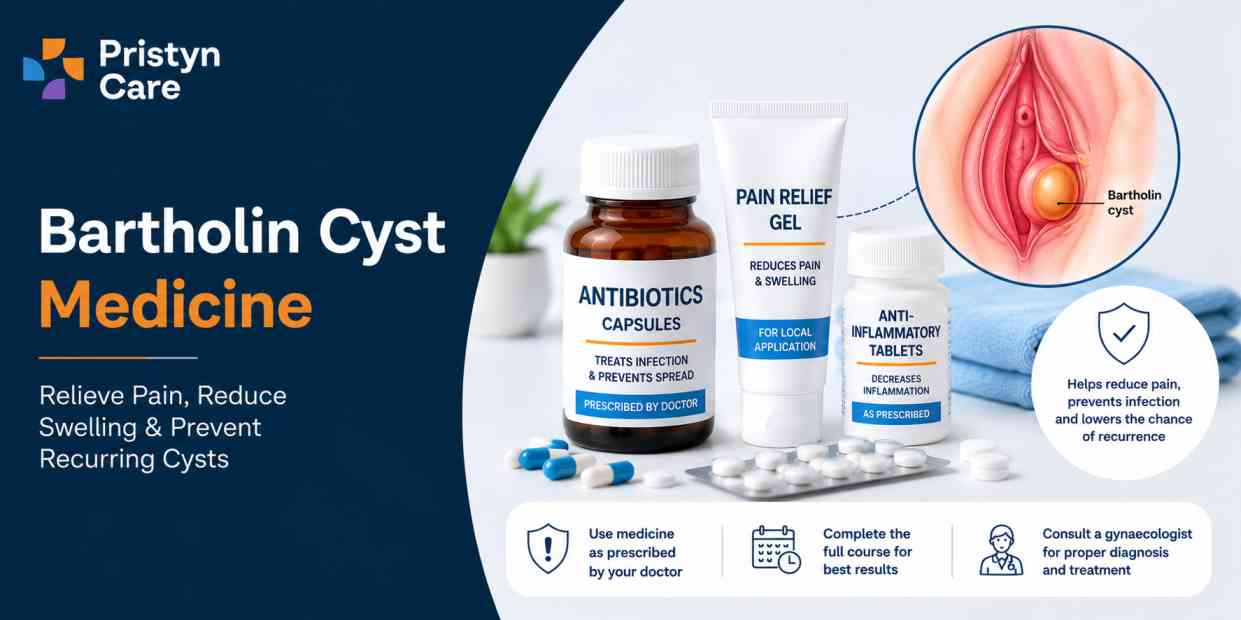
Medicines may help control pain or infection in selected situations, but medicine alone does not reliably remove a persistent or large Bartholin cyst. When a cyst becomes infected and forms an abscess, drainage is usually an important part of treatment.
Table of Contents
What Is a Bartholin Cyst?
The Bartholin glands are two small glands located on either side of the vaginal opening. They produce fluid that helps lubricate the vaginal area.
Normally, the fluid drains through a small duct.
If the duct becomes blocked, fluid can accumulate and form a Bartholin cyst.
A small cyst may not cause any symptoms and may sometimes resolve on its own.
However, if bacteria infect the cyst, it can develop into a painful collection of pus called a Bartholin abscess.
What Causes a Bartholin Cyst?
A Bartholin cyst usually develops because the duct from the Bartholin gland becomes blocked.
The exact reason for the blockage is not always clear.
An infection can occur after a cyst has formed, resulting in an abscess.
Possible factors include:
- Blockage of the Bartholin gland duct
- Local inflammation
- Bacterial infection
- Previous Bartholin cyst or abscess
- Trauma or irritation in the area
A Bartholin cyst is not necessarily caused by poor hygiene or a sexually transmitted infection.
What Are the Symptoms of a Bartholin Cyst?
A small Bartholin cyst may cause no symptoms.
When symptoms occur, they can include:
- A lump near the vaginal opening
- Swelling on one side of the vaginal opening
- Discomfort while walking
- Pain while sitting
- Discomfort during sexual intercourse
- Tenderness around the lump
- Pressure or fullness in the vaginal area
If the cyst becomes infected, symptoms may become much more severe.
These can include:
- Severe pain
- Rapidly increasing swelling
- Redness
- Warmth around the lump
- Pus formation
- Difficulty walking or sitting
- Fever or feeling unwell
These symptoms can indicate a Bartholin abscess rather than a simple cyst.
Is There Any Medicine for Bartholin Cyst?
There is no single medicine that works for every Bartholin cyst.
Treatment depends primarily on:
- Size of the cyst
- Whether it causes symptoms
- Whether it is infected
- Whether an abscess has developed
- Whether the cyst keeps coming back
- The patient's age and clinical history
Possible approaches include:
| Treatment | What it may help with |
| Warm sitz baths | May encourage drainage and relieve discomfort in some small cysts |
| Pain relievers | Reduce pain and discomfort |
| Antibiotics | Used in selected cases when infection requires them |
| Drainage | Treats a symptomatic cyst or abscess by allowing fluid/pus to escape |
| Word catheter | Helps keep the drainage opening open while the area heals |
| Marsupialization | Creates a permanent drainage opening for selected recurrent cysts |
| Excision | Removal of the gland/cyst in selected recurrent or concerning cases |
The important point is that medicines generally manage symptoms or infection; they do not physically remove a persistent cyst.
What Is the Best Medicine for Bartholin Cyst?
There is no universally "best" Bartholin cyst medicine.
If the cyst is small and not infected, a doctor may recommend observation and warm sitz baths rather than medication.
If the cyst is painful, pain-relieving medicine may help with symptoms.
If there is an infection, antibiotics may sometimes be prescribed based on the clinical situation.
However, when a cyst becomes a large or painful abscess, simply taking medicine may not be enough because pus has accumulated inside the swollen area.
In that situation, drainage may provide more effective relief.
Can Antibiotics Cure a Bartholin Cyst?
Antibiotics do not usually make a blocked Bartholin cyst disappear.
A simple cyst is primarily a blockage and fluid collection rather than an infection.
Antibiotics may be considered when there is an associated infection or another specific reason for antibiotic treatment.
When an abscess has formed, antibiotics alone may also be insufficient because the pus collection may need to be drained.
Therefore, taking antibiotics repeatedly without addressing a recurrent cyst or abscess is not an effective long-term strategy.
Bartholin Cyst Pain Medicine
Pain medicine can help control discomfort caused by a Bartholin cyst or abscess.
Depending on the individual's health and medical history, a doctor may recommend an appropriate over-the-counter or prescription pain reliever.
However, pain medicine only addresses the symptom.
If the pain is caused by an infected cyst or abscess, the underlying collection may still need appropriate treatment.
If pain is severe or rapidly increasing, do not keep taking painkillers while waiting for the problem to resolve on its own.
Can a Bartholin Cyst Go Away Without Treatment?
Yes, some small Bartholin cysts may resolve without a procedure, particularly when they are not infected and do not cause significant symptoms.
Warm sitz baths may sometimes encourage spontaneous drainage and provide comfort.
However, a large, painful, infected, or recurrent cyst should be assessed by a gynecologist.
A cyst that repeatedly becomes swollen, drains, and then returns may require a more definitive treatment approach.
Bartholin Cyst vs Bartholin Abscess
It is important to distinguish between the two.
| Feature | Bartholin Cyst | Bartholin Abscess |
| Contents | Usually fluid | Pus/infected material |
| Pain | May be painless or mildly uncomfortable | Often significantly painful |
| Swelling | May be small or moderate | Often rapidly increasing |
| Infection | Not necessarily present | Usually present |
| Fever | Usually absent | May occur |
| Treatment | Observation or drainage depending on symptoms | Drainage is often important |
| Antibiotics | Not routinely required for every cyst | May be used in selected cases |
A person searching for Bartholin cyst medicine may actually have an abscess.
This distinction matters because the treatment can be very different.
Can Medicine Cure a Bartholin Abscess?
When a Bartholin cyst becomes an abscess, pus collects inside the gland or surrounding tissue.
In many cases, draining the abscess is an important part of treatment.
Antibiotics may be used in selected circumstances, but they do not necessarily replace drainage.
This is why a painful lump that is becoming larger, redder, or more tender should be evaluated instead of being treated only with antibiotics or painkillers.
When Does a Bartholin Cyst Need Drainage?
A doctor may recommend drainage when the cyst or abscess:
- Is significantly painful
- Is large
- Interferes with walking or sitting
- Causes pain during sexual intercourse
- Has become infected
- Has formed an abscess
- Keeps returning
- Does not improve with conservative measures
The aim is to allow the trapped fluid or pus to drain and, where appropriate, create a pathway that reduces the chance of the duct becoming blocked again.
What Procedures Are Used for Bartholin Cyst?
The appropriate procedure depends on the size, symptoms, infection status, and recurrence history.
1. Word Catheter
A Word catheter is a small tube placed into the cyst or abscess after drainage.
It helps keep the opening open while the area heals, creating a new drainage pathway.
It is commonly used for symptomatic Bartholin cysts and abscesses.
2. Marsupialization
During marsupialization, the cyst is opened and its edges are sutured to create a lasting drainage opening.
This may be considered for recurrent or selected symptomatic cysts.
3. Cyst or Gland Excision
Complete removal of the Bartholin gland may be considered in selected cases, particularly when the cyst repeatedly recurs or when there is a concern that requires further evaluation.
This is generally not the first treatment for every Bartholin cyst.
Does Bartholin Cyst Treatment Require Surgery?
Not every Bartholin cyst needs surgery.
A small, painless cyst may simply be observed.
A symptomatic or infected cyst may need drainage.
For recurrent cysts, a procedure such as Word catheter placement or marsupialization may be recommended.
Therefore, treatment should be based on the condition of the cyst rather than assuming that either medicine or surgery is always required.
Can a Bartholin Cyst Be Permanently Cured?
Many Bartholin cysts can be successfully treated.
However, recurrence is possible, especially when the gland or duct remains prone to blockage.
For recurrent cysts, creating a new drainage pathway through a procedure can reduce the chance of repeated blockage.
In selected cases, gland removal may be considered.
The appropriate approach depends on the individual situation.
Can Bartholin Cysts Come Back?
Yes.
A Bartholin cyst can recur even after it has drained or improved.
Recurrence can occur because the underlying gland or duct can become blocked again.
Repeated episodes of:
Lump → swelling → pain → drainage → temporary relief → recurrence
should not simply be treated with another course of medicine each time.
A gynecologist can determine whether a more definitive procedure would be appropriate.
When Should You See a Doctor for a Bartholin Cyst?
Consult a gynecologist if you have:
- A new lump near the vaginal opening
- Persistent swelling
- Significant pain
- A rapidly growing lump
- Pus or foul-smelling discharge
- Fever
- Difficulty walking or sitting
- Pain during sexual intercourse
- A cyst that repeatedly comes back
- Symptoms that do not improve with conservative measures
Special consideration after age 40
A new Bartholin-area lump in someone aged 40 or older should be evaluated by a doctor because, although uncommon, Bartholin gland malignancy needs to be considered and ruled out when clinically appropriate.
Do not assume that every new lump in this age group is simply a Bartholin cyst.
Don’t Keep Taking Medicine for a Recurrent Bartholin Cyst
If the same lump repeatedly returns after antibiotics or pain medicine, the issue may not be that you need a "stronger" medicine.
The underlying duct may still be blocked.
Repeated self-treatment can therefore create a cycle:
Medicine → temporary improvement → cyst remains/reforms → symptoms return → more medicine
Instead, the cyst should be examined to determine whether it needs drainage or another definitive treatment.
Bartholin Cyst Medicine vs Procedure
| Treatment | Main purpose | Can it remove the cyst? |
| Pain medicine | Relieve pain | No |
| Antibiotics | Treat selected infections | Usually no |
| Warm sitz baths | Comfort and possible spontaneous drainage | Sometimes a small cyst may drain |
| Word catheter | Establish a drainage pathway | Yes, as part of cyst/abscess treatment |
| Marsupialization | Create a lasting drainage opening | Yes, treats the cyst |
| Gland excision | Remove the gland | Yes, in selected cases |
The key is to treat the cause and physical problem, not only the symptoms.
Frequently Asked Questions
1. What is the best medicine for Bartholin cyst?
There is no single best medicine. Small, uncomplicated cysts may not require medication, while painful or infected cysts may need pain relief, antibiotics in selected cases, or drainage.
2. Can antibiotics cure a Bartholin cyst?
Antibiotics generally do not remove a simple Bartholin cyst. They may be prescribed when infection is present or in other selected situations.
3. Can a Bartholin cyst go away on its own?
Yes, some small cysts can resolve or drain spontaneously. Persistent, painful, large, infected, or recurrent cysts should be evaluated.
4. What medicine is used for a Bartholin abscess?
Pain medicine and, in selected cases, antibiotics may be used. However, an abscess often needs drainage because medicine alone may not adequately remove the pus collection.
5. Is a Bartholin cyst dangerous?
Most Bartholin cysts are benign. However, a new Bartholin-area lump, particularly in someone aged 40 or older, should be medically evaluated.
6. Can I drain a Bartholin cyst myself?
No. Do not puncture, squeeze, cut, or attempt to drain the cyst yourself. This can cause injury or spread infection.
7. Does every Bartholin cyst need surgery?
No. Small, asymptomatic cysts may only require observation. Symptomatic or recurrent cysts may require drainage or another procedure.
8. Why does my Bartholin cyst keep coming back?
The duct may continue to become blocked after the cyst drains. Recurrent cysts may benefit from a procedure that creates a more permanent drainage pathway.
9. Is a Bartholin cyst the same as a Bartholin abscess?
No. A cyst is generally a fluid-filled blocked gland, while an abscess is an infected collection of pus and is typically much more painful.
Conclusion
If you are searching for Bartholin cyst medicine, remember that treatment depends on whether you have a small uncomplicated cyst, an infected cyst, or a Bartholin abscess.
A small cyst may sometimes settle with conservative care. Pain medicine can help with discomfort, while antibiotics may be appropriate in selected cases involving infection.
However, medicines cannot reliably remove a persistent or recurrent Bartholin cyst. When an abscess develops, drainage is often an important part of treatment. Recurrent cysts may require procedures such as Word catheter placement or marsupialization to create a better drainage pathway.
If you have a painful or recurrent lump near the vaginal opening, particularly if it is growing rapidly or associated with fever or significant swelling, consult a gynecologist rather than repeatedly self-medicating.
Disclaimer: This content is intended for general informational purposes only and should not be considered a substitute for professional medical advice, diagnosis, or treatment. Do not start, stop, or change any medication without consulting a qualified healthcare professional.
 Doctor available
5.0/5

38+ Years Experience Overall
Doctor available
5.0/5
32+ Years Experience Overall
Doctor available
4.9/5
24+ Years Experience Overall
Doctor available
5.0/5
21+ Years Experience Overall
Doctor available
4.5/5
16+ Years Experience Overall
Doctor available
4.5/5
16+ Years Experience Overall
Doctor available
4.9/5
15+ Years Experience Overall
Doctor available
4.5/5
14+ Years Experience Overall
Doctor available
4.5/5
10+ Years Experience Overall
Doctor available
4.5/5
9+ Years Experience Overall
Doctor available
5.0/5
25+ Years Experience Overall
Doctor available
4.5/5
20+ Years Experience Overall
Doctor available
4.8/5
12+ Years Experience Overall
Doctor available
5.0/5
41+ Years Experience Overall
Doctor available
4.5/5
36+ Years Experience Overall
Doctor available
4.8/5
34+ Years Experience Overall
Doctor available
4.5/5
33+ Years Experience Overall
.jpg/1719467422422_ban-Icon.png) Doctor available
Doctor available
4.5/5
25+ Years Experience Overall
Doctor available
4.5/5
24+ Years Experience Overall
 Doctor available
5.0/5
23+ Years Experience Overall
Doctor available
4.5/5
23+ Years Experience Overall
Doctor available
4.5/5
22+ Years Experience Overall
Doctor available
5.0/5
21+ Years Experience Overall
Doctor available
4.5/5
20+ Years Experience Overall
Doctor available
4.9/5
18+ Years Experience Overall
Doctor available
5.0/5
18+ Years Experience Overall
Doctor available
4.5/5
17+ Years Experience Overall
Doctor available
5.0/5
16+ Years Experience Overall
Doctor available
MBBS, MS - Obstetrics & Gynaecology, DNB, MRCOG (Part 1) FIRM
₹1200₹600Consultation Fee
4.5/5
16+ Years Experience Overall
Doctor available
5.0/5
16+ Years Experience Overall
Doctor available
4.5/5
15+ Years Experience Overall
Doctor available
5.0/5
15+ Years Experience Overall
Doctor available.jpg/1659710531266_ban-Icon.png)
4.5/5
15+ Years Experience Overall
Doctor available
4.5/5
15+ Years Experience Overall
Doctor available
4.5/5
15+ Years Experience Overall
Doctor available.jpg/1721735880936_ban-Icon.png)
5.0/5
15+ Years Experience Overall
Doctor available
4.5/5
15+ Years Experience Overall
Doctor available.jpg/1712404409865_ban-Icon.png)
MBBS, DIPLOMA IN OBSTETRICS AND GYNAECOLOGY FELLOWSHIP IN GYNAECOLOGICAL LAPROSCOPIC SURGERIES.
₹1200₹600Consultation Fee
5.0/5
14+ Years Experience Overall
Doctor available
4.7/5
14+ Years Experience Overall
Doctor available
MBBS, FAGE, DNB, MD(AIIMS DELHI ), FICMCH, FMAS, DIPLOMA IN ADVANCED ART (GERMANY)
FREEConsultation Fee
4.7/5
14+ Years Experience Overall
Doctor available
4.5/5
12+ Years Experience Overall
Doctor available
5.0/5
11+ Years Experience Overall
Doctor available
5.0/5
11+ Years Experience Overall
Doctor available
4.9/5
11+ Years Experience Overall
Doctor available
4.5/5
9+ Years Experience Overall
Doctor available
4.5/5
9+ Years Experience Overall
Doctor available
4.5/5
8+ Years Experience Overall
Doctor available
4.5/5
7+ Years Experience Overall

Free Bartholin Cyst Surgery Cost Calculator

Our care coordinator will call you shortly.
Social share:





- Bartholin Cyst Treatment in Hyderabad
- Bartholin Cyst Treatment in Ghaziabad
- Bartholin Cyst Treatment in Bangalore
- Bartholin Cyst Treatment in Pune
- Bartholin Cyst Treatment in Mumbai
- Bartholin Cyst Treatment in Chennai
- Bartholin Cyst Treatment in Noida
- Bartholin Cyst Treatment in Delhi
- Bartholin Cyst Treatment in Faridabad
Related Calculators

Dedicated Support at Every Step!
Our Doctors are available 24 hours a day, 7 days a week to help you!
Related Calculators
Get In Touch with our expert doctors !
- please enter 10 digit number.


