


 Views: 0
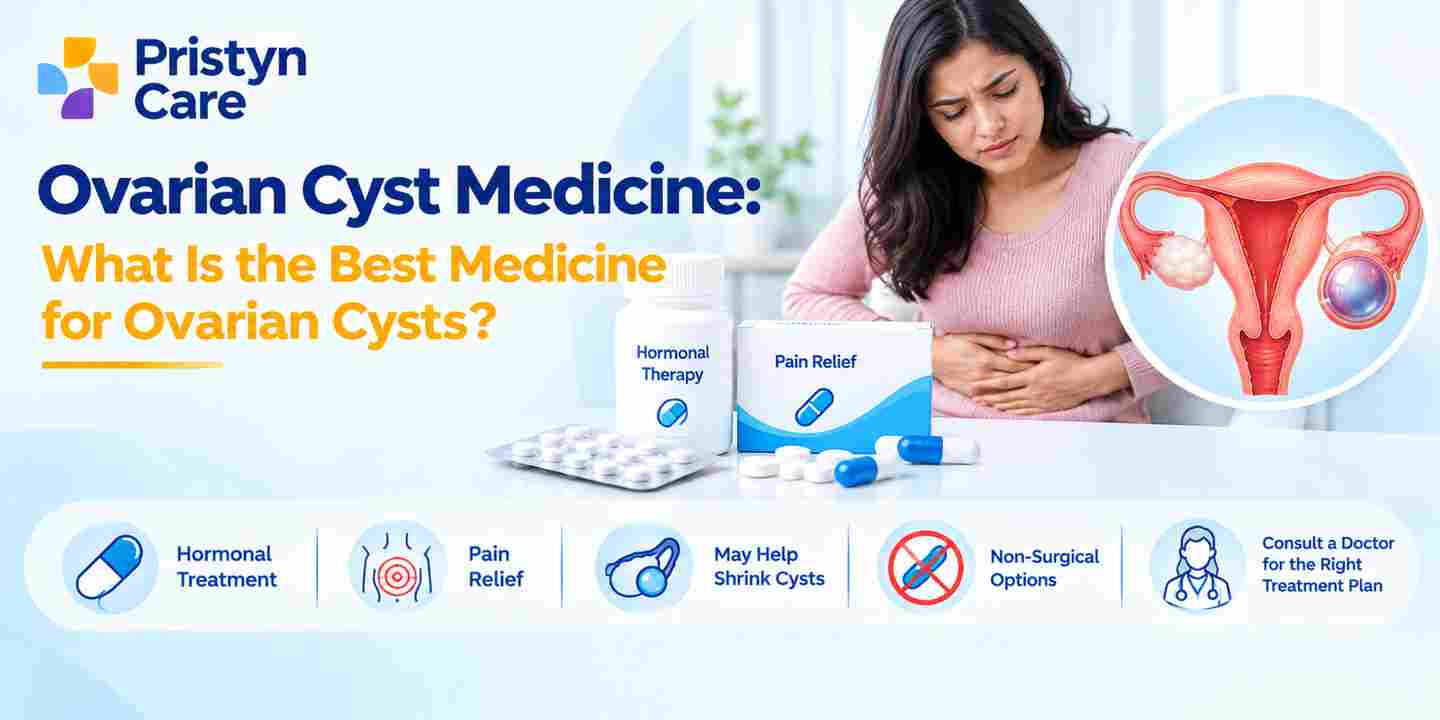
Ovarian Cyst Medicine: What Is the Best Medicine for Ovarian Cysts?
However, not every ovarian cyst can be treated with medicine. The right treatment depends on the type, size and appearance of the cyst, symptoms, age, menstrual status, and whether the cyst is changing over time.



Dedicated Support at Every Step!
Our Doctors are available 24 hours a day, 7 days a week to help you!

Table of Contents
An ovarian cyst is a fluid-filled sac or, in some cases, a solid or mixed lesion that develops in or on an ovary. Many ovarian cysts are common, harmless, and temporary, especially functional cysts related to the menstrual cycle. They may disappear on their own without any treatment.
If you are searching for the best medicine for an ovarian cyst, it is important to know that there is no single tablet, syrup, Ayurvedic medicine, homeopathic medicine, or herbal product that can reliably dissolve every type of ovarian cyst.
What Is an Ovarian Cyst?
An ovarian cyst is a sac that develops in or on an ovary. Some cysts contain fluid, while others may contain blood, tissue, or other material.
Ovarian cysts can develop due to different causes. Common types include:
- Functional or follicular cysts
- Corpus luteum cysts
- Hemorrhagic cysts
- Endometriomas
- Dermoid cysts
- Cystadenomas
- Polycystic ovaries associated with PCOS
Many functional ovarian cysts are benign and resolve naturally within a few menstrual cycles.
No Cost EMI, Hassle-free Insurance Approval
What Are the Symptoms of an Ovarian Cyst?
Small ovarian cysts may not cause any symptoms and are often found incidentally during an ultrasound.
When symptoms occur, they may include:
- Lower abdominal or pelvic pain
- Pain on one side of the abdomen
- Bloating or abdominal fullness
- Pain during sexual intercourse
- Irregular or painful periods
- Heavier or lighter menstrual bleeding
- Frequent urination if a cyst presses on the bladder
- Difficulty passing stool if there is pressure on the bowel
- Feeling full quickly
- Lower back or thigh discomfort
Sudden, severe pelvic pain, especially when associated with vomiting, dizziness, fainting or weakness, requires urgent medical evaluation because complications such as ovarian torsion or cyst rupture may occur.
What Is the Best Medicine for an Ovarian Cyst?
There is no universal best medicine for ovarian cysts.
The medicine or treatment recommended depends primarily on what type of cyst has been identified.
For example:
- A small functional cyst may only require observation.
- Pain caused by a cyst may be managed with appropriate pain medication.
- Hormonal contraceptives may sometimes be prescribed for menstrual-cycle management or to prevent new functional cysts, but they do not reliably make an existing cyst disappear faster.
- Endometriomas are associated with endometriosis and may require hormonal treatment or surgery depending on symptoms and fertility plans.
- Large, persistent, complex, symptomatic or suspicious cysts may require a procedure or surgery rather than medicine.
Therefore, taking a medicine simply because it is advertised as an “ovarian cyst removal medicine” is not recommended without knowing the type of cyst.
Ovarian Cyst Medicine Names
There is no single ovarian cyst medicine name that applies to every patient.
Depending on the situation, a gynecologist may recommend medicines such as:
| Medicine/Treatment | Why It May Be Used |
| Pain relievers | To manage pelvic pain or discomfort |
| Hormonal contraceptives | May regulate periods and reduce the formation of some new functional cysts |
| Hormonal medicines | May be used in selected conditions such as endometriosis |
| GnRH-related medicines | May be prescribed in selected cases of endometriosis |
| Other prescription medicines | Depend on the underlying condition |
| Observation and follow-up ultrasound | Common for many small, uncomplicated cysts |
| Laparoscopic cyst removal | Considered for selected persistent, large, symptomatic or suspicious cysts |
The specific medicine, dose and duration should be decided by a gynecologist after evaluating the patient.
Can Medicine Remove an Ovarian Cyst?
This depends on the type of cyst.
Many functional ovarian cysts can disappear naturally as part of the normal menstrual cycle. In these cases, no specific medicine may be necessary.
However, medicine cannot reliably dissolve or remove every type of ovarian cyst.
For example:
- Functional cysts may resolve without treatment.
- Endometriomas generally do not simply disappear because of pain medication.
- Dermoid cysts do not reliably dissolve with medicines.
- Large persistent cysts may continue to remain despite medication.
- Suspicious or complex ovarian masses require proper evaluation rather than self-treatment.
The goal of treatment is therefore not always to “shrink the cyst with medicine.” Sometimes the safest approach is monitoring, while in other cases a procedure is more appropriate.
Medicine for Ovarian Cyst Pain
If an ovarian cyst is causing mild to moderate pelvic pain, a doctor may recommend an appropriate pain reliever.
Pain medicines can help control symptoms, but they do not necessarily treat the underlying cyst.
If pelvic pain:
- Suddenly becomes severe
- Is accompanied by vomiting
- Causes dizziness or fainting
- Occurs with heavy vaginal bleeding
- Is associated with fever
- Develops suddenly on one side
you should seek urgent medical attention rather than repeatedly taking painkillers.
Sudden severe pain can occur with complications such as ovarian torsion or cyst rupture.
Can Birth Control Pills Treat Ovarian Cysts?
Hormonal contraceptive pills may be prescribed in some patients, particularly when menstrual-cycle regulation or prevention of some new functional cysts is relevant.
However, birth control pills should not be considered a universal ovarian cyst removal medicine.
They generally do not make an existing ovarian cyst disappear faster in the way many people expect.
A gynecologist may recommend hormonal contraception based on the patient's:
- Age
- Menstrual pattern
- Cyst history
- Need for contraception
- Symptoms
- Overall health
Homeopathic Medicine for Ovarian Cyst
Homeopathy is frequently searched for as an alternative treatment for ovarian cysts.
However, there is no scientifically established homeopathic medicine proven to reliably dissolve or remove ovarian cysts.
Using homeopathic treatment should not replace:
- Gynecological evaluation
- Pelvic ultrasound
- Follow-up imaging
- Appropriate blood tests when indicated
- Surgical evaluation when required
This is particularly important when an ovarian cyst is large, persistent, complex, painful or associated with abnormal bleeding.
A person may feel better symptomatically while an underlying cyst continues to grow or change.
Therefore, do not delay medical evaluation solely because symptoms improve after taking an alternative medicine.
Ayurvedic Medicine for Ovarian Cyst
Ayurvedic medicines are also commonly searched for when people are looking for a natural treatment for ovarian cysts.
However, there is currently no established Ayurvedic medicine proven to reliably eliminate all types of ovarian cysts.
The term “ovarian cyst” covers several different conditions. A treatment that might be discussed for menstrual symptoms does not necessarily remove a dermoid cyst, endometrioma or another structural ovarian lesion.
If you prefer Ayurveda as a complementary approach, discuss it with your gynecologist and qualified Ayurvedic practitioner, particularly if you are:
- Pregnant or trying to conceive
- Taking prescription medicines
- Having severe symptoms
- Diagnosed with a large or complex cyst
- Experiencing abnormal bleeding
Do not postpone necessary imaging or gynecological treatment in favor of an unproven cyst-removal remedy.
Himalaya Medicine for Ovarian Cyst
People may also search for Himalaya medicine for ovarian cyst or herbal products that claim to support ovarian health.
There is no universally established Himalaya medicine that can be recommended as a proven treatment for all ovarian cysts.
Before taking any herbal or Ayurvedic product, it is important to determine:
- What type of cyst you have
- How large it is
- Whether it is simple or complex
- Whether it is changing in size
- Whether you have symptoms
- Whether you are trying to become pregnant
A branded herbal product should not be assumed to dissolve an ovarian cyst simply because it is marketed for women's health.
Can an Ovarian Cyst Go Away on Its Own?
Yes, some ovarian cysts can disappear without treatment.
Functional cysts are particularly likely to resolve naturally over time.
Your gynecologist may recommend:
- Observation
- Repeat ultrasound
- Monitoring symptoms
- Follow-up after one or more menstrual cycles
However, spontaneous resolution cannot be assumed for every ovarian cyst.
The ultrasound appearance and clinical history help determine whether observation is appropriate.
When Does an Ovarian Cyst Need Treatment?
Treatment may be considered when a cyst:
- Is large
- Continues to grow
- Persists over multiple follow-ups
- Causes significant pain
- Causes pressure symptoms
- Looks complex on ultrasound
- Is associated with complications
- Is suspicious for malignancy
- Is associated with endometriosis
- Causes problems with fertility in selected situations
The decision is individualized rather than based only on the size of the cyst.
Ovarian Cyst Treatment Without Surgery
Not every ovarian cyst requires surgery.
Depending on the diagnosis, treatment may include:
1. Watchful Waiting
For many small, simple and asymptomatic cysts, the doctor may recommend observation.
A repeat ultrasound may be performed to determine whether the cyst has disappeared, remained stable or changed.
2. Medicines
Medicines may help manage:
- Pain
- Menstrual symptoms
- Hormonal conditions
- Endometriosis-related symptoms
However, medicine does not reliably remove every type of ovarian cyst.
3. Hormonal Treatment
Hormonal treatment may be useful in selected conditions, particularly when endometriosis or menstrual-cycle-related symptoms are involved.
The choice depends on fertility plans and the individual's medical history.
4. Treating the Underlying Condition
If the cyst is associated with endometriosis, PCOS or another condition, treating the underlying problem may be an important part of management.
When Is Surgery Needed for an Ovarian Cyst?
Surgery may be recommended when the cyst is:
- Very large
- Persistent
- Increasing in size
- Causing significant symptoms
- Repeatedly causing complications
- Complex or suspicious on imaging
- Associated with ovarian torsion
- Associated with endometriosis in selected cases
The goal is usually to remove the cyst while preserving healthy ovarian tissue whenever this is appropriate.
Laparoscopic Ovarian Cyst Removal
When surgery is required and the patient is an appropriate candidate, laparoscopic ovarian cystectomy may be considered.
During the procedure, the surgeon makes small incisions and uses a camera and specialized instruments to remove the cyst.
Potential advantages of laparoscopy can include:
- Smaller incisions
- Less postoperative discomfort
- Shorter recovery compared with many open procedures
- Earlier return to routine activities
However, the appropriate surgical approach depends on the cyst's size, appearance, location, suspected type and other clinical factors.
In some cases, open surgery may be necessary.
Ovarian Cyst Medicine vs Surgery
| Factor | Medicines/Observation | Surgery |
| Small functional cyst | Often appropriate | Usually not required |
| Mild symptoms | May help manage symptoms | Usually not first choice |
| Existing structural cyst | May not remove it | Can remove the cyst |
| Dermoid cyst | Does not reliably dissolve it | May be considered |
| Endometrioma | Hormonal treatment may control symptoms | Considered in selected cases |
| Large persistent cyst | May not be sufficient | May be recommended |
| Suspicious cyst | Requires specialist evaluation | May be required |
| Ovarian torsion | Emergency treatment needed | Often requires urgent surgery |
 Doctor available
4.5/5

32+ Years Experience Overall
Doctor available
4.9/5
24+ Years Experience Overall
Doctor available
4.5/5
10+ Years Experience Overall
Doctor available
4.5/5
9+ Years Experience Overall
Doctor available
5.0/5
12+ Years Experience Overall
.jpg/1719467422422_ban-Icon.png)
 Doctor available
4.5/5
22+ Years Experience Overall
Doctor available
5.0/5
21+ Years Experience Overall
Doctor available
4.5/5
16+ Years Experience Overall
Doctor available
5.0/5
16+ Years Experience Overall
Doctor available
MBBS, MS - Obstetrics & Gynaecology, DNB, MRCOG (Part 1) FIRM
₹1200₹600Consultation Fee
4.5/5
16+ Years Experience Overall
Doctor available
4.5/5
15+ Years Experience Overall
Doctor available.jpg/1659710531266_ban-Icon.png)
4.5/5
15+ Years Experience Overall
Doctor available.jpg/1721735880936_ban-Icon.png)
5.0/5
15+ Years Experience Overall
Doctor available
4.5/5
15+ Years Experience Overall
Doctor available.jpg/1712404409865_ban-Icon.png)
MBBS, DIPLOMA IN OBSTETRICS AND GYNAECOLOGY FELLOWSHIP IN GYNAECOLOGICAL LAPROSCOPIC SURGERIES.
₹1200₹600Consultation Fee
5.0/5
14+ Years Experience Overall
Doctor available
4.8/5
14+ Years Experience Overall
Doctor available
MBBS, FAGE, DNB, MD(AIIMS DELHI ), FICMCH, FMAS, DIPLOMA IN ADVANCED ART (GERMANY)
FREEConsultation Fee
5.0/5
14+ Years Experience Overall
Doctor available
4.5/5
12+ Years Experience Overall
Doctor available
4.5/5
11+ Years Experience Overall
Doctor available
4.5/5
9+ Years Experience Overall
Doctor available
4.5/5
9+ Years Experience Overall
Doctor available
4.5/5
8+ Years Experience Overall
Doctor available
4.5/5
7+ Years Experience Overall
Can Ovarian Cysts Be Permanently Cured?
“Permanent cure” depends on the type of ovarian cyst.
A functional cyst may disappear naturally and never return.
However, some conditions can cause new cysts to develop.
For example:
- Endometriosis can lead to recurrent endometriomas.
- Functional cysts can occur again as part of the menstrual cycle.
- PCOS involves multiple ovarian follicles and is different from having one simple ovarian cyst.
- Some structural cysts can recur or develop separately later.
Removing one cyst does not necessarily prevent every future ovarian cyst.
Ovarian Cyst and Fertility
Having an ovarian cyst does not automatically mean that you will have fertility problems.
Many ovarian cysts have little or no effect on fertility.
However, certain conditions, particularly endometriosis, may affect fertility.
Treatment decisions should therefore consider whether you are:
- Trying to conceive
- Planning pregnancy in the future
- Undergoing fertility treatment
- Experiencing difficulty conceiving
Some surgeries can also affect ovarian reserve, so the benefits and risks should be discussed carefully before surgery, particularly in patients who want future pregnancy.
How Is an Ovarian Cyst Diagnosed?
A gynecologist may use:
- Medical history
- Pelvic examination
- Pelvic ultrasound
- Transvaginal ultrasound
- Pregnancy testing when appropriate
- Blood tests in selected cases
- MRI or additional imaging in selected situations
Ultrasound is particularly useful because it can provide information about:
- Cyst size
- Location
- Fluid content
- Wall characteristics
- Solid components
- Blood flow
- Whether the cyst appears simple or complex
The ultrasound report is therefore more useful than simply knowing that “a cyst” is present.
Ovarian Cyst vs PCOS
An ovarian cyst and polycystic ovary syndrome (PCOS) are not the same thing.
A simple ovarian cyst is generally a specific sac or lesion within or around the ovary.
PCOS is a hormonal and metabolic condition associated with features such as:
- Irregular ovulation
- Irregular periods
- Elevated androgen activity
- Acne or excess facial/body hair in some patients
- Polycystic ovarian morphology in some patients
Having ovarian cysts does not automatically mean that you have PCOS.
What Should You Avoid If You Have an Ovarian Cyst?
Avoid trying to treat an undiagnosed ovarian cyst by yourself.
In particular:
- Do not take hormonal medicines without medical advice.
- Do not repeatedly take painkillers to hide worsening symptoms.
- Do not assume every cyst can be dissolved with herbal products.
- Do not rely exclusively on homeopathic treatment.
- Do not ignore a cyst that is increasing in size.
- Do not skip recommended follow-up ultrasounds.
- Do not delay urgent care for sudden severe pelvic pain.
When Should You See a Gynecologist?
Make an appointment if you have:
- Persistent pelvic pain
- Recurrent abdominal discomfort
- Unexplained bloating
- Irregular periods
- Pain during intercourse
- A known ovarian cyst
- A cyst that has persisted on follow-up ultrasound
- A rapidly enlarging abdominal or pelvic swelling
Seek urgent medical care if you experience:
- Sudden severe pelvic or abdominal pain
- Severe pain with vomiting
- Fainting or severe dizziness
- Heavy vaginal bleeding
- Fever with significant pelvic pain
- Sudden weakness or collapse
These symptoms can indicate a complication and should not be managed only with pain medicine at home.
Frequently Asked Questions
1. What is the best medicine for an ovarian cyst?
There is no single best medicine for every ovarian cyst. Treatment depends on the cyst type, size, symptoms, ultrasound findings and other factors. Some cysts need only observation, while others may require hormonal treatment, a procedure or surgery.
2. What is the name of the medicine used for ovarian cysts?
There is no single ovarian cyst medicine name. Doctors may prescribe pain medicines or hormonal treatments depending on the underlying condition. Some cysts do not require any medicine.

Free Ovarian Cyst Surgery Cost Calculator

Our care coordinator will call you shortly.
3. Can medicine dissolve an ovarian cyst?
Some functional cysts disappear naturally, but medicines cannot reliably dissolve every type of ovarian cyst. Structural cysts such as dermoid cysts generally require a different approach if treatment is necessary.
4. Can homeopathy cure ovarian cysts?
There is no scientifically established homeopathic medicine proven to reliably eliminate ovarian cysts. A known ovarian cyst should be monitored and treated according to its medical diagnosis.
5. Can Ayurvedic medicine cure ovarian cysts?
There is no universally established Ayurvedic medicine proven to dissolve or permanently eliminate all types of ovarian cysts. Medical evaluation is important before relying on alternative treatment.
6. Can Himalaya medicine remove an ovarian cyst?
No particular branded herbal medicine should be assumed to remove an ovarian cyst. Treatment should be based on the type and characteristics of the cyst.
7. Do ovarian cysts go away without treatment?
Yes, many functional ovarian cysts disappear naturally. However, persistent, large, complex or symptomatic cysts may require treatment.
8. Does an ovarian cyst always require surgery?
No. Many ovarian cysts can be monitored without surgery. Surgery is considered when the cyst is persistent, large, symptomatic, suspicious or associated with complications.
9. Can an ovarian cyst affect pregnancy?
Many ovarian cysts do not affect fertility. However, conditions such as endometriosis can affect fertility, and some large or complicated cysts may require treatment.


10. Can an ovarian cyst come back after treatment?
It can. The likelihood depends on the underlying cause. Treating or removing one cyst does not necessarily prevent future cysts from developing.
Conclusion
There is no single best medicine for an ovarian cyst because ovarian cysts have different causes and characteristics.
Small functional cysts often disappear naturally and may only require monitoring. Medicines can help control pain or treat certain underlying hormonal conditions, but they do not reliably remove every type of ovarian cyst.
Homeopathic, Ayurvedic and herbal products, including products marketed specifically for ovarian health, should not be considered proven cyst-removal treatments without appropriate medical evaluation.
If a cyst is large, persistent, painful, complex or suspicious, a gynecologist may recommend closer monitoring, additional testing or ovarian cyst removal. When surgery is appropriate, minimally invasive laparoscopic treatment may be an option for many patients.
The safest approach is to identify what type of ovarian cyst you have first, and then choose treatment based on that diagnosis rather than choosing a medicine based only on the term “ovarian cyst.”
Disclaimer: This information is for educational purposes only and should not replace consultation with a qualified gynecologist. Do not start prescription, hormonal, Ayurvedic or homeopathic treatment for an ovarian cyst without appropriate medical advice.
Social share:




Related Calculators

Dedicated Support at Every Step!
Our Doctors are available 24 hours a day, 7 days a week to help you!
Related Calculators
Get In Touch with our expert doctors !
- please enter 10 digit number.


