


 Views: 340
Anal Fistula Medicine: Can Medicines Cure Anal Fistula Without Surgery?
An anal fistula is an abnormal tunnel that develops between the inside of the anus or rectum and the skin around the anus. It commonly develops after an anal abscess has drained, leaving behind a persistent tract.


Dedicated Support at Every Step!
Our Doctors are available 24 hours a day, 7 days a week to help you!

The right treatment depends on the fistula's location, complexity, presence of an abscess, and whether the anal sphincter muscles are involved. An examination by a colorectal surgeon or proctologist can help determine the appropriate treatment.
Table of Contents
What Is an Anal Fistula?
An anal fistula is an abnormal passage or tunnel that connects the anal canal or rectum with the skin near the anus.
It often develops following an anal abscess. When an abscess drains, either naturally or after treatment, an abnormal tract can sometimes remain between the infected anal gland and the skin.
Because this tract may have an internal opening inside the anus and an external opening on the skin, simply treating the symptoms may not eliminate the underlying problem.
This is why people with persistent discharge, swelling, or repeated abscesses should not rely only on self-medication.
What Causes an Anal Fistula?
An anal fistula most commonly develops after an anal abscess.
Other possible causes include:
- Recurrent anal abscess
- Infections around the anus
- Inflammatory bowel diseases such as Crohn's disease
- Previous anorectal surgery
- Tuberculosis in some cases
- Trauma or other less common conditions
A fistula can remain relatively quiet for some time and then become active again when the tract gets blocked or infected.
What Are the Symptoms of an Anal Fistula?
Common symptoms include:
- A small opening near the anus
- Repeated pus or fluid discharge
- Pain or tenderness around the anus
- Swelling or redness
- Recurrent anal abscess
- Skin irritation
- Itching around the anal opening
- Blood mixed with discharge
- Foul-smelling discharge
- Temporary relief after pus drains
One important clue is repeated swelling followed by discharge and temporary relief. This can happen when an underlying fistula repeatedly fills and drains.
Is There Any Medicine for Anal Fistula?
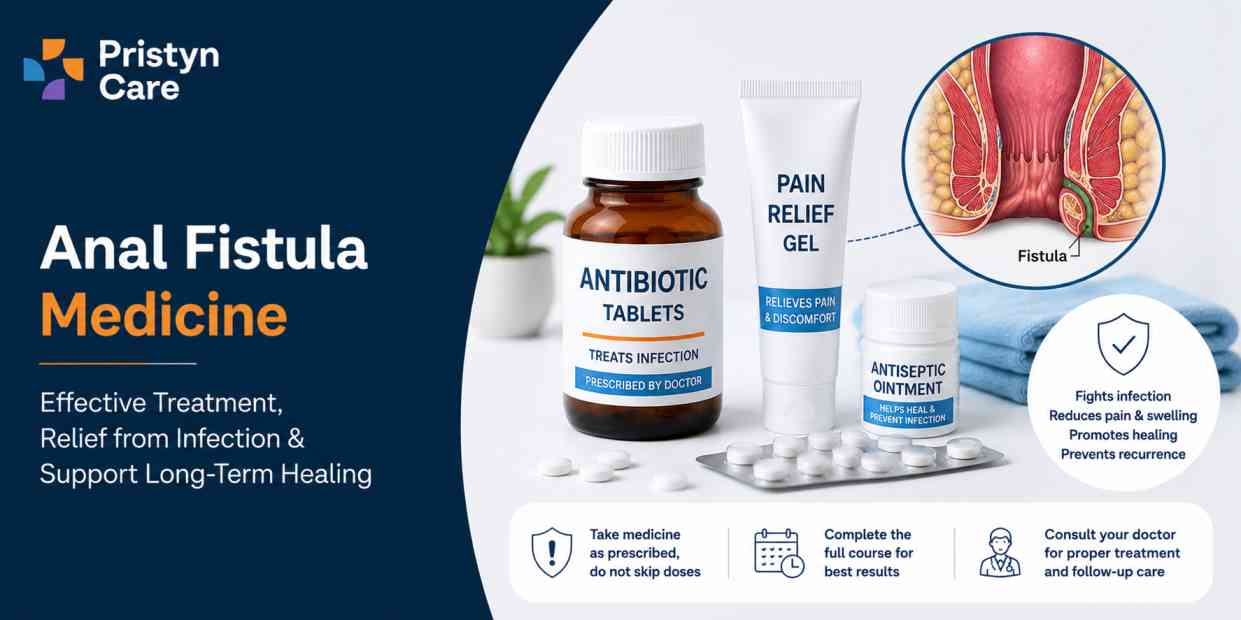
There are medicines that may help manage certain symptoms or associated infections, but there is no single "best medicine" that can reliably eliminate an established anal fistula tract.
Depending on the patient's condition, a doctor may recommend:
| Treatment | What it may help with |
| Antibiotics | Certain bacterial infections or surrounding infection |
| Pain relievers | Pain and discomfort |
| Stool-softening measures | Reducing straining during bowel movements |
| Fibre and fluids | Keeping stools softer |
| Medicines for associated bowel conditions | Managing underlying disease |
| Surgical/procedural treatment | Treating the fistula tract itself |
The important distinction is that symptom control and fistula treatment are not always the same thing.
If a fistula tract remains present, symptoms may return even after temporary improvement.
Best Medicine for Anal Fistula: What Can Medicines Actually Do?
1. Antibiotics
Antibiotics may be prescribed when there is an infection or specific clinical indication.
However, antibiotics generally do not remove the abnormal fistula tract itself.
They may therefore be useful as part of treatment in selected situations, but they should not be considered a permanent cure for an established fistula.
2. Pain Medicines
Painkillers can help reduce discomfort caused by inflammation, swelling, or an associated abscess.
However, they only manage the symptom and do not close the fistula.
3. Stool-Softening Measures
Keeping stools soft can reduce straining and irritation around the anal region.
A doctor may recommend dietary fibre, adequate fluids, or stool-softening medication depending on the patient's bowel habits.
These measures can support recovery but do not directly eliminate the fistula tract.
Can Antibiotics Cure an Anal Fistula?
Usually, antibiotics alone cannot cure an established anal fistula.
This is because the problem is not simply the presence of bacteria. There is an abnormal tunnel connecting the anal canal or rectum to the skin.
Antibiotics may help control an associated infection, particularly when there is surrounding inflammation or another clinical reason to prescribe them.
But once the acute infection settles, the fistula tract may still remain.
This is why repeated courses of antibiotics without evaluating the underlying fistula can lead to a cycle of:
Swelling → infection → antibiotics → temporary relief → recurrence
If this pattern keeps repeating, a specialist evaluation is important.
Anal Fistula Homeopathic Medicine
There is no reliable evidence that homeopathic medicines can permanently close an established anal fistula tract.
Homeopathic products should not be used as a substitute for appropriate medical evaluation, particularly when there is:
- Pus discharge
- Increasing pain
- Fever
- Recurrent swelling
- A persistent opening near the anus
- Repeated abscesses
Delaying evaluation can allow an infection or abscess to persist or recur.
If you are considering homeopathy, discuss it with your doctor rather than delaying treatment for a fistula that may require a procedure.
Can Homeopathy Cure Anal Fistula Without Surgery?
Sometimes a painful lump or temporary swelling around the anus may actually be another condition. But when a true fistula tract has formed, medicines generally cannot simply make that established tunnel disappear.
A specialist first needs to determine:
- Whether a fistula is actually present
- Where the tract starts and ends
- Whether an abscess is present
- Whether the fistula involves the sphincter muscles
- Whether it is simple or complex
- Whether it is recurrent
The treatment can then be selected accordingly.
Can an Anal Fistula Heal Without Surgery?
A small amount of discharge may stop temporarily, but that does not necessarily mean the fistula has been cured.
A fistula can become blocked, causing pressure and infection to build up again. The tract may then reopen and start draining.
This creates the common pattern of:
Pain/swelling → pus formation → drainage → relief → recurrence
Therefore, if a fistula repeatedly opens and drains, it should be evaluated rather than repeatedly treated only with medicines.
Some fistulas may require a procedure, while others may be managed with different sphincter-preserving techniques depending on their anatomy.
Why Medicines May Not Cure an Anal Fistula
The main reason is structural.
An established fistula is an abnormal tract, not simply an infection.
Think of it like a tunnel under the skin. Medicines may reduce inflammation or infection around the tunnel, but they do not necessarily remove the tunnel itself.
This is why someone may feel better after taking antibiotics or pain medicine but develop the same symptoms again weeks or months later.
Repeated recurrence is a reason to investigate the fistula rather than continuing self-medication.
When Does an Anal Fistula Need Surgery?
A procedure or surgery may be recommended when the fistula:
- Causes recurrent pus discharge
- Keeps coming back after temporary improvement
- Causes repeated abscesses
- Produces persistent pain or swelling
- Has a clearly established fistula tract
- Does not resolve with appropriate conservative management
- Has a complex tract that requires definitive treatment
The exact procedure depends on the relationship between the fistula and the anal sphincter muscles.
The goal is to eliminate the abnormal tract while protecting continence.
What Procedures Are Used for Anal Fistula?
There is no single procedure that is suitable for every fistula.
Depending on the fistula's anatomy, a specialist may consider options such as:
Fistulotomy
Fistulotomy involves opening the fistula tract so that it can heal from the inside outward.
It is commonly considered for suitable, simple fistulas where opening the tract does not compromise important sphincter muscle.
Seton Placement
A seton may be placed through the fistula tract, particularly in certain complex fistulas or when gradual drainage is required while protecting the sphincter.
LIFT Procedure
The ligation of intersphincteric fistula tract procedure, commonly called LIFT, is designed to treat selected fistulas while avoiding division of significant portions of the sphincter muscle.
Advancement Flap
An advancement flap may be considered for selected fistulas where preserving the sphincter is especially important.
Laser Fistula Treatment
Laser-based techniques may be offered for selected fistulas. The suitability of laser treatment depends on the fistula's anatomy and the treating surgeon's assessment.
Therefore, a person should not choose a procedure simply because it is described as "laser" or "minimally invasive." The underlying fistula anatomy matters more than the name of the procedure.
Anal Fistula Medicine vs Surgery
| Factor | Medicines | Procedure/Surgery |
| Pain relief | Yes, depending on medicine | Usually improves once the underlying problem is treated |
| Treats infection | In selected cases | May address the source of infection |
| Removes fistula tract | No | Yes, depending on procedure |
| Prevents recurrent discharge | Usually not by itself | Can provide definitive treatment |
| Suitable for established fistula | Usually supportive | Often required |
| Treatment choice | Depends on symptoms | Depends on fistula anatomy |
Medicines can have an important role in managing infection and symptoms, but they are generally not a substitute for definitive treatment of an established fistula.
Can Anal Fistula Be Permanently Cured?
In many cases, an anal fistula can be successfully treated.
However, "permanent cure" depends on factors such as:
- Fistula type
- Location
- Number of tracts
- Sphincter involvement
- Presence of an abscess
- Underlying medical conditions
- Previous fistula procedures
- Whether the entire tract has been adequately treated
A fistula that repeatedly returns after temporary medical treatment needs proper assessment rather than repeated self-medication.
Can an Anal Fistula Come Back After Treatment?
Yes, recurrence is possible.
The risk depends on the complexity of the fistula and the treatment used.
Recurrence may be more likely when:
- The fistula has multiple branches
- There is an undetected secondary tract
- An abscess develops
- The fistula involves a significant portion of the sphincter
- An underlying bowel disease is present
- The original tract does not completely heal
Follow-up after treatment is therefore important.
What Can You Do Until You See a Doctor?
While waiting for medical evaluation, some general measures may help reduce irritation:
- Keep the area clean and dry
- Drink adequate fluids
- Eat enough fibre to avoid constipation
- Avoid prolonged straining during bowel movements
- Take medicines only as recommended by a doctor
- Do not attempt to cut, puncture, or drain the fistula yourself
- Seek urgent medical attention if you develop fever, severe pain, rapidly increasing swelling, or difficulty passing stool
These measures can support comfort but should not be considered a replacement for evaluation.
When Should You See a Doctor for an Anal Fistula?
See a colorectal surgeon, proctologist, or appropriately trained general surgeon if you have:
- Persistent pus discharge near the anus
- A recurrent lump or swelling
- Repeated anal abscesses
- A small opening that continuously or repeatedly drains
- Persistent pain
- Blood or foul-smelling discharge
- Fever associated with anal swelling
- Symptoms that return after antibiotics
Early evaluation can help determine whether the problem is an abscess, fistula, fissure, piles, or another condition.
Don’t Keep Treating a Fistula Only With Medicines
If you have been taking medicines repeatedly and the same swelling or discharge keeps returning, the problem may not be the lack of a "strong enough" medicine.
The underlying fistula tract may still be present.
Instead of repeatedly switching between antibiotics, painkillers, Ayurvedic products, or anal fistula homeopathic medicines, get the condition properly evaluated.
A specialist can identify the fistula's anatomy and determine whether conservative management is reasonable or whether a procedure would provide a more definitive solution.
Frequently Asked Questions
1. What is the best medicine for anal fistula?
There is no single best medicine that cures every anal fistula. Medicines may help manage infection, pain, or associated bowel problems, but an established fistula may require a procedure.
2. Can antibiotics cure anal fistula?
Antibiotics can help treat certain infections associated with a fistula, but they generally do not eliminate the fistula tract itself.
3. Can homeopathic medicine cure anal fistula?
There is no reliable evidence that homeopathic medicines can permanently close an established anal fistula. A persistent fistula should be medically evaluated.
4. Can an anal fistula heal without surgery?
Some symptoms may temporarily settle, but a persistent fistula tract often does not disappear simply because symptoms improve. Treatment depends on the type and anatomy of the fistula.
5. Is anal fistula surgery always necessary?
Not every patient requires the same procedure, and treatment depends on the fistula's anatomy. A specialist should determine whether and what type of intervention is appropriate.
6. Can a fistula become an abscess again?
Yes. If the fistula opening becomes blocked, infection and pus can build up and form another abscess.
7. Is laser treatment available for anal fistula?
Laser-based fistula procedures may be suitable for selected patients. The choice depends on the fistula's location, complexity, and relationship with the sphincter muscles.
8. Why does my fistula keep coming back after medicine?
Medicines may control infection or symptoms temporarily without eliminating the underlying fistula tract. Recurrent discharge or swelling warrants specialist evaluation.
Conclusion
Searching for anal fistula medicine or anal fistula homeopathic medicine is understandable, especially if you want to avoid surgery.
However, an established anal fistula is more than an infection. It is an abnormal tract that may continue to cause discharge, swelling, and recurrent abscesses even when medicines temporarily improve the symptoms.
Medicines can have a role in managing associated infection, pain, and bowel problems, but they generally cannot be relied upon to permanently close the fistula tract.
If you have recurrent pus discharge, swelling, pain, or repeated abscesses, consult a specialist to determine whether a fistula is present and which treatment is most appropriate.
The goal should not simply be to stop the symptoms temporarily, but to identify and treat the underlying fistula while preserving normal anal sphincter function.
Disclaimer: This content is intended for general informational purposes only and should not be considered a substitute for professional medical advice, diagnosis, or treatment. Do not start, stop, or change any medication without consulting a qualified healthcare professional.

Free Fistula Surgery Cost Calculator

Our care coordinator will call you shortly.
Social share:




Related Calculators

Dedicated Support at Every Step!
Our Doctors are available 24 hours a day, 7 days a week to help you!
Related Calculators
Get In Touch with our expert doctors !
- please enter 10 digit number.


