


 Views: 1
Phimosis Medicine: What Is the Best Medicine for Phimosis?




Dedicated Support at Every Step!
Our Doctors are available 24 hours a day, 7 days a week to help you!

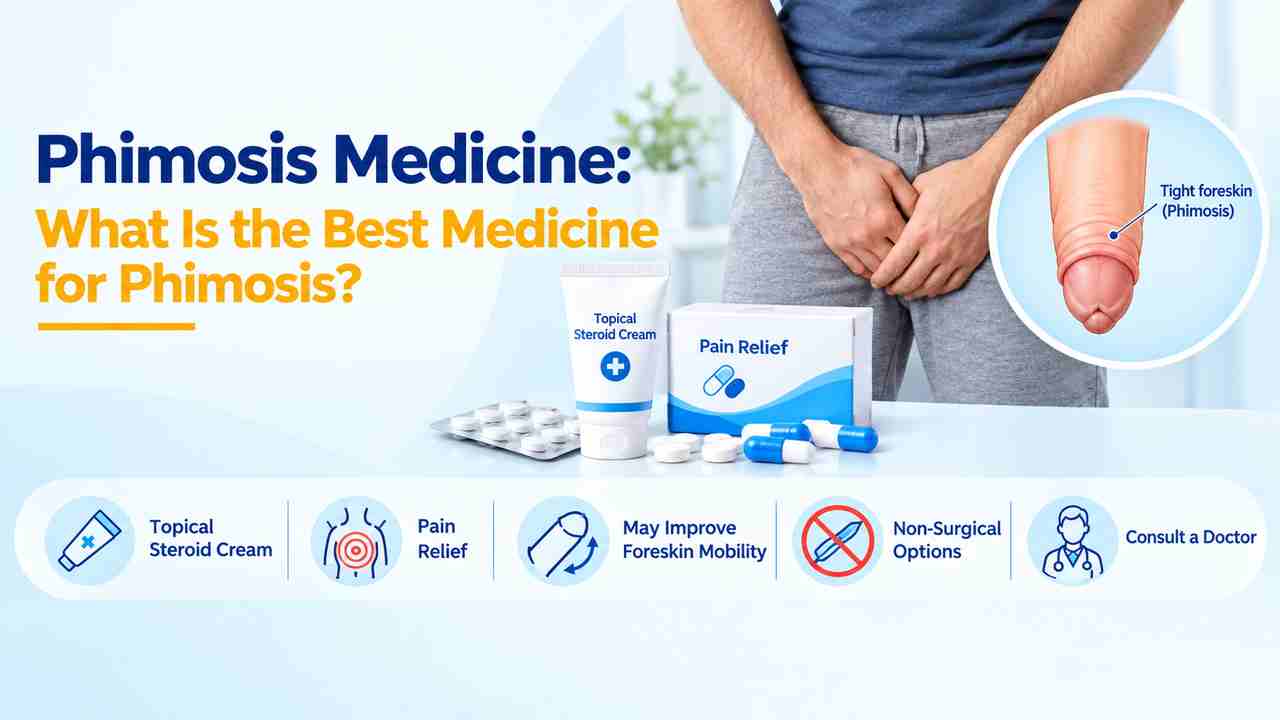
If you are searching for the best medicine for phimosis, it is important to understand that treatment depends on the person's age, severity of tightness, symptoms, and whether there is scarring or an underlying condition such as recurrent balanitis.
Homeopathic medicines are also commonly searched for phimosis, but there is no scientifically established homeopathic medicine proven to permanently cure phimosis.
Table of Contents
What Is Phimosis?
Phimosis occurs when the foreskin is too tight to retract over the glans penis.
It can be:
- Physiological phimosis: Common in young children and often improves naturally as they grow.
- Pathological phimosis: Usually associated with scarring, inflammation, infection or an underlying skin condition and may require medical treatment.
In adults, persistent tight foreskin may cause discomfort during erections or sexual activity and may make cleaning difficult.
No Cost EMI, Hassle-free Insurance Approval
What Are the Symptoms of Phimosis?
Symptoms can vary depending on the severity.
Common symptoms include:
- Foreskin that cannot be pulled back completely
- Tightness around the foreskin
- Pain when retracting the foreskin
- Pain during erection
- Pain or discomfort during sexual intercourse
- Difficulty cleaning underneath the foreskin
- Recurrent balanitis
- Redness or inflammation of the foreskin
- Swelling
- Cracks or small tears in the foreskin
- Weak or altered urine stream in severe cases
- Ballooning of the foreskin while urinating
Not every tight foreskin requires treatment. In young children, non-retractability can be a normal part of development.
What Is the Best Medicine for Phimosis?
There is no single medicine that is best for every case of phimosis.
For many patients with mild to moderate phimosis, doctors may recommend a topical corticosteroid cream or ointment, usually combined with a structured and gentle stretching routine.
Commonly prescribed topical corticosteroids may include:
- Betamethasone
- Mometasone
- Hydrocortisone
- Other corticosteroids depending on the patient's age and condition
The exact medicine, strength and duration should be determined by a doctor.
How Does Steroid Cream Help Phimosis?
Topical corticosteroids can:
- Reduce inflammation
- Improve the flexibility of the foreskin
- Soften tight tissue
- Make gentle stretching easier
- Improve foreskin retractability
The medicine does not simply “remove” the foreskin. Its purpose is to make the tight foreskin more flexible so that it can gradually retract.
Phimosis Medicine Names
There is no universal phimosis medicine name that is appropriate for everyone.
A doctor may prescribe a topical steroid based on the patient's age and severity.
| Medicine/Treatment | Potential Role in Phimosis |
| Betamethasone cream/ointment | May improve foreskin flexibility and retractability |
| Mometasone cream/ointment | May be prescribed for selected cases |
| Hydrocortisone | May be used in selected mild inflammatory conditions |
| Antibiotics | Used only when a bacterial infection is diagnosed or suspected |
| Antifungal medicine | Used when fungal infection is present |
| Gentle foreskin stretching | Often combined with topical treatment |
| Circumcision | Considered when conservative treatment fails or significant scarring is present |
The medicine should be applied only as directed by a doctor because inappropriate or prolonged corticosteroid use can cause skin problems.
Can Medicine Cure Phimosis Permanently?
Sometimes, yes.
Mild to moderate phimosis without significant scarring may improve substantially with topical corticosteroid treatment and appropriate stretching.
However, treatment success depends on factors such as:
- Age
- Severity
- Duration of phimosis
- Presence of scarring
- Recurrent inflammation
- Skin conditions
- Previous treatment
- Whether stretching is performed correctly
If the foreskin has significant scar tissue, medicine may not be enough.
In such cases, a urologist may recommend a procedure such as circumcision or, in selected cases, foreskin-preserving surgery.
How to Use Phimosis Cream?
If a doctor prescribes a steroid cream, it is generally applied to the tightest part of the foreskin, followed by gentle stretching according to the doctor's instructions.
The important word is gentle.
Do not forcibly pull back a tight foreskin because this can cause:
- Small tears
- Bleeding
- Pain
- Scar formation
- Worsening phimosis
The foreskin should never be forcibly retracted in a child.
A doctor or urologist can demonstrate the appropriate stretching technique.
Best Homeopathic Medicine for Phimosis
Homeopathy is frequently searched for as a non-surgical treatment for phimosis.
However, there is no scientifically established homeopathic medicine proven to permanently cure phimosis or remove foreskin scarring.
Phimosis can result from a physical narrowing or scarred foreskin. Therefore, relying exclusively on homeopathy may delay effective treatment.
If someone chooses to use homeopathy as a complementary approach, they should still obtain an appropriate diagnosis from a qualified healthcare professional.
This is especially important if there is:
- Pain
- Recurrent infection
- Bleeding
- Significant scarring
- Difficulty urinating
- Painful erections
- Recurrent balanitis
Phimosis Homeopathy Medicine: Does It Really Work?
Searches for phimosis homeopathy medicine usually reflect the desire to avoid surgery.
However, there is insufficient scientific evidence that homeopathic medicines can reliably reverse pathological phimosis.
If the problem is caused by scarring, a medicine that has not been proven to remove scar tissue should not be relied upon as the sole treatment.
For suitable patients, topical steroid treatment and gentle stretching have a much more established role in conservative management.
Can Phimosis Be Treated Without Surgery?
Yes, many cases can be managed without surgery.
Depending on the patient's age and condition, treatment may involve:
1. Observation
In young boys, a non-retractable foreskin may be completely normal.
If there are no symptoms, doctors may recommend simply allowing the foreskin to develop naturally.
2. Topical Steroid Treatment
Steroid cream or ointment can improve foreskin flexibility in many cases.
It is generally used together with gentle stretching.
3. Treatment of Infection or Inflammation
If phimosis is associated with balanitis or another infection, treating the underlying problem may be necessary.
The medicine depends on the cause:
- Antifungal medicine for confirmed fungal infection
- Antibiotics for selected bacterial infections
- Anti-inflammatory treatment for certain inflammatory conditions
4. Foreskin-Preserving Procedures
In selected cases, procedures designed to widen the foreskin rather than remove it completely may be considered.
5. Circumcision
Circumcision may be recommended when conservative treatment fails or when significant scarring or recurrent complications are present.
When Does Phimosis Need Surgery?
Surgery is not automatically required for every tight foreskin.
A urologist may recommend surgery when:
- Steroid treatment does not work
- Phimosis repeatedly returns
- There is significant scarring
- Recurrent balanitis occurs
- Painful erections persist
- Sexual activity is significantly affected
- The foreskin repeatedly tears
- Urination is affected
- There is pathological phimosis
- A condition such as lichen sclerosus has caused significant foreskin changes
The most appropriate procedure depends on the underlying cause.
 Doctor available
4.5/5

31+ Years Experience Overall
Doctor available
5.0/5
30+ Years Experience Overall
Doctor available
4.5/5
29+ Years Experience Overall
Doctor available
4.5/5
25+ Years Experience Overall
Doctor available
4.5/5
24+ Years Experience Overall
Doctor available
4.5/5
23+ Years Experience Overall
Doctor available
4.5/5
23+ Years Experience Overall
Doctor available
4.5/5
19+ Years Experience Overall
Doctor available
4.5/5
19+ Years Experience Overall
Doctor available
4.5/5
17+ Years Experience Overall
Doctor available
4.5/5
15+ Years Experience Overall
Doctor available
4.5/5
15+ Years Experience Overall
Doctor available
4.5/5
15+ Years Experience Overall
Doctor available
4.5/5
14+ Years Experience Overall
Doctor available
5.0/5
13+ Years Experience Overall
Doctor available
4.5/5
13+ Years Experience Overall
Doctor available
5.0/5
12+ Years Experience Overall
Doctor available
4.5/5
12+ Years Experience Overall
Doctor available
4.5/5
12+ Years Experience Overall
Doctor available
5.0/5
25+ Years Experience Overall
 (4) (1).jpg/1682933853454_ban-Icon.png) Doctor available
Doctor available
5.0/5
27+ Years Experience Overall
Doctor available
4.5/5
27+ Years Experience Overall
Doctor available.jpg/1681796287744_ban-Icon.png)
4.9/5
25+ Years Experience Overall
Doctor available
4.6/5
24+ Years Experience Overall
Doctor available
4.5/5
24+ Years Experience Overall
Doctor available
MBBS, DNB( General Surgery) MNAMS, FMAS, FIAGES, FAIS
₹1200₹600Consultation Fee
4.6/5
24+ Years Experience Overall
Doctor available
4.7/5
23+ Years Experience Overall
Doctor available
4.5/5
23+ Years Experience Overall
Doctor available
4.5/5
23+ Years Experience Overall
Doctor available
4.7/5
22+ Years Experience Overall
Doctor available
5.0/5
22+ Years Experience Overall
Doctor available
4.5/5
21+ Years Experience Overall
Doctor available
4.5/5
21+ Years Experience Overall
Doctor available
4.7/5
20+ Years Experience Overall
Doctor available
4.5/5
20+ Years Experience Overall
Doctor available
4.9/5
20+ Years Experience Overall
Doctor available
5.0/5
20+ Years Experience Overall
Doctor available
4.5/5
19+ Years Experience Overall
Doctor available
4.8/5
17+ Years Experience Overall
Doctor available
5.0/5
17+ Years Experience Overall
Doctor available
4.9/5
17+ Years Experience Overall
Doctor available.jpeg/1777541472938_ban-Icon.png)
4.8/5
17+ Years Experience Overall
Doctor available
5.0/5
17+ Years Experience Overall
Doctor available
5.0/5
17+ Years Experience Overall
Doctor available
5.0/5
16+ Years Experience Overall
Doctor available
5.0/5
16+ Years Experience Overall
Doctor available
4.5/5
16+ Years Experience Overall
Doctor available
4.8/5
16+ Years Experience Overall
Doctor available
4.5/5
16+ Years Experience Overall
Doctor available
5.0/5
16+ Years Experience Overall
Doctor available
5.0/5
15+ Years Experience Overall
Doctor available
4.5/5
15+ Years Experience Overall
Doctor available
4.6/5
15+ Years Experience Overall
Doctor available
5.0/5
15+ Years Experience Overall
Doctor available
4.9/5
14+ Years Experience Overall
Doctor available.jpg/1679651251511_ban-Icon.png)
5.0/5
14+ Years Experience Overall
Doctor available
4.5/5
14+ Years Experience Overall
Doctor available
5.0/5
13+ Years Experience Overall
Doctor available
4.5/5
13+ Years Experience Overall
Doctor available
4.7/5
13+ Years Experience Overall
Doctor available
4.5/5
13+ Years Experience Overall
Doctor available
5.0/5
13+ Years Experience Overall
Doctor available
4.5/5
12+ Years Experience Overall
Doctor available.jpg/1681109066874_ban-Icon.png)
4.9/5
12+ Years Experience Overall
Doctor available
4.5/5
12+ Years Experience Overall
Doctor available
MBBS, M.S.(Gen. Surgery), DNB (Gen. Surgery), F.MAS, D.MAS, FAIS, FALS, FIAGES
₹1200₹600Consultation Fee
4.5/5
12+ Years Experience Overall
Doctor available
4.8/5
12+ Years Experience Overall
Doctor available
4.5/5
12+ Years Experience Overall
Doctor available
4.8/5
12+ Years Experience Overall
Doctor available
4.5/5
11+ Years Experience Overall
Doctor available.jpg/1685814002647_ban-Icon.png)
4.9/5
11+ Years Experience Overall
Doctor available
5.0/5
11+ Years Experience Overall
Doctor available
4.5/5
11+ Years Experience Overall
Doctor available
4.5/5
10+ Years Experience Overall
Doctor available
5.0/5
10+ Years Experience Overall
Doctor available
4.5/5
9+ Years Experience Overall
Doctor available
4.5/5
8+ Years Experience Overall
Doctor available
4.5/5
8+ Years Experience Overall
Doctor available
4.5/5
27+ Years Experience Overall
Doctor available
4.5/5
27+ Years Experience Overall
Doctor available
4.5/5
26+ Years Experience Overall
Doctor available
4.5/5
26+ Years Experience Overall
Doctor available
5.0/5
24+ Years Experience Overall
 Doctor available
4.5/5
21+ Years Experience Overall
Doctor available
4.5/5
21+ Years Experience Overall
Doctor available
5.0/5
21+ Years Experience Overall
Doctor available
4.5/5
20+ Years Experience Overall
Doctor available
4.5/5
20+ Years Experience Overall
Doctor available
4.5/5
20+ Years Experience Overall
Doctor available
4.5/5
20+ Years Experience Overall
Doctor available
4.5/5
19+ Years Experience Overall
Doctor available
4.5/5
18+ Years Experience Overall
Doctor available
4.9/5
18+ Years Experience Overall
Doctor available
5.0/5
17+ Years Experience Overall
Doctor available
4.8/5
16+ Years Experience Overall
Doctor available
4.8/5
15+ Years Experience Overall
Doctor available
MBBS, MS - General Surgery, MCh - Urology/Genito-Urinary Surgery
₹1200₹600Consultation Fee
5.0/5
15+ Years Experience Overall
Doctor available
4.5/5
15+ Years Experience Overall
Doctor available
Dr. Penmetsa Bhanu Prakash Raju
MBBS, MS-General Surgery, FNB-Minimal Acess Surgery
₹1200₹600Consultation Fee
4.5/5
15+ Years Experience Overall
Doctor available
5.0/5
14+ Years Experience Overall
Doctor available
4.9/5
14+ Years Experience Overall
Doctor available
4.5/5
14+ Years Experience Overall
Doctor available
4.5/5
14+ Years Experience Overall
Doctor available
4.5/5
14+ Years Experience Overall
Doctor available
5.0/5
14+ Years Experience Overall
Doctor available
4.5/5
13+ Years Experience Overall
Doctor available (1).png/1742636902782_ban-Icon.png)
4.5/5
13+ Years Experience Overall
Doctor available
5.0/5
13+ Years Experience Overall
Doctor available
4.9/5
13+ Years Experience Overall
Doctor available
5.0/5
13+ Years Experience Overall
Doctor available
4.5/5
13+ Years Experience Overall
Doctor available
4.5/5
13+ Years Experience Overall
Doctor available
4.5/5
12+ Years Experience Overall
Doctor available
4.5/5
12+ Years Experience Overall
Doctor available
4.5/5
12+ Years Experience Overall
Doctor available
4.5/5
11+ Years Experience Overall
Doctor available
4.5/5
11+ Years Experience Overall
Doctor available
4.5/5
10+ Years Experience Overall
Doctor available
4.5/5
10+ Years Experience Overall
Doctor available
4.5/5
9+ Years Experience Overall
Doctor available
4.5/5
7+ Years Experience Overall
Circumcision for Phimosis
Circumcision involves removing the foreskin that covers the head of the penis.
It is one of the definitive treatments for persistent pathological phimosis.
Circumcision may be considered when:
- Medicines have failed
- There is severe scarring
- Recurrent infections occur
- Phimosis is causing significant symptoms
- The foreskin cannot retract because of pathological narrowing
Modern circumcision techniques can be performed using different surgical approaches, including conventional surgical methods and certain device-assisted or minimally invasive techniques depending on the patient and provider.
A urologist can explain which approach is appropriate.
Can Phimosis Be Cured Without Circumcision?
Yes, in many cases.
The possibility of avoiding circumcision depends on the cause and severity.
Patients with mild or moderate phimosis and no significant scarring may respond well to:
Topical steroid + gentle stretching + treatment of the underlying cause
However, severe scarring may make conservative treatment less successful.
Therefore, it is better to determine whether the foreskin is simply tight or actually scarred before deciding that surgery is necessary.
Phimosis Medicine vs Circumcision
| Factor | Medicine + Stretching | Circumcision |
| Mild phimosis | Often suitable | Usually not first choice |
| Young child with physiological phimosis | Observation may be enough | Usually unnecessary |
| Moderate phimosis | May improve | Considered if conservative treatment fails |
| Significant scarring | May be less effective | Often considered |
| Recurrent balanitis | May treat associated infection | May be recommended in recurrent cases |
| Painful erections | May improve if tightness responds | Definitive option when persistent |
| Severe pathological phimosis | May not be sufficient | May be recommended |
| Recurrent phimosis | May require repeated treatment | Can provide definitive treatment |
| Urinary problems | Requires medical evaluation | May be required in severe cases |
Phimosis in Children
A tight or non-retractable foreskin is often normal in young boys.
Parents should not forcibly retract the foreskin.
As children grow, the foreskin generally becomes more retractable.
Medical evaluation is recommended if a child develops:
- Recurrent infections
- Pain
- Bleeding
- Difficulty urinating
- Persistent swelling
- Significant scarring
- Recurrent inflammation
If treatment is required, topical steroid therapy may be considered before surgery in many cases.
Phimosis in Adults
Phimosis in adults is more likely to require evaluation because it can sometimes develop or worsen due to:
- Recurrent balanitis
- Fungal infections
- Bacterial infections
- Scarring
- Diabetes
- Lichen sclerosus
- Repeated inflammation
- Previous foreskin injuries
Adults may experience:
- Pain during erections
- Pain during sex
- Difficulty retracting the foreskin
- Problems maintaining hygiene
- Recurrent infections
- Foreskin tearing
An adult with newly developed or worsening phimosis should be evaluated by a urologist rather than simply taking an over-the-counter cream.
Can Phimosis Affect Sex?
Yes.
Depending on its severity, phimosis can cause:
- Pain during erection
- Pain during intercourse
- Difficulty with penetration
- Foreskin tearing
- Bleeding
- Anxiety around sexual activity
Treating the underlying tightness can improve sexual comfort.
However, painful sex should not be assumed to be caused only by phimosis. Other penile or sexual-health conditions can produce similar symptoms.

Free Phimosis Surgery Cost Calculator

Phimosis and Diabetes
Adults with diabetes can have an increased risk of recurrent genital infections and inflammation.
Repeated balanitis can contribute to foreskin scarring and pathological phimosis.
If an adult develops recurrent:
- Balanitis
- Fungal infections
- Foreskin cracking
- Tightness
- Difficulty retracting the foreskin
a doctor may recommend evaluation for contributing factors, including diabetes when clinically appropriate.
Treating only the foreskin problem without addressing recurrent underlying inflammation may allow the problem to return.
What Happens If Phimosis Is Left Untreated?
Mild physiological phimosis in children may resolve naturally and may not require treatment.
However, pathological phimosis that remains untreated can sometimes lead to:
- Recurrent balanitis
- Painful erections
- Foreskin tears
- Bleeding
- Difficulty maintaining hygiene
- Pain during sexual intercourse
- Urinary difficulties
- Recurrent inflammation
- Further scarring
In severe cases, the tight foreskin can become trapped behind the glans after retraction. This is called paraphimosis and requires urgent medical attention.
Phimosis vs Paraphimosis
These two conditions are different.
Phimosis
The foreskin is too tight to retract normally over the glans.
Paraphimosis
The foreskin has been retracted behind the glans but becomes stuck there and cannot be brought forward again.
Paraphimosis can cause swelling and restrict blood flow to the glans.
Paraphimosis is an emergency and requires immediate medical treatment.
When Should You See a Urologist?
You should consult a urologist if:
- You cannot retract your foreskin and it is causing symptoms
- Phimosis develops for the first time in adulthood
- You experience painful erections
- Sex becomes painful
- The foreskin repeatedly tears
- You have recurrent balanitis
- You notice scarring
- Urination becomes difficult
- Symptoms continue despite steroid treatment
Seek urgent medical attention if:
- The foreskin becomes stuck behind the glans
- The penis becomes significantly swollen
- The glans changes color
- You have severe pain
- You cannot urinate
These symptoms can indicate paraphimosis or another urgent condition.
Frequently Asked Questions
1. What is the best medicine for phimosis?
For many suitable patients, a doctor may prescribe a topical corticosteroid cream or ointment combined with gentle foreskin stretching. However, there is no single best medicine for every case.
2. What is the medicine name for phimosis?
Commonly prescribed topical corticosteroids may include betamethasone or mometasone, depending on the patient's age and condition. The medicine and strength should be selected by a doctor.
3. Can phimosis be cured with medicine?
Mild to moderate phimosis may improve with topical steroid treatment and gentle stretching. Severe scarring may not respond adequately to medicines and may require a procedure or circumcision.
4. What is the best homeopathic medicine for phimosis?
There is no scientifically established homeopathic medicine proven to permanently cure phimosis. Appropriate medical evaluation is recommended before choosing treatment.
5. Does homeopathy cure phimosis permanently?
There is insufficient scientific evidence that homeopathy can permanently reverse pathological phimosis, particularly when significant scar tissue is present.
6. Can I use steroid cream for phimosis without seeing a doctor?
It is better to use steroid treatment only after medical evaluation and according to the prescribed instructions. Incorrect application or prolonged use can cause skin-related side effects.
7. Can phimosis be cured without circumcision?
Yes. Many mild to moderate cases can improve with topical steroid treatment and gentle stretching. However, severe scarring or recurrent pathological phimosis may require circumcision or another procedure.
8. Is phimosis normal in children?
A non-retractable foreskin can be normal in young boys. It should never be forcibly retracted. Treatment is considered when symptoms or pathological changes are present.
9. Can phimosis cause pain during sex?
Yes. Tight foreskin can cause painful erections, discomfort during intercourse, tearing or bleeding.
10. Does phimosis come back after treatment?
It can, particularly when an underlying cause such as recurrent inflammation or scarring remains. Treating the underlying condition and following the prescribed stretching or treatment plan can reduce recurrence.
11. Is circumcision the only permanent treatment for phimosis?
Circumcision is a definitive treatment for pathological phimosis, but it is not the only possible treatment in every case. Some patients respond well to conservative treatment, while selected patients may be candidates for foreskin-preserving procedures.


Conclusion
There is no single best medicine for phimosis because treatment depends on the person's age, severity of foreskin tightness, symptoms and presence of scarring.
For suitable patients, topical corticosteroid treatment combined with gentle stretching can significantly improve foreskin retractability and may help avoid surgery.
Homeopathic medicines are commonly searched for as an alternative, but there is no scientifically established homeopathic medicine proven to permanently cure phimosis.
If phimosis is severe, recurrent, scarred or does not improve with conservative treatment, a urologist may recommend a procedure or circumcision. The goal is to choose the least invasive effective treatment while addressing the underlying cause..
Disclaimer: This information is for educational purposes only and should not replace consultation with a qualified urologist. Do not start steroid creams, antibiotics, antifungal medicines or alternative treatments for phimosis without appropriate medical advice.
Social share:





Related Calculators

Dedicated Support at Every Step!
Our Doctors are available 24 hours a day, 7 days a week to help you!


