


 Views: 1
Piles Medicine: What Is the Best Medicine for Piles and Hemorrhoids?
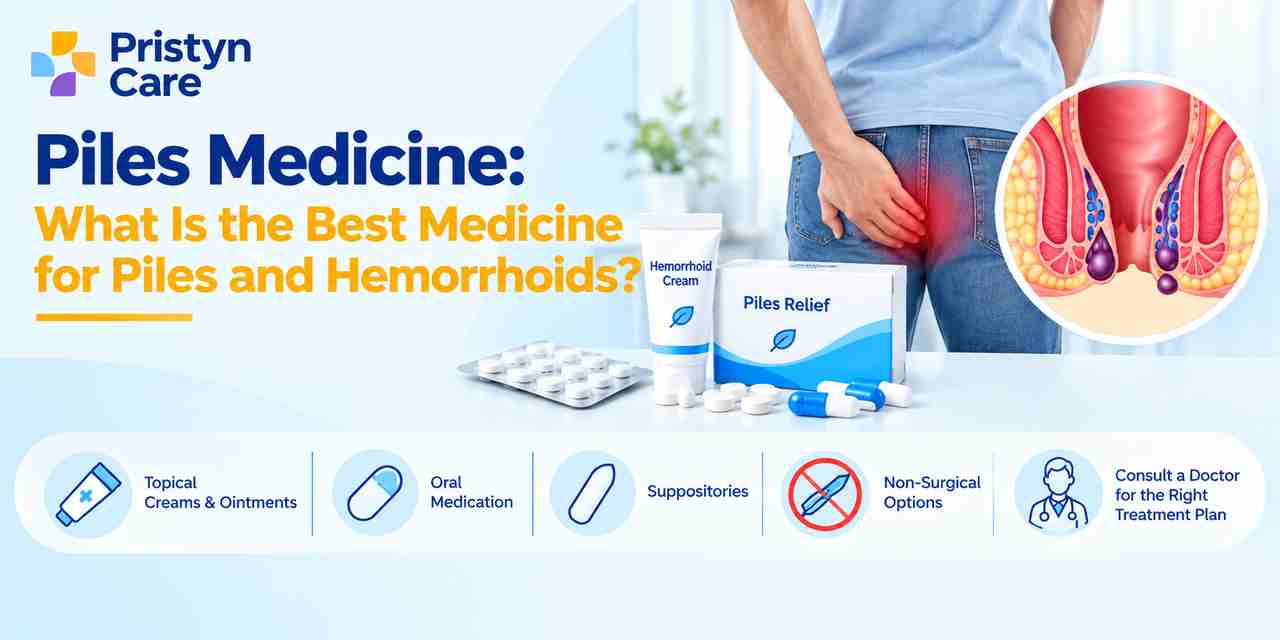
Piles, also called hemorrhoids, are swollen and enlarged blood vessels and supporting tissues around the anus or lower rectum. They can occur inside the rectum as internal piles or under the skin around the anus as external piles.



Dedicated Support at Every Step!
Our Doctors are available 24 hours a day, 7 days a week to help you!

There is no single piles medicine name, tablet, cream or ointment that works for every patient. Medicines can often provide relief from pain, itching, swelling and constipation, and some early piles improve with medicines and lifestyle changes. However, medicines cannot reliably eliminate advanced or recurrent piles.
Table of Contents
What Are Piles?
Piles are swollen vascular cushions in the anal canal. These tissues normally help with bowel control, but excessive pressure or weakening of supporting tissues can cause them to become enlarged and symptomatic.
Piles are commonly associated with:
- Chronic constipation
- Straining during bowel movements
- Sitting on the toilet for a long time
- Low-fibre diet
- Pregnancy
- Obesity
- Frequent heavy lifting
- Chronic diarrhoea
- Increasing age
- Family history
Piles are generally classified as internal or external.
Internal Piles
Internal hemorrhoids develop inside the rectum.
They are commonly classified into four grades:
| Grade | Description |
| Grade 1 | Enlarged hemorrhoids remain inside the rectum |
| Grade 2 | Prolapse during bowel movement but go back inside on their own |
| Grade 3 | Prolapse and need to be pushed back manually |
| Grade 4 | Remain prolapsed and cannot be pushed back easily |
External Piles
External hemorrhoids develop under the skin around the anus.
They can cause:
- Pain
- Swelling
- Itching
- A lump near the anus
- Bleeding
- Thrombosis or blood clot formation
No Cost EMI, Hassle-free Insurance Approval
What Is the Best Medicine for Piles?
There is no single best medicine for piles.
Treatment depends on the symptoms and grade of hemorrhoids.
For mild piles, treatment may include:
- Fibre supplements
- Stool softeners or appropriate laxatives
- Adequate fluids
- Short-term topical creams or ointments
- Pain-relieving medicines when appropriate
- Medicines that reduce itching or irritation
These measures can be particularly useful when constipation and straining are contributing to the problem.
However, medicines mainly control symptoms and reduce contributing factors. They do not necessarily remove the underlying enlarged hemorrhoidal tissue.
If piles continue to bleed, prolapse or cause significant symptoms despite medical treatment, a proctologist may recommend a procedure.
Piles Medicine Names
The appropriate medicine depends on the symptoms.
Common treatment categories include:
| Medicine/Treatment | Purpose |
| Fibre supplements | Soften stools and reduce straining |
| Osmotic laxatives | Help relieve constipation |
| Stool softeners | Make bowel movements easier |
| Topical anesthetics | Temporarily reduce pain or discomfort |
| Topical corticosteroids | May reduce inflammation and itching for short-term use |
| Protective ointments | Help soothe irritated anal skin |
| Pain relievers | Help control pain |
| Flavonoid/venotonic medicines | May be used in selected cases to reduce symptoms |
| Antibiotics | Used only when a bacterial infection is actually present |
| Procedures | Considered when medicines are insufficient |
The exact medicine and duration should be determined based on the patient's symptoms and medical history.
Piles Medicine Tablet
People commonly search for a piles medicine tablet or “piles tablet name.”
There is no universal tablet that permanently removes piles.
Depending on the patient's symptoms, a doctor may recommend:
- A fibre supplement
- A laxative for constipation
- A stool softener
- An appropriate pain reliever
- A prescription medicine for selected symptoms
- A flavonoid/venotonic preparation in selected cases
The tablet should be selected according to the problem being treated.
For example, if constipation is causing repeated straining, improving bowel movements may be more important than simply taking a painkiller.
Piles Medicine Cream and Ointment
Piles creams and ointments can provide temporary relief from symptoms such as:
- Itching
- Burning
- Mild pain
- Irritation
- Swelling
Depending on the formulation, topical products may contain ingredients such as:
- Local anesthetics
- Mild corticosteroids
- Protective agents
- Astringents
- Other symptom-relieving ingredients
However, creams generally do not permanently remove hemorrhoids.
Avoid using steroid-containing creams for prolonged periods without medical advice because long-term use on the sensitive skin around the anus can cause adverse effects.
Piles Medicine Cream Name
There is no single best piles cream name for everyone.
The appropriate product depends on whether the dominant symptom is:
- Pain
- Itching
- Inflammation
- Bleeding
- Skin irritation
- A thrombosed external hemorrhoid
A doctor or pharmacist can help select an appropriate short-term topical treatment.
Medicine for Piles Pain
Pain from piles can occur because of inflammation, irritation, thrombosis or an associated anal fissure.
Depending on the cause and severity, treatment may include:
- Appropriate oral pain relievers
- Topical anesthetic preparations
- Warm sitz baths
- Stool-softening measures
- Treatment of constipation
However, severe or sudden anal pain should not automatically be assumed to be piles.
A painful lump can sometimes be a thrombosed external hemorrhoid, while severe pain during bowel movements may indicate an anal fissure or another condition.
If pain is severe or persistent, proper diagnosis is important.
Bleeding Piles Medicine
Bleeding is a common symptom of internal hemorrhoids, especially during or after passing stool.
Mild bleeding may improve when constipation and straining are controlled.
Treatment can include:
- Fibre
- Adequate water intake
- Stool-softening treatment
- Short-term topical treatment when appropriate
- Treatment of the underlying hemorrhoid
However, rectal bleeding should not always be attributed to piles.
Bleeding can also occur because of:
- Anal fissure
- Polyps
- Inflammatory bowel disease
- Colorectal cancer
- Other gastrointestinal conditions
Therefore, new, recurrent, heavy or unexplained rectal bleeding should be evaluated by a doctor.
Best Antibiotic Medicine for Piles
Antibiotics are not routinely required for piles.
Hemorrhoids are not normally caused by a bacterial infection.
Taking an antibiotic simply because you have piles is therefore not recommended.
Antibiotics may be prescribed when a doctor identifies an associated bacterial infection or another condition that genuinely requires antibiotic treatment.
Using unnecessary antibiotics can cause:
- Side effects
- Allergic reactions
- Antibiotic resistance
- Disruption of normal gut bacteria
If piles are painful, bleeding or swollen, the correct treatment depends on the underlying cause rather than automatically taking an antibiotic.
Over-the-Counter Medicine for Piles
Some over-the-counter treatments can help manage mild hemorrhoid symptoms.
These may include:
- Fibre supplements
- Stool softeners
- Certain laxatives
- Topical hemorrhoid preparations
- Appropriate pain relievers
OTC medicines may be reasonable for short-term symptom relief when symptoms are mild.
However, repeated self-medication is not a substitute for evaluation if:
- Bleeding keeps returning
- A lump remains outside the anus
- Symptoms are worsening
- Pain is severe
- Piles repeatedly return
- Treatment is not working
Allopathic Medicine for Piles
“Allopathic medicine” generally refers to conventional medical treatment.
For piles, conventional treatment can include:
For constipation
- Fibre supplements
- Osmotic laxatives
- Stool softeners
- Adequate fluid intake
For pain
- Appropriate oral pain medicines
- Topical anesthetic preparations
For itching and inflammation
- Short-term topical preparations
- Selected corticosteroid-containing products
For persistent piles
Medicines may be combined with procedures such as:
- Rubber band ligation
- Sclerotherapy
- Infrared coagulation
- Hemorrhoidectomy
- Stapled hemorrhoidopexy in selected cases
- Other minimally invasive treatments depending on the hemorrhoid type
Homeopathic Medicine for Piles
Homeopathy is commonly searched for as a treatment for piles, including:
- Homeopathic medicine for piles
- Best homeopathic medicine for hemorrhoids
- Piles ki homeopathic medicine
- Homeo medicine for piles
- Homeopathic medicine for bleeding piles
- Homeopathic medicine for piles and constipation
However, there is no scientifically established homeopathic medicine proven to permanently eliminate hemorrhoids.
Homeopathic treatment should not replace an evaluation when there is:
- Persistent bleeding
- Prolapsed piles
- Severe pain
- Recurrent symptoms
- A lump that does not go back inside
- Unexplained weight loss
- Changes in bowel habits
Symptom improvement does not necessarily mean that the underlying hemorrhoid has disappeared.
Best Homeopathic Medicine for Piles
There is no scientifically established best homeopathic medicine for piles.
Different homeopathic products may be marketed for symptoms such as bleeding, constipation or pain, but there is insufficient high-quality evidence that homeopathic medicines can reliably remove hemorrhoidal tissue or permanently cure piles.
If you are considering homeopathy, do not delay appropriate examination, particularly for recurrent or unexplained rectal bleeding.
Ayurvedic Medicine for Piles
Ayurvedic medicines and herbal treatments are frequently searched for under terms such as:
- Ayurvedic medicine for piles
- Best Ayurvedic medicine for piles
- Ayurvedic medicine for hemorrhoids
- Ayurvedic medicine for internal piles
- Ayurvedic medicine for external piles
- Piles Ayurvedic medicine name
- Ayurvedic medicine for piles in Patanjali
- Baidyanath medicine for piles
Some Ayurvedic approaches may focus on bowel regularity, diet and symptom management.
However, there is no universally proven Ayurvedic medicine that can permanently remove every type or grade of hemorrhoid.
If piles are advanced or prolapsed, relying solely on an herbal medicine may delay effective treatment.
Patanjali Medicine for Piles
Patanjali products are commonly searched for as piles medicine.
However, no branded Ayurvedic or herbal product should automatically be considered a permanent cure for hemorrhoids.
If considering a Patanjali or other herbal product, check its ingredients and discuss its use with a qualified healthcare professional, particularly if you:
- Take prescription medicines
- Are pregnant
- Have significant bleeding
- Have severe pain
- Have persistent or prolapsed piles
Most importantly, do not use a branded product as a substitute for evaluation of unexplained rectal bleeding.
Himalaya Medicine for Piles
Searches for Himalaya medicine for piles usually indicate an interest in herbal or Ayurvedic symptom management.
There is no single Himalaya product that can be recommended as a proven universal cure for hemorrhoids.
The appropriate treatment depends on the type and grade of piles.
A small Grade 1 hemorrhoid and a Grade 4 prolapsed hemorrhoid should not be expected to respond in the same way to an herbal product.
Baidyanath Medicine for Piles
Baidyanath is another brand frequently searched for in relation to piles.
However, branded Ayurvedic medicines should not be assumed to remove hemorrhoids permanently.
Before using any product, it is important to determine whether the symptoms are actually caused by hemorrhoids and whether there is another condition such as an anal fissure, abscess or another cause of rectal bleeding.
 Doctor available
4.5/5

31+ Years Experience Overall
Doctor available
5.0/5
30+ Years Experience Overall
Doctor available
4.5/5
25+ Years Experience Overall
Doctor available
4.5/5
23+ Years Experience Overall
Doctor available
4.5/5
17+ Years Experience Overall
Doctor available
4.5/5
15+ Years Experience Overall
Doctor available
4.5/5
15+ Years Experience Overall
Doctor available
4.5/5
14+ Years Experience Overall
Doctor available
5.0/5
13+ Years Experience Overall
Doctor available
4.5/5
13+ Years Experience Overall
Doctor available
5.0/5
12+ Years Experience Overall
Doctor available
5.0/5
27+ Years Experience Overall
Doctor available
4.5/5
27+ Years Experience Overall
Doctor available.jpg/1681796287744_ban-Icon.png)
4.9/5
25+ Years Experience Overall
Doctor available
4.6/5
24+ Years Experience Overall
Doctor available
4.5/5
24+ Years Experience Overall
Doctor available
MBBS, DNB( General Surgery) MNAMS, FMAS, FIAGES, FAIS
₹1200₹600Consultation Fee
4.6/5
24+ Years Experience Overall
Doctor available
4.7/5
23+ Years Experience Overall
Doctor available
4.5/5
23+ Years Experience Overall
Doctor available
4.5/5
23+ Years Experience Overall
Doctor available
4.7/5
22+ Years Experience Overall
Doctor available
5.0/5
22+ Years Experience Overall
Doctor available
4.5/5
21+ Years Experience Overall
Doctor available
4.5/5
21+ Years Experience Overall
Doctor available
4.7/5
20+ Years Experience Overall
Doctor available
4.5/5
20+ Years Experience Overall
Doctor available
5.0/5
20+ Years Experience Overall
Doctor available
4.9/5
20+ Years Experience Overall
Doctor available
MBBS, DNB-General Surgery, FMAS, FCLS, FLHS, FICS, FIAGES, MCLS, MNAMS,
₹3000₹1500Consultation Fee
5.0/5
19+ Years Experience Overall
Doctor available
4.5/5
19+ Years Experience Overall
Doctor available
4.8/5
17+ Years Experience Overall
Doctor available
5.0/5
17+ Years Experience Overall
Doctor available
4.9/5
17+ Years Experience Overall
Doctor available
5.0/5
17+ Years Experience Overall
Doctor available
5.0/5
17+ Years Experience Overall
Doctor available
5.0/5
16+ Years Experience Overall
Doctor available
5.0/5
16+ Years Experience Overall
Doctor available
4.5/5
16+ Years Experience Overall
Doctor available
4.8/5
16+ Years Experience Overall
Doctor available
5.0/5
16+ Years Experience Overall
Doctor available
4.5/5
16+ Years Experience Overall
Doctor available
4.6/5
15+ Years Experience Overall
Doctor available
4.5/5
15+ Years Experience Overall
Doctor available
5.0/5
15+ Years Experience Overall
Doctor available
4.5/5
15+ Years Experience Overall
Doctor available
4.9/5
14+ Years Experience Overall
Doctor available.jpg/1679651251511_ban-Icon.png)
5.0/5
14+ Years Experience Overall
Doctor available
4.5/5
14+ Years Experience Overall
Doctor available
5.0/5
13+ Years Experience Overall
Doctor available
4.5/5
13+ Years Experience Overall
Doctor available
4.7/5
13+ Years Experience Overall
Doctor available
4.5/5
13+ Years Experience Overall
Doctor available
5.0/5
13+ Years Experience Overall
Doctor available
5.0/5
13+ Years Experience Overall
Doctor available
4.5/5
12+ Years Experience Overall
Doctor available
4.8/5
12+ Years Experience Overall
Doctor available
4.8/5
12+ Years Experience Overall
Doctor available
MBBS, M.S.(Gen. Surgery), DNB (Gen. Surgery), F.MAS, D.MAS, FAIS, FALS, FIAGES
₹1200₹600Consultation Fee
4.5/5
12+ Years Experience Overall
Doctor available.jpg/1681109066874_ban-Icon.png)
4.9/5
12+ Years Experience Overall
Doctor available
4.5/5
12+ Years Experience Overall
Doctor available
4.5/5
12+ Years Experience Overall
Doctor available
4.5/5
12+ Years Experience Overall
Doctor available.jpg/1685814002647_ban-Icon.png)
4.9/5
11+ Years Experience Overall
Doctor available
4.5/5
11+ Years Experience Overall
Doctor available
4.5/5
11+ Years Experience Overall
Doctor available
5.0/5
11+ Years Experience Overall
Doctor available
4.5/5
10+ Years Experience Overall
Doctor available
5.0/5
10+ Years Experience Overall
Doctor available
4.5/5
9+ Years Experience Overall
Doctor available
4.5/5
8+ Years Experience Overall
Doctor available
4.5/5
8+ Years Experience Overall
Doctor available
4.5/5
27+ Years Experience Overall
Doctor available
4.5/5
27+ Years Experience Overall
Doctor available
4.5/5
26+ Years Experience Overall
Doctor available
4.5/5
26+ Years Experience Overall
Doctor available
5.0/5
24+ Years Experience Overall
 Doctor available
4.5/5
21+ Years Experience Overall
Doctor available
4.5/5
21+ Years Experience Overall
Doctor available
5.0/5
21+ Years Experience Overall
Doctor available
4.5/5
20+ Years Experience Overall
Doctor available
4.5/5
20+ Years Experience Overall
Doctor available
4.5/5
19+ Years Experience Overall
Doctor available
4.5/5
18+ Years Experience Overall
Doctor available
4.9/5
18+ Years Experience Overall
Doctor available
4.5/5
15+ Years Experience Overall
Doctor available
Dr. Penmetsa Bhanu Prakash Raju
MBBS, MS-General Surgery, FNB-Minimal Acess Surgery
₹1200₹600Consultation Fee
4.5/5
15+ Years Experience Overall
Doctor available
4.9/5
14+ Years Experience Overall
Doctor available
4.5/5
14+ Years Experience Overall
Doctor available
4.5/5
14+ Years Experience Overall
Doctor available
4.5/5
14+ Years Experience Overall
Doctor available
5.0/5
14+ Years Experience Overall
Doctor available (1).png/1742636902782_ban-Icon.png)
4.5/5
13+ Years Experience Overall
Doctor available
5.0/5
13+ Years Experience Overall
Doctor available
4.9/5
13+ Years Experience Overall
Doctor available
4.5/5
13+ Years Experience Overall
Doctor available
4.5/5
12+ Years Experience Overall
Doctor available
4.5/5
11+ Years Experience Overall
Doctor available
4.5/5
10+ Years Experience Overall
Doctor available
4.5/5
10+ Years Experience Overall
Doctor available
4.5/5
9+ Years Experience Overall
Doctor available
4.5/5
7+ Years Experience Overall
Dabur, Hamdard and Other Herbal Medicines for Piles
Similar searches include:
- Dabur medicine for piles
- Hamdard medicine for piles
- Unani medicine for piles
- Siddha medicine for piles
- Herbal medicine for piles
- Medicinal plants for piles
- Ramdev medicine for piles
Herbal, Unani and Siddha approaches may be used by some people for symptom management.
However, there is no established herbal or alternative medicine that can be considered a universal permanent cure for all grades of hemorrhoids.
The important question is not simply “Which medicine should I take?” but rather “What type and grade of piles do I have?”
Medicine for External Piles
External hemorrhoids can cause:
- Pain
- Swelling
- Itching
- Tenderness
- A lump around the anus
Mild external hemorrhoids may improve with:
- Fibre
- Stool-softening treatment
- Adequate water
- Warm sitz baths
- Short-term topical symptom relief
- Avoiding straining
A thrombosed external hemorrhoid can cause a sudden, very painful lump. Depending on when the thrombosis occurs and the severity of symptoms, a doctor may recommend conservative management or a procedure.
Do not attempt to puncture or drain a painful anal lump yourself.
Medicine for Internal Piles
Internal hemorrhoids commonly cause:
- Bright red bleeding during or after bowel movements
- Prolapse
- Mucus
- Itching
- A feeling of incomplete bowel emptying
Early internal hemorrhoids may respond to:
- Fibre
- Stool-softening treatment
- Better bowel habits
- Short-term symptom-relief medicines
However, Grades 3 and 4 may require a procedure or surgery if symptoms persist.
Medicine for Piles and Constipation
Constipation is one of the most important factors to address when treating piles.
Repeated hard stools and straining increase pressure on the hemorrhoidal tissues.
Treatment may include:
- Increasing dietary fibre
- Fibre supplements
- Adequate fluids
- Physical activity
- Stool-softening medicines
- Osmotic laxatives when appropriate
Avoid repeatedly using stimulant laxatives without medical advice if constipation is chronic.
If constipation and piles occur together frequently, both problems should be evaluated rather than repeatedly treating only the piles.
Can Piles Be Cured With Medicine?
Early piles can sometimes improve significantly with medicines and lifestyle changes, especially when constipation and straining are addressed.
However, medicines cannot reliably eliminate all hemorrhoids.
The likelihood of medical treatment working depends on:
- Grade of piles
- Internal vs external location
- Presence of prolapse
- Severity of bleeding
- Duration of symptoms
- Constipation
- Previous treatment
- Recurrence
For example:
- Grade 1 piles often respond well to conservative treatment.
- Grade 2 may improve but can require procedures if symptoms persist.
- Grade 3 frequently requires procedural treatment when prolapse is troublesome.
- Grade 4 often requires a more definitive intervention.
Can Piles Be Cured Permanently?
Piles can be treated effectively, but recurrence is possible.
Even after successful treatment, hemorrhoids may return if contributing factors continue, such as:
- Chronic constipation
- Repeated straining
- Low fibre intake
- Prolonged toilet sitting
- Sedentary lifestyle
- Obesity
- Pregnancy
Maintaining soft stools and healthy bowel habits can reduce the risk of recurrence.
When Is Piles Surgery Needed?
Surgery or a procedure may be considered when:
- Medicines and lifestyle changes do not provide adequate relief
- Bleeding continues
- Piles repeatedly prolapse
- Piles need to be pushed back manually
- Piles remain outside the anus
- Symptoms significantly affect daily life
- Large external or mixed hemorrhoids are present
- There is recurrent thrombosis
- Conservative treatment repeatedly fails
Not every patient who needs treatment requires conventional surgery.
Minimally Invasive Treatment for Piles
Depending on the type and grade of hemorrhoids, a proctologist may recommend minimally invasive treatment.
Rubber Band Ligation
A small band is placed around an internal hemorrhoid to cut off its blood supply. The treated tissue eventually shrinks and falls away.
It is commonly used for selected internal hemorrhoids.
Sclerotherapy
A solution is injected into the hemorrhoidal tissue to reduce blood flow and shrink the hemorrhoid.
Infrared Coagulation
Heat is used to treat selected internal hemorrhoids.
Laser Hemorrhoid Treatment
Laser-based techniques may be considered for selected patients depending on the hemorrhoid type and grade.
Hemorrhoidectomy
Surgical removal of hemorrhoidal tissue may be recommended for advanced, large or recurrent hemorrhoids, particularly when other approaches are unsuitable.
The appropriate procedure should be selected after physical examination and assessment of the hemorrhoid grade.

Free Piles Surgery Cost Calculator

Piles Medicine vs Procedure
| Condition | Medicine/Lifestyle | Procedure/Surgery |
| Grade 1 piles | Often effective | Usually unnecessary |
| Mild Grade 2 | May improve | Considered if symptoms persist |
| Persistent Grade 2 | May not be sufficient | Often considered |
| Grade 3 | Often limited benefit | Commonly considered |
| Grade 4 | Usually insufficient | Often requires definitive treatment |
| Mild bleeding | May improve | Considered if persistent |
| Severe/recurrent bleeding | May not be sufficient | Evaluation and treatment required |
| Thrombosed external piles | May help selected cases | Procedure may be considered in selected situations |
| Recurrent prolapse | Usually insufficient | Procedure/surgery may be recommended |
Female Piles Medicine
Women can develop piles for the same reasons as men.
Pregnancy is an additional risk factor because hormonal changes, constipation and increased pressure in the pelvic area can contribute to hemorrhoids.
Treatment during pregnancy should be guided by a doctor.
Do not automatically assume that an OTC, Ayurvedic, homeopathic or herbal piles medicine is safe during pregnancy.
For pregnant women, management may focus on:
- Fibre
- Fluids
- Preventing constipation
- Appropriate physical activity
- Doctor-approved symptom relief
Persistent or severe bleeding should be evaluated.
Home Remedies for Piles
Home measures can be useful for mild symptoms.
Increase Fibre
Eat more fibre-rich foods such as:
- Fruits
- Vegetables
- Whole grains
- Legumes
Drink Adequate Fluids
Adequate hydration can help keep stools softer.
Avoid Straining
Do not force bowel movements.
Avoid Long Toilet Sitting
Spending excessive time on the toilet can increase pressure around the anal area.
Warm Sitz Baths
A warm sitz bath can temporarily soothe discomfort and irritation.
Stay Physically Active
Regular movement can support bowel regularity.
These measures can complement medical treatment but may not be sufficient for advanced hemorrhoids.
What Happens If Piles Are Left Untreated?
Mild piles may remain stable or improve.
However, persistent untreated hemorrhoids can sometimes lead to:
- Recurrent bleeding
- Increasing prolapse
- Pain or irritation
- Anemia from significant chronic blood loss
- Thrombosis
- Difficulty maintaining hygiene
- Increasing dependence on symptom-relief medicines
Persistent rectal bleeding should always be evaluated rather than automatically assumed to be piles.
Piles and Anal Fissure: Are They the Same?
No.
Piles and anal fissures are different conditions.
Piles
Piles involve swollen hemorrhoidal tissue and commonly cause bright red bleeding, itching or prolapse.
Anal Fissure
An anal fissure is a tear in the lining of the anus and typically causes sharp or burning pain during and after bowel movements.
A person can have piles and an anal fissure at the same time.
Therefore, searches such as “best medicine for piles and fissure” should not be treated as though both conditions require the same medicine.
The correct treatment depends on the diagnosis.
Piles and Fistula: Are They the Same?
No.
An anal fistula is an abnormal tunnel between the anal canal and the skin near the anus, often developing after an abscess.
Medicines may control infection or inflammation in selected cases, but they generally do not close an established fistula.
Therefore, “piles and fistula medicine” should not be treated as a single treatment category.
If a person has persistent pus discharge, recurrent swelling or a small opening near the anus, a fistula should be considered and evaluated by a specialist.
When Should You See a Doctor for Piles?
Consult a doctor if:
- Rectal bleeding keeps returning
- Piles are becoming larger
- A lump is coming outside the anus
- The lump needs to be pushed back
- Pain persists
- OTC medicines are not helping
- Symptoms repeatedly return
- You have unexplained changes in bowel habits
Seek urgent medical attention if:
- Bleeding is heavy or continuous
- You feel faint or extremely weak
- You have severe sudden anal pain
- A swollen lump becomes extremely painful
- You develop fever with anal swelling
- You cannot pass stool or gas
- You have significant abdominal pain along with rectal symptoms
Frequently Asked Questions
1. What is the best medicine for piles?
There is no single best medicine for piles. Mild piles may improve with fibre, constipation treatment and short-term symptom-relief medicines. Persistent or advanced piles may require a procedure.
2. What is the medicine name for piles?
There is no universal piles medicine name. Treatment may include fibre supplements, laxatives, stool softeners, pain relievers and topical creams depending on the symptoms.
3. Which tablet is best for piles?
The appropriate tablet depends on the symptom being treated. A doctor may recommend a fibre supplement, laxative, stool softener or pain medicine rather than a single tablet that directly removes piles.
4. Which cream is best for piles?
The best cream depends on whether the main symptom is pain, itching, inflammation or irritation. Topical anesthetic, protective or short-term anti-inflammatory preparations may be used in selected cases.
5. What is the best medicine for bleeding piles?
For mild bleeding from hemorrhoids, improving stool consistency and avoiding straining can help. Persistent or recurrent bleeding should be evaluated because not all rectal bleeding is caused by piles.
6. What is the best antibiotic for piles?
There is no routinely recommended antibiotic for piles. Antibiotics are used only when an actual bacterial infection is diagnosed or suspected.
7. Can piles be cured with medicine?
Early piles can sometimes improve with medicines and lifestyle changes. Advanced or prolapsed hemorrhoids may require a procedure or surgery.
8. What is the best Ayurvedic medicine for piles?
There is no universally proven Ayurvedic medicine that permanently cures every type and grade of hemorrhoid. Ayurvedic products should not replace medical evaluation of persistent bleeding or prolapsed piles.
9. What is the best homeopathic medicine for piles?
There is no scientifically established homeopathic medicine proven to permanently eliminate hemorrhoids.
10. Can Patanjali, Himalaya, Baidyanath or Dabur medicine cure piles?
Branded herbal or Ayurvedic products may be marketed for piles, but they should not be assumed to permanently remove hemorrhoids. Treatment should depend on the type and grade of piles.
11. Can piles be cured without surgery?
Yes. Mild piles can often be managed with fibre, constipation treatment, lifestyle changes and medicines. More advanced piles may require a minimally invasive procedure or surgery.
12. Is medicine enough for Grade 3 or Grade 4 piles?
Medicine may help control symptoms but is often not enough to eliminate significant prolapse. A proctologist may recommend a procedure or surgery depending on the severity.
13. Can piles and fissure occur together?
Yes. Piles and anal fissures are different conditions, but they can occur together. Treatment should address each condition separately.
14. Can piles and fistula occur together?
They can coexist, but they are different conditions. An established fistula usually requires specialist evaluation and may need a procedure rather than only medicine.
15. Is piles medicine safe during pregnancy?
Not every piles medicine is suitable during pregnancy. Pregnant women should consult their doctor before using prescription, OTC, Ayurvedic, homeopathic or herbal medicines.


Conclusion
There is no single best medicine for piles or hemorrhoids.
For mild piles, particularly early-stage internal hemorrhoids, treatment often starts with improving bowel habits, increasing fibre, treating constipation and using short-term medicines or topical preparations for symptom relief.
If piles are repeatedly bleeding, prolapsing, painful or not responding to medicines, the next step should be proper examination rather than continuously changing medicines. Depending on the grade, treatments such as rubber band ligation, sclerotherapy, infrared coagulation, laser-based procedures or hemorrhoidectomy may be considered.
The most important step is to determine what is actually causing the anal symptoms and what grade of piles you have. This helps ensure that you receive the right treatment rather than relying on a generic “piles medicine.”
Social share:




Related Calculators

Dedicated Support at Every Step!
Our Doctors are available 24 hours a day, 7 days a week to help you!


