


 Views: 111
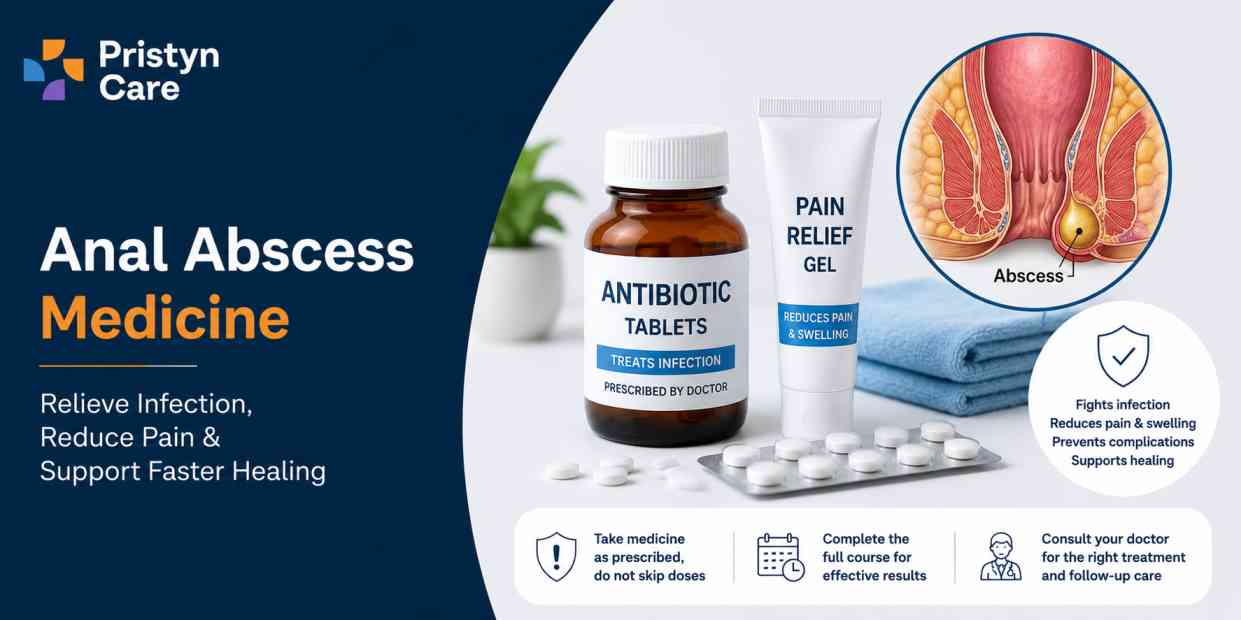
Anal Abscess Medicine: Can Medicines Cure an Anal Abscess Without Surgery?




Dedicated Support at Every Step!
Our Doctors are available 24 hours a day, 7 days a week to help you!

People often search for anal abscess medicine hoping that antibiotics, painkillers, creams, or home remedies can make the abscess disappear.
However, an important distinction is that medicines may help control infection-related symptoms, but they do not usually remove the collection of pus once an abscess has formed. Many anal abscesses require a medical procedure to drain the pus.
Delaying treatment can allow the infection to become larger or spread into surrounding tissues. In some cases, an anal abscess can also be associated with the development of an anal fistula.
If you have a painful lump, swelling, fever, or pus near the anus, it is important to get evaluated by a qualified doctor rather than relying only on self-medication.
Table of Contents
What Is an Anal Abscess?
An anal abscess is a pocket of infected fluid or pus that forms in or around the anus.
It can develop at different locations, including:
- Perianal abscess: Develops close to the anal opening.
- Intersphincteric abscess: Develops between the internal and external anal sphincter muscles.
- Ischiorectal abscess: Develops deeper in the tissues beside the anus.
- Supralevator abscess: Develops deeper in the pelvic region above the muscles that support the rectum.
The location and size of an abscess can influence the symptoms and treatment required.
A superficial abscess may appear as a painful lump near the anus, while a deeper abscess may cause severe pain without an obvious external swelling.
No Cost EMI, Hassle-free Insurance Approval
What Are the Symptoms of an Anal Abscess?
Common symptoms include:
- Severe or throbbing pain around the anus
- A painful lump or swelling
- Redness or warmth around the affected area
- Tenderness while sitting
- Pain during bowel movements
- Pus or foul-smelling discharge
- Fever or chills
- Feeling generally unwell
- Difficulty passing stools
- Increasing pain over time
Some deeper abscesses may cause significant pain or fever without an obvious lump on the skin.
If anal pain is severe or progressively worsening, do not assume that it is simply piles or an anal fissure. An examination may be needed to identify the actual cause.
Is There a Medicine for an Anal Abscess?
There is no single anal abscess medicine that can reliably eliminate an established abscess.
Depending on the situation, a doctor may prescribe medicines such as:
- Antibiotics when clinically indicated
- Pain-relieving medicines
- Medicines to manage associated conditions
- Stool-softening treatment when painful bowel movements are aggravating the condition
However, these medicines do not necessarily drain the pus trapped inside the abscess.
When an abscess has formed, drainage is often the key part of treatment.
The exact treatment depends on the size, location, depth of the abscess, severity of infection, and the patient's overall health.
Can Antibiotics Cure an Anal Abscess?
Antibiotics may be prescribed in selected cases, particularly when there are signs of systemic infection, surrounding skin infection, or certain medical conditions that increase the risk of complications.
However, antibiotics alone are generally not a substitute for drainage of a formed abscess.
Think of an abscess as a closed pocket containing infected material. Antibiotics may help control bacteria, but they may not be able to adequately clear a walled-off collection of pus.
This is why taking antibiotics repeatedly without medical evaluation can delay definitive treatment.
Do not self-prescribe antibiotics for an anal abscess.
Can Painkillers Treat an Anal Abscess?
Painkillers can temporarily reduce pain and make it easier to sit, sleep, or move around.
However, pain relief does not mean that the infection has been treated.
If a painful swelling continues to grow, becomes increasingly tender, or is associated with fever or pus, medical evaluation is important even if a painkiller temporarily makes you feel better.
Can an Anal Abscess Go Away With Medicine?
A very small or early infection may sometimes be managed differently depending on the clinical findings. However, once a significant abscess has formed, it often needs to be drained.
Waiting for the abscess to disappear on its own can allow the infection to progress.
An abscess may sometimes burst spontaneously and release pus, but this does not necessarily mean that the infection has been completely treated. A residual cavity or infected tissue may remain.
Therefore, if an abscess bursts on its own, you should still seek medical advice.
Why Does Anal Abscess Medicine Sometimes Fail?
There are several reasons why medicines alone may not resolve an anal abscess.
1. The pus remains trapped
An established abscess is a collection of pus inside a cavity. Medicines cannot always empty this collection.
2. The infection continues to build pressure
As pus accumulates, pressure inside the abscess can increase, causing severe or throbbing pain.
3. The abscess may be deeper than it appears
A deep abscess may not have an obvious external lump. In such cases, an examination or imaging may be required to identify the source.
4. There may be an underlying anal fistula
Some anal abscesses are associated with an abnormal tunnel between the anal canal and surrounding skin, known as an anal fistula.
5. Self-medication can delay appropriate treatment
Using creams, antibiotics, or painkillers without an examination may temporarily reduce symptoms while the underlying infection continues.
What Is the Treatment for an Anal Abscess?
The main treatment for many established anal abscesses is incision and drainage.
During drainage, the doctor makes an opening in the abscess to allow the accumulated pus to escape. This reduces pressure and helps clear the infected collection.
Depending on the location and complexity of the abscess, drainage may be performed under local or general anaesthesia.
For a simple superficial abscess, treatment may be relatively straightforward. Deeper or more complex abscesses may require treatment in an operating room.
The treatment approach is determined after assessing the abscess and the patient's overall condition.
Is Anal Abscess Surgery Necessary?
Not every painful lump around the anus requires surgery. However, when a true abscess has formed, drainage is often necessary.
The term "surgery" can sound intimidating, but anal abscess drainage is different from larger operations performed for complex anal conditions.
The doctor may recommend a drainage procedure when there is:
- A confirmed collection of pus
- Significant swelling
- Severe or increasing pain
- Fever or systemic symptoms
- A deep or inaccessible abscess
- Failure of conservative treatment
- A recurrent abscess
The earlier an appropriate abscess is evaluated and treated, the less likely it is that the infection will progress into surrounding tissues.
What Happens During Anal Abscess Drainage?
The exact process depends on the location and complexity of the abscess.
Generally:
- The doctor examines the affected area.
- Anaesthesia is given according to the procedure and abscess location.
- A small incision is made over or near the abscess.
- The pus is released.
- The cavity may be cleaned.
- The wound is managed according to the size and location of the abscess.
- The patient receives instructions for wound care and recovery.
The objective is to drain the infected collection and relieve pressure.
 Doctor available
4.5/5

31+ Years Experience Overall
Doctor available
5.0/5
30+ Years Experience Overall
Doctor available
4.5/5
25+ Years Experience Overall
Doctor available
4.5/5
23+ Years Experience Overall
Doctor available
4.5/5
17+ Years Experience Overall
Doctor available
4.5/5
15+ Years Experience Overall
Doctor available
4.5/5
15+ Years Experience Overall
Doctor available
4.5/5
14+ Years Experience Overall
Doctor available
5.0/5
13+ Years Experience Overall
Doctor available
4.5/5
13+ Years Experience Overall
Doctor available
5.0/5
12+ Years Experience Overall
Doctor available
5.0/5
27+ Years Experience Overall
Doctor available
4.5/5
27+ Years Experience Overall
Doctor available.jpg/1681796287744_ban-Icon.png)
4.9/5
25+ Years Experience Overall
Doctor available
4.7/5
24+ Years Experience Overall
Doctor available
4.5/5
24+ Years Experience Overall
Doctor available
MBBS, DNB( General Surgery) MNAMS, FMAS, FIAGES, FAIS
₹1200₹600Consultation Fee
4.5/5
24+ Years Experience Overall
Doctor available
4.5/5
23+ Years Experience Overall
Doctor available
4.5/5
23+ Years Experience Overall
Doctor available
4.5/5
23+ Years Experience Overall
Doctor available
4.7/5
22+ Years Experience Overall
Doctor available
4.9/5
22+ Years Experience Overall
Doctor available
4.5/5
21+ Years Experience Overall
Doctor available
4.5/5
21+ Years Experience Overall
Doctor available
4.5/5
20+ Years Experience Overall
Doctor available
4.5/5
20+ Years Experience Overall
Doctor available
4.9/5
20+ Years Experience Overall
Doctor available
5.0/5
20+ Years Experience Overall
Doctor available
4.5/5
19+ Years Experience Overall
Doctor available
4.5/5
19+ Years Experience Overall
Doctor available
4.8/5
17+ Years Experience Overall
Doctor available
5.0/5
17+ Years Experience Overall
Doctor available
4.9/5
17+ Years Experience Overall
Doctor available
5.0/5
17+ Years Experience Overall
Doctor available
5.0/5
17+ Years Experience Overall
Doctor available
5.0/5
16+ Years Experience Overall
Doctor available
5.0/5
16+ Years Experience Overall
Doctor available
4.5/5
16+ Years Experience Overall
Doctor available
4.7/5
16+ Years Experience Overall
Doctor available
4.5/5
16+ Years Experience Overall
Doctor available
4.6/5
15+ Years Experience Overall
Doctor available
4.5/5
15+ Years Experience Overall
Doctor available
5.0/5
15+ Years Experience Overall
Doctor available
5.0/5
15+ Years Experience Overall
Doctor available
4.8/5
14+ Years Experience Overall
Doctor available.jpg/1679651251511_ban-Icon.png)
4.9/5
14+ Years Experience Overall
Doctor available
4.5/5
14+ Years Experience Overall
Doctor available
5.0/5
13+ Years Experience Overall
Doctor available
4.5/5
13+ Years Experience Overall
Doctor available
4.7/5
13+ Years Experience Overall
Doctor available
4.5/5
13+ Years Experience Overall
Doctor available
5.0/5
13+ Years Experience Overall
Doctor available
5.0/5
13+ Years Experience Overall
Doctor available
4.5/5
12+ Years Experience Overall
Doctor available
4.8/5
12+ Years Experience Overall
Doctor available
4.8/5
12+ Years Experience Overall
Doctor available
MBBS, M.S.(Gen. Surgery), DNB (Gen. Surgery), F.MAS, D.MAS, FAIS, FALS, FIAGES
₹1200₹600Consultation Fee
4.5/5
12+ Years Experience Overall
Doctor available.jpg/1681109066874_ban-Icon.png)
4.9/5
12+ Years Experience Overall
Doctor available
4.5/5
12+ Years Experience Overall
Doctor available
4.5/5
12+ Years Experience Overall
Doctor available.jpg/1685814002647_ban-Icon.png)
4.9/5
11+ Years Experience Overall
Doctor available
4.5/5
11+ Years Experience Overall
Doctor available
4.5/5
11+ Years Experience Overall
Doctor available
5.0/5
11+ Years Experience Overall
Doctor available
5.0/5
10+ Years Experience Overall
Doctor available
4.5/5
10+ Years Experience Overall
Doctor available
5.0/5
9+ Years Experience Overall
Doctor available
4.5/5
8+ Years Experience Overall
Doctor available
4.5/5
8+ Years Experience Overall
Doctor available
4.5/5
27+ Years Experience Overall
Doctor available
4.5/5
27+ Years Experience Overall
Doctor available
4.5/5
26+ Years Experience Overall
Doctor available
4.5/5
26+ Years Experience Overall
Doctor available
5.0/5
24+ Years Experience Overall
 Doctor available
4.5/5
21+ Years Experience Overall
Doctor available
4.5/5
21+ Years Experience Overall
Doctor available
5.0/5
21+ Years Experience Overall
Doctor available
4.5/5
20+ Years Experience Overall
Doctor available
4.5/5
20+ Years Experience Overall
Doctor available
4.5/5
19+ Years Experience Overall
Doctor available
4.5/5
18+ Years Experience Overall
Doctor available
4.8/5
18+ Years Experience Overall
Doctor available
4.5/5
15+ Years Experience Overall
Doctor available
Dr. Penmetsa Bhanu Prakash Raju
MBBS, MS-General Surgery, FNB-Minimal Acess Surgery
₹1200₹600Consultation Fee
4.5/5
15+ Years Experience Overall
Doctor available
5.0/5
14+ Years Experience Overall
Doctor available
4.5/5
14+ Years Experience Overall
Doctor available
4.9/5
14+ Years Experience Overall
Doctor available
4.5/5
14+ Years Experience Overall
Doctor available
4.5/5
14+ Years Experience Overall
Doctor available
5.0/5
13+ Years Experience Overall
Doctor available
4.7/5
13+ Years Experience Overall
Doctor available%20(1).png/1742636902782_ban-Icon.png)
4.5/5
13+ Years Experience Overall
Doctor available
4.5/5
13+ Years Experience Overall
Doctor available
4.5/5
12+ Years Experience Overall
Doctor available
4.5/5
11+ Years Experience Overall
Doctor available
4.5/5
10+ Years Experience Overall
Doctor available
4.5/5
10+ Years Experience Overall
Doctor available
4.5/5
9+ Years Experience Overall
Doctor available
4.5/5
7+ Years Experience Overall
Can an Anal Abscess Cause an Anal Fistula?
Yes. An anal abscess and anal fistula are closely related conditions.
An abscess is an infected collection of pus, whereas a fistula is an abnormal tunnel that can develop between the anal canal or rectum and the surrounding skin.
After an abscess is drained, some patients may later develop persistent drainage or a fistula.
Possible signs of an anal fistula include:
- Recurrent swelling near the anus
- Repeated abscesses in the same area
- Persistent pus or fluid discharge
- A small opening near the anus
- Pain that improves after discharge and then returns
- Skin irritation around the opening
If an abscess repeatedly returns in the same location, an underlying fistula should be considered.
Can Medicine Treat an Anal Fistula?
Medicine alone generally cannot permanently close an established anal fistula.
Antibiotics may be used in selected situations to control infection, but they do not usually eliminate the abnormal tunnel itself.
If a fistula develops after an anal abscess, a colorectal or proctology specialist may evaluate whether a procedure such as fistulotomy, seton placement, or another fistula-sparing technique is appropriate.
The treatment depends on the fistula's location, its relationship with the anal sphincter muscles, and whether it is simple or complex.
When Should You See a Doctor for an Anal Abscess?
You should seek medical evaluation if you have:
- Severe pain around the anus
- A painful lump or swelling
- Pus discharge
- Fever or chills
- Increasing redness or swelling
- Difficulty sitting because of pain
- Pain that worsens during bowel movements
- Recurrent swelling in the same location
- An abscess that has burst but continues to drain
- Symptoms that are not improving
Seek urgent medical attention if you have severe pain accompanied by fever, chills, weakness, rapidly increasing swelling, or other signs of a spreading infection.
Can You Drain an Anal Abscess at Home?
No. You should not attempt to squeeze, puncture, cut, or drain an anal abscess yourself.
Trying to drain it at home can:
- Spread the infection
- Damage surrounding tissue
- Cause bleeding
- Leave infected material behind
- Increase the risk of complications
- Make subsequent treatment more difficult
If you suspect an anal abscess, have it examined by a qualified doctor.
What Can You Do Until You See a Doctor?
While waiting for medical evaluation, some supportive measures may provide temporary comfort:
- Keep the area clean and dry.
- Avoid squeezing or pressing the swelling.
- Take only medicines recommended by a healthcare professional.
- A warm sitz bath may temporarily provide comfort for some people.
- Drink adequate fluids.
- Avoid constipation and excessive straining.
- Seek medical attention promptly if symptoms worsen.
These measures can help with comfort but do not replace treatment of the abscess itself.
Anal Abscess Medicine vs Drainage: Which Is Better?
| Factor | Medicines | Abscess Drainage |
| Main purpose | Manage infection, inflammation, or pain when appropriate | Empty the collection of pus |
| Can it remove trapped pus? | Usually no | Yes |
| Best suited for | Selected cases and supportive treatment | Established abscess requiring drainage |
| Pain relief | Can temporarily reduce pain | Often relieves pressure-related pain after drainage |
| Treats the underlying collection? | Usually not | Yes |
| May need follow-up? | Depends on the condition | Yes, especially for recurrent or complex abscesses |
| Risk of recurrence | Depends on underlying cause | Depends on complete drainage and whether an underlying fistula exists |
Medicines and drainage are not always alternatives. A doctor may use medicines alongside drainage when clinically appropriate.

Free Piles Surgery Cost Calculator

Our care coordinator will call you shortly.
Can an Anal Abscess Be Permanently Cured?
An anal abscess can usually be treated effectively when it is properly diagnosed and drained when necessary.
However, some patients may experience recurrence, particularly when an underlying fistula or other contributing condition is present.
This is why recurrent abscesses should not simply be treated with another course of antibiotics without investigating the cause.
If an abscess keeps returning, a specialist may recommend additional evaluation to determine whether an anal fistula is present.
When Is Surgery Needed for an Anal Abscess?
Surgical drainage may be recommended when:
- A collection of pus has formed.
- Pain and swelling are significant.
- The abscess is increasing in size.
- There is fever or systemic infection.
- The abscess is located deep within the tissues.
- Medicines do not provide adequate improvement.
- The abscess has repeatedly returned.
- An associated fistula requires treatment.
The exact procedure depends on the location and complexity of the abscess.
For straightforward abscesses, drainage may be the primary treatment. If a fistula is identified, the treatment plan may be different and may require a fistula-specific procedure.
Choose Proper Treatment Instead of Self-Medicating
There is no single anal abscess medicine that can reliably cure every abscess.
Painkillers can provide temporary relief, and antibiotics may be appropriate in selected situations. However, an established collection of pus often requires drainage rather than medicine alone.
Ignoring an anal abscess or repeatedly treating it with antibiotics without an examination can allow the infection to worsen or recur.
If you have severe anal pain, a painful swelling, pus discharge, fever, or recurrent swelling near the anus, consult a specialist promptly.
At Pristyn Care, patients can consult specialists for evaluation and treatment of anal abscesses, recurrent abscesses, and associated anal fistulas. Based on the location and severity of the condition, the doctor can recommend appropriate medical management, drainage, or further surgical treatment when required.
Frequently Asked Questions
What is the best medicine for an anal abscess?
There is no single best medicine that cures an established anal abscess. A doctor may prescribe antibiotics or pain medicines in selected cases, but an abscess containing pus often requires drainage.
Can antibiotics cure an anal abscess?
Antibiotics may be useful in selected cases, but they are generally not a substitute for drainage when a significant abscess has formed.
Can an anal abscess go away on its own?
Some abscesses may rupture and drain spontaneously, but this does not guarantee that the infection has been completely treated. Medical evaluation is recommended.
Can I treat an anal abscess at home?
Home measures may provide temporary comfort, but you should not attempt to squeeze, puncture, or drain an abscess yourself. A doctor should evaluate the swelling.
Is anal abscess surgery painful?
Anal abscess drainage is performed with appropriate anaesthesia. Some soreness can occur after the procedure, but drainage can relieve the pressure and pain caused by the abscess.
Can an anal abscess turn into a fistula?
Yes. An anal abscess can be associated with the development of an anal fistula. Recurrent swelling or persistent discharge after an abscess should be evaluated.
When should I see a doctor for an anal abscess?
See a doctor if you have a painful lump, increasing anal pain, swelling, pus discharge, fever, chills, or recurrent symptoms. Prompt evaluation is particularly important if symptoms are severe or worsening.


Disclaimer
This article is intended for informational purposes only and should not be considered a substitute for professional medical advice, diagnosis, or treatment. Do not attempt to drain an anal abscess yourself or take antibiotics without medical advice. If you have severe anal pain, swelling, pus discharge, fever, chills, or recurrent symptoms, consult a qualified healthcare professional promptly.
Social share:






Related Calculators

Dedicated Support at Every Step!
Our Doctors are available 24 hours a day, 7 days a week to help you!
Related Calculators
Get In Touch with our expert doctors !
- please enter 10 digit number.


