


 Views: 50
When Does a Kidney Stone Become a Surgical Emergency?
Kidney stones are a common urological condition, and many small stones pass on their own with hydration and medication. However, in certain situations, a kidney stone can turn into a surgical emergency requiring immediate intervention.




Dedicated Support at Every Step!
Our Doctors are available 24 hours a day, 7 days a week to help you!

Understanding when a kidney stone becomes a surgical emergency is crucial to prevent serious complications like infection, kidney damage, or even life-threatening conditions.
Table of Contents
What Is a Kidney Stone?
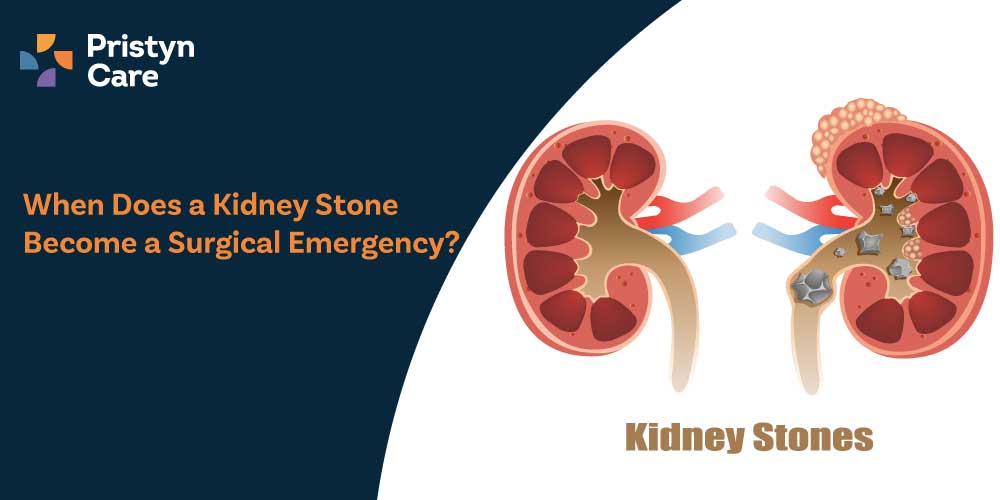
A kidney stone is a hard deposit of minerals and salts that forms in the urinary tract. It may:
- Stay in the kidney
- Move into the ureter (tube connecting kidney to bladder)
- Block urine flow
No Cost EMI, Hassle-free Insurance Approval
When Is a Kidney Stone Not an Emergency?
- Small stones (usually <5 mm)
- Mild, manageable pain
- No signs of infection or blockage
These cases are often treated conservatively.
When Does It Become a Surgical Emergency?
1. Severe, Uncontrolled Pain
- Intense pain not relieved by medications
- Persistent discomfort affecting daily function
2. Complete Urinary Obstruction
- Stone blocks urine flow completely
- Leads to swelling of the kidney (hydronephrosis)
3. Infection with Obstruction (Urosepsis Risk)
- Fever, chills, and severe pain
- Medical emergency requiring urgent drainage
This is one of the most critical situations.
4. Decreased or No Urine Output
- Indicates severe blockage
- Requires immediate intervention
5. Blood in Urine with Symptoms
- Significant bleeding along with pain or obstruction
6. Kidney Function Impairment
- Elevated creatinine levels
- Risk of permanent kidney damage
7. Stones in a Single Functional Kidney
- Immediate risk if blockage occurs
- Urgent treatment required
Emergency Treatment Options
1. Urgent Decompression
- Placement of a stent or nephrostomy tube
- Relieves pressure and drains urine
2. Definitive Stone Removal
- Performed after stabilization
- Methods include:
- Ureteroscopy (laser stone removal)
- PCNL (for large stones)
 Doctor available
4.5/5

29 Years Experience Overall
Doctor available
4.5/5
19 Years Experience Overall
Doctor available
4.5/5
15 Years Experience Overall
Doctor available
4.5/5
12 Years Experience Overall
Doctor available
4.5/5
12 Years Experience Overall
Doctor available
5.0/5
25 Years Experience Overall
%20(4)%20(1).jpg/1682933853454_ban-Icon.png) Doctor available
Doctor available.jpeg/1777541472938_ban-Icon.png)
4.8/5
17 Years Experience Overall
Doctor available
4.5/5
18 Years Experience Overall
Doctor available
4.8/5
16 Years Experience Overall
Doctor available
4.8/5
15 Years Experience Overall
Doctor available
MBBS, MS - General Surgery, MCh - Urology/Genito-Urinary Surgery
₹1200₹600Consultation Fee
5.0/5
15 Years Experience Overall
Doctor available
5.0/5
14 Years Experience Overall
Doctor available
5.0/5
14 Years Experience Overall
Doctor available
4.5/5
14 Years Experience Overall
Doctor available
4.5/5
13 Years Experience Overall
Doctor available
4.5/5
13 Years Experience Overall
Doctor available
4.5/5
12 Years Experience Overall
Doctor available
4.5/5
11 Years Experience Overall
Why Timely Treatment Matters
Delaying treatment can lead to:
- Severe infection (sepsis)
- Permanent kidney damage
- Life-threatening complications
Warning Signs You Should Never Ignore
- High fever with chills
- Severe, persistent flank pain
- Nausea and vomiting
- Difficulty or inability to urinate
- Reduced urine output

Free Kidney Stones Surgery Cost Calculator

Our care coordinator will call you shortly.
Recovery After Emergency Treatment
- Hospitalization may be required
- Pain relief and antibiotics (if infection present)
- Follow-up for complete stone removal


Final Thoughts
A kidney stone becomes a surgical emergency when it causes obstruction, infection, or severe uncontrolled symptoms. Early recognition of warning signs and prompt medical care are essential to prevent complications.
If you experience severe pain, fever, or difficulty urinating, seek immediate medical attention—timely intervention can protect your kidney function and overall health.
Social share:





- Kidney Stones Treatment in Hyderabad
- Kidney Stones Treatment in Ghaziabad
- Kidney Stones Treatment in Bangalore
- Kidney Stones Treatment in Pune
- Kidney Stones Treatment in Mumbai
- Kidney Stones Treatment in Chennai
- Kidney Stones Treatment in Noida
- Kidney Stones Treatment in Delhi
- Kidney Stones Treatment in Faridabad
Related Calculators

Dedicated Support at Every Step!
Our Doctors are available 24 hours a day, 7 days a week to help you!
Related Calculators
Get In Touch with our expert doctors !
- please enter 10 digit number.


