Delhi

Calculate your pregnancy due date and explore personalized weekly milestones throughout your pregnancy journey.


Comprehensive tools, expert guidance, and personalized support to help you through every stage of your pregnancy journey.

Calculate your pregnancy due date accurately using multiple methods, including last menstrual period (LMP), conception date, IVF transfer, or ultrasound details.

Access comprehensive pregnancy guides, trimester-by-trimester information, and expert-written articles to understand baby development and maternal health.

Book online consultations with certified OB-GYNs and pregnancy specialists for trusted medical advice and personalized care.

Get answers to your pregnancy-related questions anytime with round-the-clock helpline and chat support from healthcare professionals.

Receive personalized meal plans, exercise routines, and wellness advice tailored to your pregnancy stage and nutritional needs.

Join live webinars and workshops covering pregnancy care, childbirth preparation, postpartum recovery, and newborn parenting basics.
Your due date, also known as the estimated due date (EDD), is the approximate date when your baby is expected to be born. Knowing your pregnancy due date helps you plan antenatal visits, prepare for delivery, and understand your pregnancy timeline better.
However, it’s important to remember that the due date is only an estimate, not a guaranteed delivery date. Every pregnancy is different, and only around 4% of babies are born exactly on their estimated due date, with most arriving a little earlier or later.
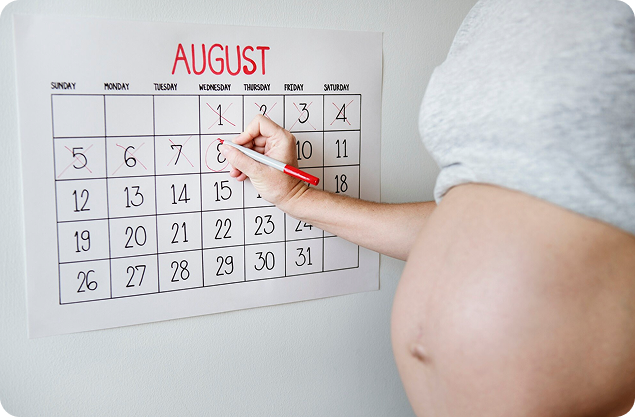
Most pregnancies last about 40 weeks, which is why doctors usually calculate the due date by counting 280 days from the first day of your last menstrual period (LMP). This method is widely used and helps estimate your expected delivery date accurately.
Standard Formula: Due Date = First day of LMP + 280 days
Another commonly used approach is Naegele’s Rule, where you subtract three months from the first day of your last period and then add seven days.
Naegele’s Rule Formula: Due Date = LMP − 3 months + 7 days
You can simply select Last Period in our Pregnancy Due Date Calculator to get your estimated due date. This is the same method most healthcare providers use during early pregnancy.


Speak to a Gynaecology specialist today.
You can try to plan your pregnancy by timing conception, but a due date is only an estimate. Using an ovulation calculator can help identify fertile days, though the exact delivery date cannot be predicted.
Yes, due dates can change as pregnancy progresses based on ultrasounds and growth measurements. This is common, and your doctor will explain any adjustments during checkups.
If you're expecting twins or multiple babies, your estimated due date may be different from a singleton pregnancy. Multiple pregnancies often deliver earlier, and your doctor may adjust your due date based on ultrasound findings and medical monitoring.
Most women have their first pregnancy ultrasound between 6 and 8 weeks to confirm the pregnancy and check viability. A dating scan is commonly done between 8 and 12 weeks to estimate the due date more accurately.
Naegele's Rule is a standard method used to calculate the estimated due date. It works by adding 7 days to the first day of your last menstrual period (LMP) and then adding 9 months.
Yes. If your menstrual cycle is shorter or longer than the average 28 days, your due date may vary. Due date calculators that consider your cycle length can provide a more accurate estimated delivery date.
Yes. The pregnancy tracker is designed to support you throughout all three trimesters, providing week-by-week updates, development milestones, and helpful pregnancy insights.
Yes. You can share your pregnancy details and calculated due date with your doctor or healthcare provider to help guide prenatal care and medical consultations.
Yes. Your personal and pregnancy-related information is kept secure and confidential. Data protection measures are in place to ensure privacy and safeguard your health information.