

Select City


Call Us
Book Appointment
ACDF Surgery (Anterior Cervical Discectomy and Fusion) is a commonly performed cervical spine surgery used to treat neck pain, arm pain, numbness, weakness, and neurological symptoms caused by a cervical herniated disc, cervical spinal stenosis, degenerative disc disease, or cervical radiculopathy. During the procedure, the damaged cervical disc is removed to relieve pressure on the spinal cord or nerves, and the affected vertebrae are fused to stabilize the spine. ACDF surgery has a high success rate, with most patients experiencing significant relief from symptoms and improved quality of life.
ACDF Surgery (Anterior Cervical Discectomy and Fusion) is a commonly performed cervical spine ...surgery used to treat neck pain, arm pain, numbness, weakness, and neurological symptoms caused by a cervical herniated disc, cervical spinal stenosis, degenerative disc disease, or cervical radiculopathy. During the procedure, the damaged cervical disc is removed to relieve pressure on the spinal cord or nerves, and the affected vertebrae are fused to stabilize the spine. ACDF surgery has a high success rate, with most patients experiencing significant relief from symptoms and improved quality of life.Read More




3M+
Happy Patients
50+
Disease
200+
Hospitals
30+
Cities

Free Cab Facility

No-Cost EMI

Support in Insurance Claim

1-day Hospitalization

USFDA-Approved Procedure
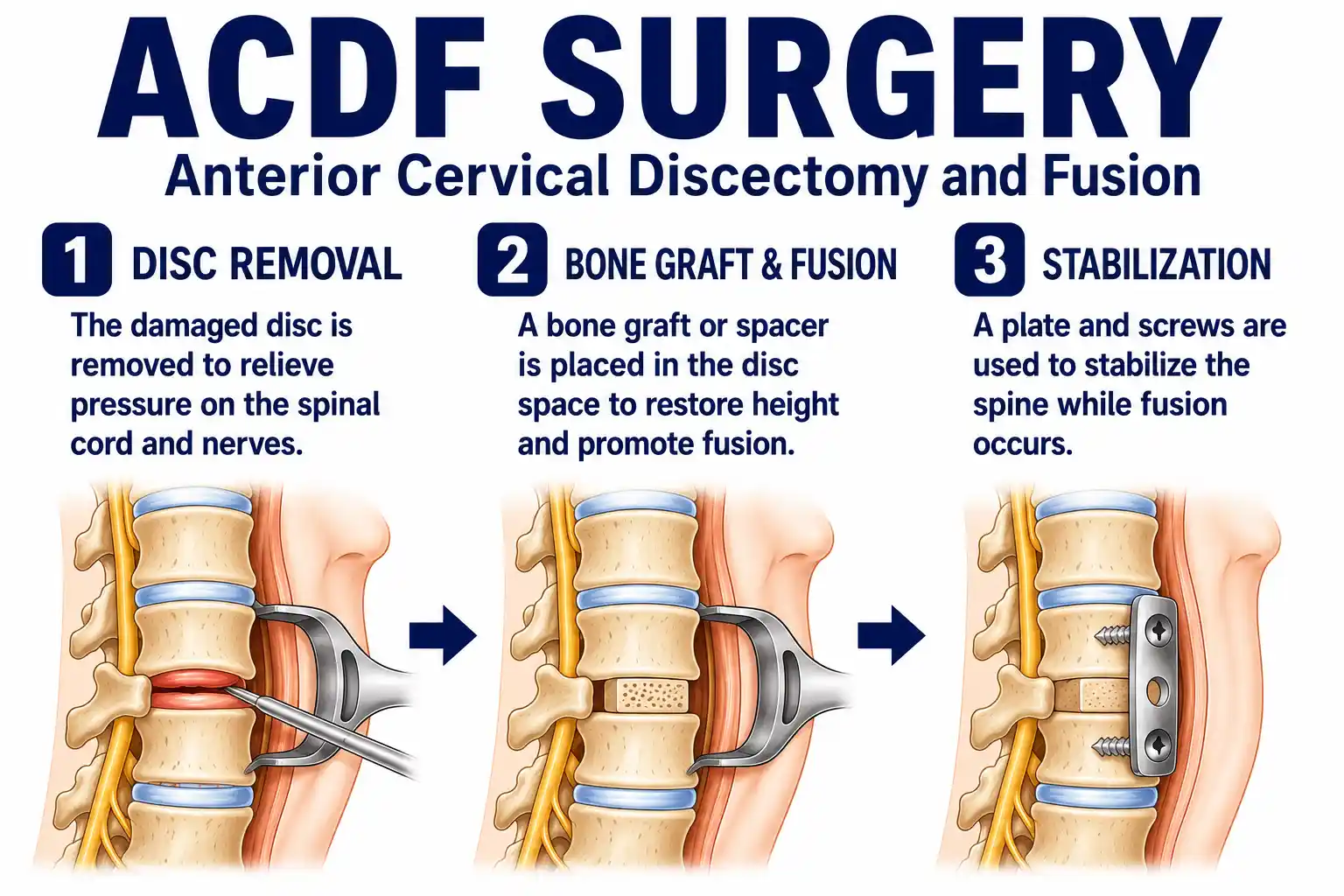
Anterior Cervical Discectomy and Fusion (ACDF) is a surgical procedure performed through the front of the neck to remove a damaged cervical disc and fuse adjacent vertebrae.
The surgery is designed to:
ACDF is considered one of the most effective treatments for cervical disc disorders when conservative treatments fail.
Free ACDF Surgery Cost Calculator
Fill details to get actual cost
Cervical Herniated Disc
A herniated cervical disc occurs when the soft inner portion of a spinal disc protrudes and compresses nearby nerves, causing pain, numbness, and weakness.
Cervical Spinal Stenosis
Spinal stenosis refers to narrowing of the spinal canal, which may compress the spinal cord or nerve roots.
Degenerative Disc Disease
Age-related wear and tear can cause cervical discs to lose hydration and height, leading to chronic neck pain and nerve compression.
Cervical Radiculopathy
This condition occurs when cervical nerve roots become compressed, causing pain, tingling, numbness, or weakness radiating into the shoulder, arm, or hand.
Bone Spurs (Cervical Osteophytes)
Bone spurs can develop due to arthritis and contribute to nerve compression and spinal stenosis.
You may be a candidate for ACDF surgery if you have:
When Is Surgery Recommended?
ACDF surgery is usually considered when symptoms continue for several weeks or months despite:
Single-Level ACDF Surgery
A single damaged cervical disc is removed and the adjacent vertebrae are fused.
This is the most commonly performed ACDF procedure.
Multi-Level ACDF Surgery
Two or more damaged cervical discs are removed and multiple vertebral levels are fused.
Multi level ACDF is often required in patients with extensive cervical degeneration or spinal stenosis.

Diet & Lifestyle Consultation

Post-Surgery Follow-Up

Free Cab Facility

24*7 Patient Support
Preoperative Evaluation
Before surgery, the spine surgeon may recommend:
Surgical Procedure
Step 1: Anterior Neck Incision
A small incision is made on the front of the neck.
Step 2: Removal of Damaged Disc
The affected cervical disc is carefully removed to decompress the spinal cord and nerve roots.
Step 3: Nerve and Spinal Cord Decompression
Bone spurs and other compressive structures are removed.
Step 4: Cervical Fusion
A bone graft or cage is placed in the empty disc space.
Step 5: Stabilization
A small titanium plate and screws may be used to improve stability and facilitate fusion.
Step 6: Closure
The incision is closed and dressed appropriately.
| Feature | ACDF Surgery | Cervical Disc Replacement |
|---|---|---|
| Removes damaged disc | Yes | Yes |
| Preserves motion | No | Yes |
| Requires fusion | Yes | No |
| Suitable for severe degeneration | Yes | Limited cases |
| Long-term track record | Excellent | Good |
| Multi-level treatment | Common | Select cases |
The best option depends on age, spinal stability, disc degeneration, and surgeon assessment.
Effective Pain Relief
Most patients experience substantial improvement in neck and arm pain.
Improved Neurological Function
Relief of nerve compression often improves strength, sensation, and mobility.
Spinal Stability
Fusion eliminates abnormal movement between vertebrae.
High Success Rate
ACDF surgery consistently demonstrates excellent clinical outcomes.
Improved Quality of Life
Many patients return to work, exercise, and normal daily activities after recovery.
The success rate of ACDF surgery generally ranges between 85% and 95%.
Factors affecting outcomes include:
Patients undergoing surgery for arm pain and nerve compression often report the highest satisfaction rates.
Recovery varies between individuals, but most patients follow a similar timeline.
First Week
Weeks 2-6
Months 2-3
Months 3-12
Most patients return to a normal and active lifestyle after successful recovery.
Benefits often include:
Maintaining good posture, spinal health, and regular exercise can help preserve long-term results.
Before surgery, patients should:
Proper preparation may improve surgical outcomes and recovery.
Although ACDF is considered safe, every surgery carries potential risks.
Common Risks
Rare Complications
Choosing an experienced spine surgeon can help minimize complications.
The ACDF surgery cost in India depends on several factors, including:
On average, ACDF surgery cost in India may range between ₹2.5 lakhs and ₹6 lakhs or more, depending on the complexity of the procedure.
Yes, ACDF surgery is generally covered by health insurance when it is medically necessary.
Insurance approval may require:
Patients should consult their insurance provider to understand policy specific coverage, exclusions, waiting periods, and claim procedures.
Successful outcomes depend heavily on:
An experienced spine surgeon can help determine whether ACDF surgery or cervical disc replacement is the most appropriate treatment option.
ACDF stands for Anterior Cervical Discectomy and Fusion, a procedure that removes a damaged cervical disc and fuses adjacent vertebrae to relieve nerve compression and stabilize the spine.
Patients with cervical herniated discs, cervical spinal stenosis, degenerative disc disease, or cervical radiculopathy that does not improve with conservative treatment may require ACDF surgery.
The success rate is generally between 85% and 95%, particularly for relieving arm pain caused by nerve compression.
Most patients recover sufficiently for daily activities within 4 to 8 weeks, while complete fusion may take several months.
Potential risks include infection, bleeding, nerve injury, swallowing difficulties, non-union of the fusion, and adjacent segment degeneration.
In most cases, ACDF surgery is covered by health insurance when deemed medically necessary by the treating surgeon.
Single-level ACDF treats one cervical disc, while multi-level ACDF addresses two or more damaged cervical discs.
Both procedures are effective. The choice depends on spinal stability, age, disc degeneration, and overall suitability determined by the surgeon.
Yes. ACDF surgery is specifically designed to relieve neck pain, arm pain, numbness, tingling, and weakness caused by cervical nerve compression.
The cost typically ranges from ₹2.5 lakhs to ₹6 lakhs or more, depending on the hospital, surgeon, implants used, and complexity of the surgery.

Avail FREE Doctor Consultation

Consult with our expert surgeon for more than 50+ diseases

Once you share your details, our care coordinator will get in touch with you.

The coordinator will understand your symptoms and health condition in detail.

Your consultation will be scheduled at the earliest.
3M +
Happy Patients
150 +
Clinics
30 +
Cities

120Cr—Patient Savings Delivered
so patients focus on recovery, not bills.

Complete Transparency
No hidden charges or surprise bills

End-to-End Insurance Handling
Complete insurance processing support

Up to 20% Savings on Every Surgery
powered by smarter insurance handling

Easy EMI Options
Flexible payment plans available
120Cr—Patient Savings Delivered
so patients focus on recovery, not bills.
Complete Transparency
No hidden charges or surprise bills
Your Form Has Been Submitted Successfully.
Our care coordinator will call you shortly.

Book Your FREE Consultation
Consult with our expert surgeon for more than 50+ diseases
Once you share your details, our care coordinator will get in touch with you.
The coordinator will understand your symptoms and health condition in detail.
Your consultation will be scheduled at the earliest.
3M +
Happy Patients
150 +
Clinics
30 +
Cities