Select City

Call Us
Book FREE Appointment
Get safe and advanced gynecomastia surgery at Pristyn Care. Our expert Plastic surgeons offer advanced procedures like chest fat removal and male breast reduction surgery to help men achieve a flatter, more defined chest. Book a Discounted consultation today.
Get safe and advanced gynecomastia surgery at Pristyn Care. Our expert Plastic surgeons ... offer advanced procedures like chest fat removal and male breast reduction surgery to help men achieve a flatter, more defined chest. Book a Discounted consultation today. Read More




3M+
Happy Patients
50+
Disease
200+
Hospitals
30+
Cities

Free Cab Facility

No-Cost EMI

Support in Insurance Claim

1-day Hospitalization

USFDA-Approved Procedure
Choose Your City
It help us to find the best doctors near you.

Bangalore
Chennai
Coimbatore
Delhi
Hyderabad
Indore
Kochi
Kolkata
Mumbai
Pune
Vijayawada
Delhi
Hyderabad
Pune
Mumbai
Bangalore
 Doctor Not Found
4.5/5
36+ Years Experience
 Pristyn Care Diyos Hospital, Safdarjung Enclave, Delhi
4.5/5
15+ Years Experience
Pristyn Care Zoi Hospital, ShivBagh, Ameerpet, Hyd
4.5/5
15+ Years Experience
Pristyn Care Diyos Hospital, Safdarjung Enclave, Delhi
4.5/5
13+ Years Experience
Manorama Ganj, Old Palasia, Indore, Madhya Pradesh 452003
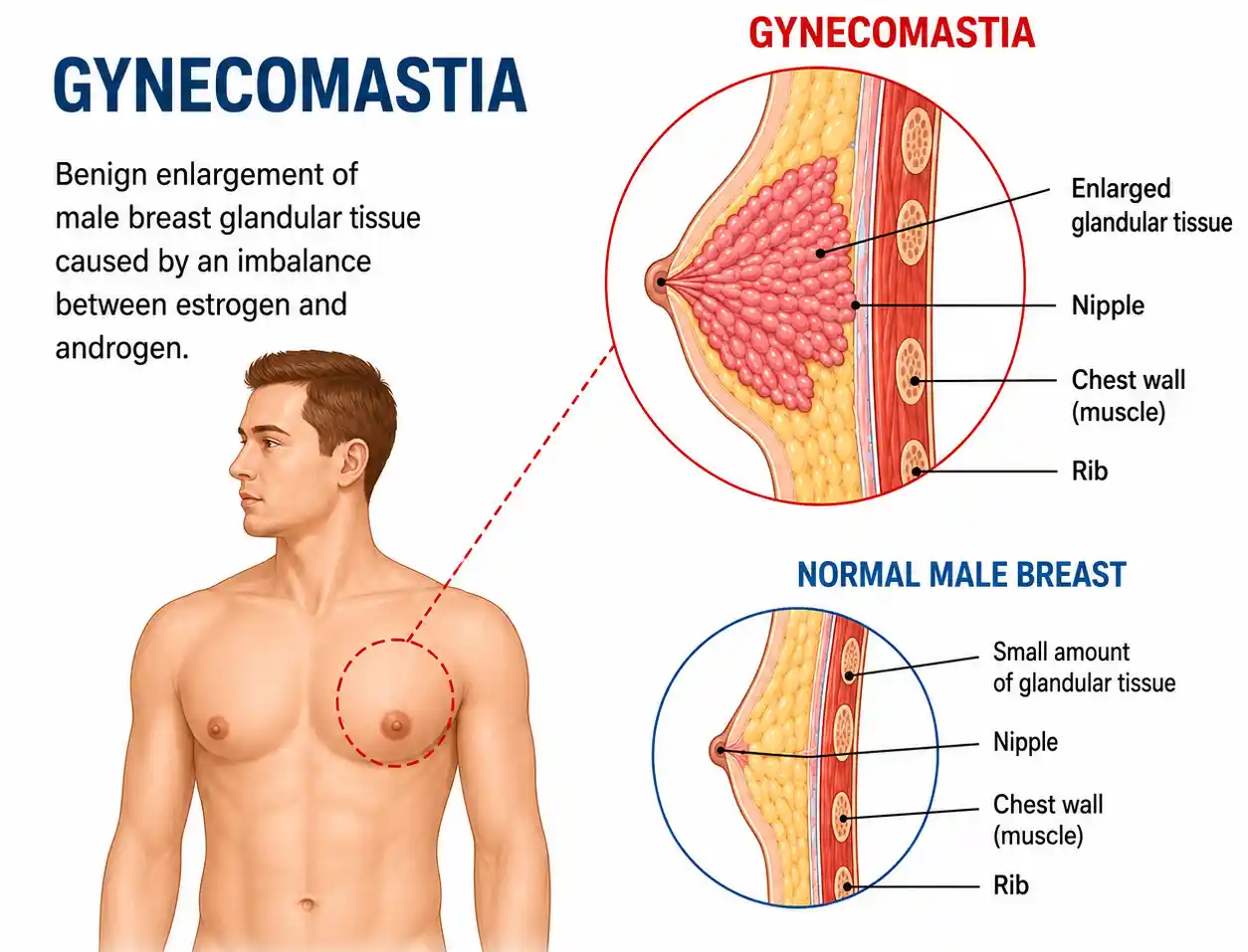
Gynecomastia is a condition in males characterized by the abnormal enlargement of breast tissue due to a hormonal imbalance between estrogen and testosterone.
It can affect one or both breasts and may occur at any age, from newborns to older men. Common causes include puberty, obesity, certain medications, and underlying health conditions like liver or kidney disease.
While it is usually harmless, treatment options such as medication or surgery are available for those experiencing discomfort or emotional distress.
Disease name
Surgery name
Duration
Treated by
Free Gynecomastia Surgery Cost Calculator
Fill details to get actual cost
Medical treatment is considered for stage 1 gynecomastia. Especially when caused by hormonal imbalance or certain medications. This option is generally used for temporary or mild cases.
Hormonal therapy may be recommended to balance oestrogen and testosterone levels. In rare cases, medications such as tamoxifen or raloxifene are prescribed.
There is no permanent non-surgical solution for moderate or advanced gynecomastia. However, mild cases may improve with certain non-surgical methods, such as:
Non-surgical treatments like supplements or creams are not scientifically proven to offer reliable results. Pristyn Care does not recommend such unverified methods for gynecomastia removal.
Enlarged breasts may not resolve on their own, even after trying medication. Consider surgery if you feel self-conscious about your appearance or experience discomfort.
At Pristyn Care, we offer two main surgical treatments for gynecomastia:
Your surgeon will assess your condition to recommend the most suitable approach or combination of treatments. Both surgeries are performed under expert care to ensure safety, effectiveness, and a natural chest contour.
| Grade | What It Looks Like | Treatment Approach |
| Grade 1 (Mild) | A small, button-like swelling under the nipple with no loose skin. Often seen in teenagers during puberty and usually not noticeable under clothes. | Most cases at this stage don’t need any treatment and may go away on their own. If needed, simple lifestyle changes or hormone-balancing medications may help. Medicines are used only when absolutely necessary and under expert guidance. |
| Grade 2 (Moderate, No Skin Sagging) | The breast area looks fuller and spreads across the chest, but the skin is still firm without any sagging. It can be more noticeable, especially when shirtless. | If it’s due to fat, weight loss or liposuction might help. But if there’s glandular tissue involved, a minor surgery may be advised. Sometimes, medication may be considered if hormones are the cause. |
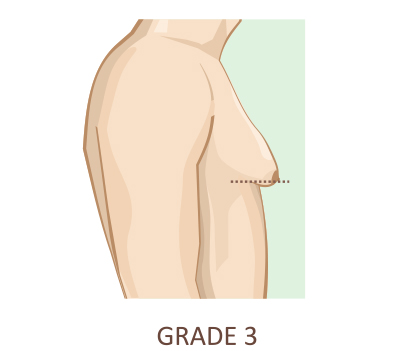
| Grade 3 (Moderate with Loose Skin) | The breasts appear more developed with visible sagging. It’s firmer and often shows through clothing, causing emotional distress. | Surgery is usually the best option here. Most patients need a mix of liposuction to remove fat and excision surgery to remove the gland. This gives a flatter, more natural chest shape. |
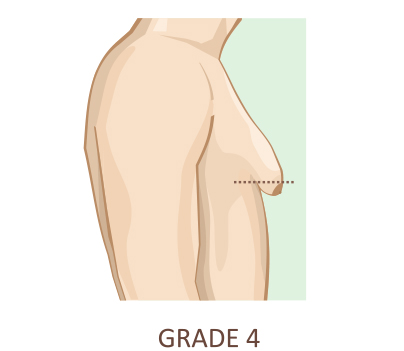
| Grade 4 (Severe with Significant Sagging) | The chest looks very enlarged and saggy, much like female breasts. It can cause back discomfort and affect posture. | At this stage, surgery is the most effective choice. It typically involves removing both fat and glandular tissue, along with tightening the skin to reshape the chest. This helps restore confidence and comfort. |
Consult a plastic or cosmetic surgeon experienced in male gynecomastia for the diagnosis. The doctor will perform a physical examination, with the patient lying on their back, to carefully assess the chest.
The examination includes:
Note: Pristyn Care does not recommend imaging tests for diagnosing gynecomastia. These include X-rays, CT scans, MRI, and mammograms. If necessary, the doctor may advise these tests for further evaluation.

 The patient arrives at the hospital at the scheduled time.
Registration and admission formalities are completed.
Vital signs such as blood pressure, pulse, temperature, and oxygen levels are checked.
The surgical team reviews the patient's reports and prepares for surgery.
The patient arrives at the hospital at the scheduled time.
Registration and admission formalities are completed.
Vital signs such as blood pressure, pulse, temperature, and oxygen levels are checked.
The surgical team reviews the patient's reports and prepares for surgery.
 The plastic surgeon examines the chest and marks the treatment area.
The anesthetist performs a final pre-anesthesia evaluation.
Consent forms are signed after discussing the procedure and expected outcomes.
The surgical area is cleaned and prepared.
An IV line is started for fluids and medications.
The plastic surgeon examines the chest and marks the treatment area.
The anesthetist performs a final pre-anesthesia evaluation.
Consent forms are signed after discussing the procedure and expected outcomes.
The surgical area is cleaned and prepared.
An IV line is started for fluids and medications.
 The patient is taken to the operation theatre.
General anesthesia or local anesthesia with sedation is administered, depending on the extent of the surgery.
The patient becomes pain-free and comfortable before the procedure begins.
The patient is taken to the operation theatre.
General anesthesia or local anesthesia with sedation is administered, depending on the extent of the surgery.
The patient becomes pain-free and comfortable before the procedure begins.
 Small incisions are made in inconspicuous areas around the chest, usually near the edge of the areola.
Liposuction is performed to remove excess fatty tissue, if required.
Excess glandular breast tissue is carefully excised to create a flatter chest contour.
Excess skin may be removed in cases of significant breast enlargement.
The incisions are closed with dissolvable or fine sutures.
A compression garment is applied to minimize swelling and support healing.
Small incisions are made in inconspicuous areas around the chest, usually near the edge of the areola.
Liposuction is performed to remove excess fatty tissue, if required.
Excess glandular breast tissue is carefully excised to create a flatter chest contour.
Excess skin may be removed in cases of significant breast enlargement.
The incisions are closed with dissolvable or fine sutures.
A compression garment is applied to minimize swelling and support healing.
 The patient is shifted to the recovery room for monitoring.
Nurses monitor blood pressure, pulse, oxygen levels, and pain levels.
The surgical dressings and compression garment are checked before discharge.
Once fully awake and medically stable, the patient is prepared for discharge.
The patient is shifted to the recovery room for monitoring.
Nurses monitor blood pressure, pulse, oxygen levels, and pain levels.
The surgical dressings and compression garment are checked before discharge.
Once fully awake and medically stable, the patient is prepared for discharge.
 Most patients return home on the same day after surgery.
Pain relief medicines and antibiotics (if prescribed) are provided.
The patient is advised to wear the compression garment as instructed by the surgeon.
Detailed post-operative instructions regarding wound care, activity restrictions, and follow-up visits are explained.
Most patients can resume light daily activities within a few days, while strenuous exercise should be avoided until cleared by the surgeon.
Most patients return home on the same day after surgery.
Pain relief medicines and antibiotics (if prescribed) are provided.
The patient is advised to wear the compression garment as instructed by the surgeon.
Detailed post-operative instructions regarding wound care, activity restrictions, and follow-up visits are explained.
Most patients can resume light daily activities within a few days, while strenuous exercise should be avoided until cleared by the surgeon.
Here are the key benefits of choosing gynecomastia surgery to treat enlarged male breasts:

Diet & Lifestyle Consultation

Post-Surgery Recovery Follow up

Free Cab Facility

24*7 Patient Support
Following a gynecomastia operation, proper post-procedure care is important for proper healing. Here is what patients can expect after male breast surgery:
Additional Recovery Tips
Exercise may help with chest fat removal in pseudo gynecomastia, but true male gynecomastia caused by glandular tissue often requires a gynecomastia operation for visible results.
You should consult a qualified gynecomastia doctor or plastic surgeon experienced in male breast plastic surgery and mammaplasty.
Yes, gynecomastia surgery is safe and performed by skilled surgeons using advanced, minimally invasive techniques.
Yes, stage 1 gynecomastia in teens is often hormonal and may resolve on its own, while adult cases may require gyno removal through surgery.
While rare, it can recur due to hormonal imbalance, medication side effects, or weight gain. Following medical advice helps prevent recurrence after gynecomastia removal.
Male gynecomastia surgery is generally recommended after puberty, typically after age 18, once hormone levels have stabilised.
Most patients resume daily activities within a few days. Complete recovery after men’s chest reduction usually takes 4-6 weeks.
You can return to light activity in a few days but avoid intense workouts and upper-body exercises for at least 4 weeks after gynecomastia treatment.
The cost of gynecomastia operation in India ranges from ₹36,000 to ₹85,000, depending on the gynecomastia stages and the technique used.
Most insurance plans do not cover plastic surgery gynecomastia, as it is usually considered cosmetic. However, we help patients with documentation if medically justified.

.jpg/1752216854459_ban-Icon.png)

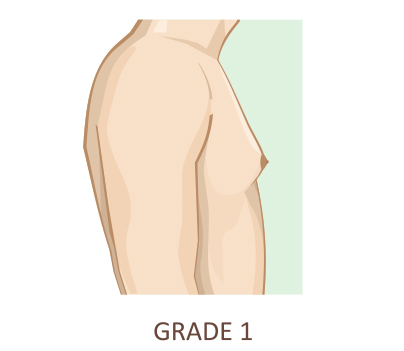
Grade I
This grade has only a minor level of enlargement in the breasts. A localized button of tissue starts to grow around the areola. The chest will only be slightly swollen, and it won’t be noticeable when you are wearing clothes. Thus, treatment is usually not required at this grade.
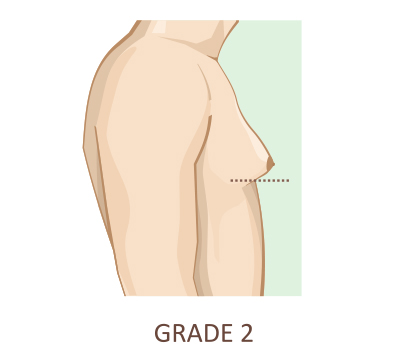
Grade II
At this grade, the male breast tissues expand to the width of the chest. The pectoral muscles are almost completely covered with the breast tissues, but the edges are still less prominent. At this grade, the doctors prescribe a diet to reduce the estrogen levels in the body. Surgery can also be done if the patient feels concerned.
Grade III
It is a moderate stage of breast development at which the breast tissues become completely visible through clothes. The excess skin continues to grow and become more prominent. The breasts also have more firmness at this stage. The patient can opt for surgical treatment at this stage too.
Grade IV
At this grade, the development of breasts is almost complete. It is the most severe stage as there is a large amount of excess skin. At this stage, the condition becomes a major.
 DS
DS
Dev Singh

 Recommends
Recommends
Very good experience with the doctor 👌 👍🏻 👍🏻Very good doctor....he didi surgery of my son ...it was very well done five star to dr prateek
.svg) GG
GG
Gaurav Gulechha
Recommends
Recommends
He was approachable, patient, and had a positive attitude throughout the visit. He explained my condition and the procedure clearly, making it easy to understand and helping me feel comfortable. He answered all my questions without rushing. Overall, it was a great experience, and I would definitely recommend him to anyone facing a similar health issue.
.svg) AP
AP
Adarsh Paramanick
Recommends
Recommends
Dr. Vinay Nandlal Baretha is just an amazing doctor, highly experienced, well and very good behavior and amazing experience with him. Very satisfied.
RP
Rishab pandey
Recommends
Recommends
His behaviour is very good
SU
Sumit
Recommends
Recommends
Thanks pristyncare
KJ
Koushik jana
Recommends
Recommends
Dr. Binoy Nandalal Baretha is an excellent plastic surgeon. He performed my Grade 2 gynecomastia surgery, and I got great results. I am very happy with the outcome. If anyone else is facing this issue, you can definitely consult Dr. Binoy sir.
.svg)
Avail FREE Doctor Consultation

Consult with our expert surgeon for more than 50+ diseases

Once you share your details, our care coordinator will get in touch with you.

The coordinator will understand your symptoms and health condition in detail.

Your consultation will be scheduled at the earliest.
3M +
Happy Patients
150 +
Clinics
30 +
Cities

120Cr—Patient Savings Delivered
so patients focus on recovery, not bills.

Complete Transparency
No hidden charges or surprise bills

End-to-End Insurance Handling
Complete insurance processing support

Up to 20% Savings on Every Surgery
powered by smarter insurance handling

Easy EMI Options
Flexible payment plans available
120Cr—Patient Savings Delivered
so patients focus on recovery, not bills.
Complete Transparency
No hidden charges or surprise bills
Your Form Has Been Submitted Successfully.
Our care coordinator will call you shortly.


Book Your FREE Consultation
Consult with our expert surgeon for more than 50+ diseases
Once you share your details, our care coordinator will get in touch with you.
The coordinator will understand your symptoms and health condition in detail.
Your consultation will be scheduled at the earliest.
3M +
Happy Patients
150 +
Clinics
30 +
Cities