Select City

Stapedectomy surgery is the best treatment for hearing loss due to otosclerosis, abnormal hardening of the middle ear bones. Consult expert ENT specialists at Pristyn Care for advanced treatment of otosclerosis via advanced stapedectomy surgery and prevent complete hearing loss.
Stapedectomy surgery is the best treatment for hearing loss due to otosclerosis, abnormal ... Read More




Free Cab Facility

No-Cost EMI

Support in Insurance Claim

1-day Hospitalization

USFDA-Approved Procedure
Choose Your City
It help us to find the best doctors near you.

Bangalore
Delhi
Hyderabad
Kochi
Mumbai
Pune
Delhi
Hyderabad
Pune
Mumbai
Bangalore
 Pristyn Care La Midas, Main, Nathupur Rd, nr. 38, DLF Phase 3, Sector 24, Gurugram, Haryana 122002
First Floor, B- 1-6 Dev Corpora, Eastern Express Hwy, Khopat, Thane West, Thane, Maharashtra 400601
3B/79, Ekta Recidency, Pipeline road, near Hanuman mandir, Oppo. Noble medical, Chembur (w), Tilak Nagar, Mumbai, Maharashtra - 400089.
Pristyn Care La Midas, Main, Nathupur Rd, nr. 38, DLF Phase 3, Sector 24, Gurugram, Haryana 122002
First Floor, B- 1-6 Dev Corpora, Eastern Express Hwy, Khopat, Thane West, Thane, Maharashtra 400601
3B/79, Ekta Recidency, Pipeline road, near Hanuman mandir, Oppo. Noble medical, Chembur (w), Tilak Nagar, Mumbai, Maharashtra - 400089.
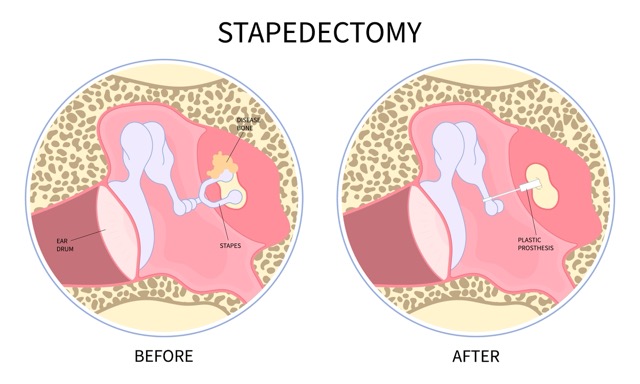
Stapedectomy surgery is a minimally invasive surgery performed if the patient has hearing loss due to sclerosis or damage of the tiny U-shaped stapes (stirrup bone) in the middle ear. The surgery involves complete removal of the stapes and insertion of a prosthesis to emulate the motion of a functional stapes bone and restore the patient’s hearing.
It is most commonly performed due to otosclerosis, a disorder in which the stapes bone gets fixed due to abnormal bone tissue formation around the stapes. This prevents the bone from vibrating – and amplifying the sound waves – leading to a decrease in the hearing ability in one or both ears.
Since hearing loss due to otosclerosis is very slow and gradual, most patients don’t notice it or get any treatment till the condition has gotten worse, which can complicate the treatment. If you have any hearing problems, get in touch with an ENT specialist immediately.
Disease name
Surgery name
Duration
Treated by
Free Eardrum Surgery Cost Calculator
Fill details to get actual cost
Pristyn Care is the best treatment center for advanced USFDA-approved minimally invasive surgeries for a variety of ENT problems, including stapedectomy. It is one of the largest and finest surgery providers in India.
Pristyn Care has expert ENT specialists with plenty of expertise and experience in dealing with ear problems conventionally and surgically. Moreover, it is partnered with the best ENT clinics and clinics in most major Indian cities for advanced treatment.
Pristyn Care also provides auxiliary services to all patients, including Discounted consultations, complimentary cab and meal services, and many more. Contact us and book a Discounted consultation with the top ENT doctors near you right away.
If you are experiencing any degree of hearing loss, you should undergo the following diagnostic tests to determine the cause of hearing problems and the appropriate treatment for it. The diagnostic procedure generally begins with a medical history and physical examination.
Otosclerosis is a hereditary disease and patients who have a family history are more likely to suffer from the condition. During physical examination, the ENT specialist will look in the ear canal using an endoscope to determine whether the patient’s symptoms are due to an infection, sclerosis, trauma, etc. If the patient has otosclerosis in both ears, the ear with worse hearing is operated first.
The ENT may suggest the following hearing tests to determine the severity of hearing loss in the patient:
Diagnostic tests also commonly required before a stapedectomy include imaging tests like CT scan, X-ray, etc., as they help the ENT to visualize the internal structures and learn about the extent of the sclerosis to finalize the best type of prosthesis for the patient.
Generally, for mild otosclerosis, most ENT doctors prefer a watchful waiting approach or hearing aids. While hearing aids can’t reverse the damage due to otosclerosis, they can aid the patient’s hearing ability before the progression of the disease.
If the patient has severe hearing loss, the doctor may recommend a stapedectomy surgery. In advanced modern surgeries, local anesthesia is preferred to perform the surgery, so it is an outpatient procedure and the patient can avoid anesthesia-related complications.
The ENT surgeon may use a laser or microscopic instrument to lift the tympanum and gain access to the middle ear. Then the required part of the stapes is removed and a prosthetic device is fitted in its place.
Finally, the ear canal is packed and bandaged to keep the eardrum and prosthetic in place and aid in the patient’s recovery post-surgery. Complete surgery may take around 90 minutes to 2 hours.

Diet & Lifestyle Consultation

Post-Surgery Recovery Follow up

Free Cab Facility

24*7 Patient Support
Before undergoing a stapedectomy, the patient should be completely aware of the pros and cons of the surgery. There is a very slight chance that the patient may have permanent sensorineural hearing loss after the surgery, so they should be prepared for that. Patients should also be advised properly regarding postoperative recovery so they can avoid complications.
Some general preparative measures the patient can take before the surgery are:
What Happens During Stapedectomy?
 Step 1 · 30-60 mins
Hospital Admission
 The patient arrives at the hospital or surgical center on the scheduled day of surgery.
Registration and admission formalities are completed.
Vital signs such as blood pressure, pulse, temperature, and oxygen levels are checked.
Hearing test results, CT scan (if required), blood tests, and other pre-operative investigations are reviewed.
The patient arrives at the hospital or surgical center on the scheduled day of surgery.
Registration and admission formalities are completed.
Vital signs such as blood pressure, pulse, temperature, and oxygen levels are checked.
Hearing test results, CT scan (if required), blood tests, and other pre-operative investigations are reviewed.
 Step 2 · 20–40 mins
Pre-surgery Preparation
The ENT surgeon reviews the patient's hearing loss, diagnosis of otosclerosis, and confirms the surgical plan.
The anesthetist performs a final pre-anesthesia assessment.
Consent forms are signed after discussing the procedure, expected benefits, recovery, and possible risks.
The ear is cleaned and prepared for surgery.
An IV line is started for fluids, antibiotics, and medications.
 Step 3 · 10–15 mins
Anesthesia Administration
The patient is taken to the operation theatre.
Local anesthesia with sedation or general anesthesia is administered, depending on the patient's condition and surgeon's preference.
The patient remains comfortable and pain-free throughout the procedure.
 Step 4 · 1-2 Hours
Stapedectomy Procedure Begins
The surgeon accesses the middle ear through the ear canal, avoiding external incisions.
The eardrum is gently lifted to expose the middle ear bones (ossicles).
The immobilized stapes bone is partially or completely removed.
A tiny prosthetic implant is positioned to replace the stapes and restore sound transmission to the inner ear.
The eardrum is carefully repositioned, and the ear canal is packed with a protective dressing to support healing.
 Step 5 · 1–2 Hours
Recovery Room Observation
The patient is shifted to the recovery room for monitoring.
Nurses monitor blood pressure, pulse, oxygen levels, hearing, balance, and pain control.
The patient is observed for dizziness, nausea, or bleeding before discharge.
 Step 6 · Same Day or Within 24 Hours
Discharge & Recovery
Most patients return home on the same day or within 24 hours after stapedectomy.
Pain relief medicines, antibiotics (if prescribed), and ear care instructions are provided.
The patient is advised to keep the ear dry, avoid forceful nose blowing, heavy lifting, flying, swimming, and strenuous activities until approved by the surgeon.
Follow-up appointments are scheduled to remove ear packing, assess healing, and perform hearing tests to evaluate improvement.
Patients should seek immediate medical attention if they experience severe dizziness, sudden hearing loss, persistent ear discharge, heavy bleeding, high fever, or severe ear pain after surgery.
As discussed above, most patients are suggested stapedectomy for treatment of otosclerosis, i.e., the fusion of stapes with the surrounding bone. Other indications of stapedectomy are:
Common symptoms for which stapedectomy may be necessary are:
Mild symptoms are usually managed conservatively, but in severe cases, the patients may need surgery for relief. In children, stapedectomy may be required for congenital stapedial fixation, or juvenile otosclerosis.
Patients with hearing loss due to otosclerosis can benefit from stapedectomy, as it can reverse the hearing loss, or enable them to use hearing aids. In children, stapedectomy is especially beneficial over conservative treatments as it prevents the long-term effects of pediatric hearing loss without impeding their activities or increasing the risk of future hearing loss.
There are some cases in which a stapedectomy is not recommended, such as:
Generally, it takes about 3-4 weeks for the patients to have noticeable improvement in hearing, so do not panic if there is no difference in hearing immediately after the surgery.
Most patients have mild pain or discomfort after the surgery for a few days. Normally, over-the-counter pain medications are enough to soothe the patient’s pain, but if the patient has severe pain, it may be a sign of postsurgical complications, and the patient should consult their doctor immediately.
Most patients are able to go home on the same day nowadays, and are suggested rest and very light activity for the first few days. Complete recovery can take upto 6 weeks, but most patients can return to daily life activities much before that.
There may be a little bloody discharge in the first couple of days, you can place small cotton balls in the ear to absorb it. If there is any sign of infection, your surgeon may advise antibiotic drops to avoid it.
Some patients may also have unsteadiness, numbness around the ear, and popping, clicking or pulsating sounds in the ear for the first few days.
After the surgery, patients have to avoid straining the ear canal so they must – not lift heavy weights, avoid staining while coughing or sneezing, and avoid inserting anything in the ear canal- till they have completely recovered.
Most patients can resume work and their daily life within 1 week, if they have a desk job or lead a sedentary lifestyle, but they have to wait at least 3-4 weeks before performing strenuous activities, heavy lifting, exercises, running, etc.
Some tips that you should follow to improve recovery after stapedectomy surgery are:
While 80-90% of people do not have any complications after the surgery, in rare cases, the patient may suffer from complications. Most stapedectomy complications disappear within a few days on their own or can be managed if diagnosed in time, but if not, they can result in severe hearing loss. Some potential complications of stapedectomy are:
Absence of improvement in hearing and additional loss of hearing are the most common signs of treatment failure. You should consult a doctor immediately if you exhibit the following symptoms:
The patient’s ears may be noise sensitive during the first few days, so they should avoid pubs, concerts, and other noisy areas. They should also avoid activities like swimming, contact sports, scuba diving, etc., till they have received approval from the doctor.
Yes, stapedectomy is generally covered under insurance as it is a medically necessary procedure. However, to be sure, you should check the terms of your policy or connect with your insurance provider.
During a stepdotomy, the surgeon uses a laser to make a precise hole in the stapes bone to insert an implant, and then replaces the immobile part of the stapes with a piston-like implant. Since the surgery does not entail the removal of the entire stapes bone, it provides better recovery, hearing ability, and lower risk of complications. Therefore, most surgeons nowadays prefer stapedotomy over stapedectomy.
Most people consider hearing aids better as they do not require surgery, however though hearing aids improve the hearing ability, they do not treat the underlying condition. Therefore they are not preferred for patients with progressive hearing problems.
Patients have to avoid submerging their ears under water for at least four to six weeks, so they can start swimming after that with doctor’s approval.
While sleeping, the patient should use 2-3 pillows to elevate the head while sleeping, or sleep in a reclining chair to keep the head elevated. This helps reduce postoperative swelling and aids recovery.
No, generally stapedectomy prosthetics are permanent and don’t need to be removed. However, if the patient needs a revision stapedectomy, the implant may be removed and replaced with another implant.



Rohit

 Recommends
Doctor was really supportive and staff was also helpful
Vikas Mehra, 41 Yrs
Recommends
My hearing was dull for years. After the stapedectomy at Pristyn Care, there's clear difference. The procedure went smooth and succesfull. Also want to thank Pristyn Sheetla Hispital staff, they kept good care of me.
.svg)








.svg)