Select City

Call Us
Book Appointment
A meniscus tear is one of the most common knee injuries, especially among athletes, active adults, and older individuals with age-related cartilage degeneration. The meniscus acts as a shock absorber between the thigh bone (femur) and shin bone (tibia), helping distribute body weight and stabilize the knee joint. When this cartilage tears, it can cause pain, swelling, locking of the knee, and difficulty walking. At Pristyn Care, our experienced orthopedic surgeons provide comprehensive diagnosis and advanced treatment for meniscus tears. Depending on the severity of the injury, treatment may include medications, physiotherapy, or minimally invasive arthroscopic meniscus surgery. Our goal is to relieve pain, preserve knee function, and help you return to your normal activities as quickly and safely as possible.
A meniscus tear is one of the most common knee injuries, especially among ...athletes, active adults, and older individuals with age-related cartilage degeneration. The meniscus acts as a shock absorber between the thigh bone (femur) and shin bone (tibia), helping distribute body weight and stabilize the knee joint. When this cartilage tears, it can cause pain, swelling, locking of the knee, and difficulty walking. At Pristyn Care, our experienced orthopedic surgeons provide comprehensive diagnosis and advanced treatment for meniscus tears. Depending on the severity of the injury, treatment may include medications, physiotherapy, or minimally invasive arthroscopic meniscus surgery. Our goal is to relieve pain, preserve knee function, and help you return to your normal activities as quickly and safely as possible.Read More




3M+
Happy Patients
50+
Disease
200+
Hospitals
30+
Cities

Free Cab Facility

No-Cost EMI

Support in Insurance Claim

1-day Hospitalization

USFDA-Approved Procedure
Choose Your City
It help us to find the best doctors near you.

Bangalore
Delhi
Hyderabad
Indore
Jaipur
Kochi
Mumbai
Pune
Delhi
Hyderabad
Pune
Mumbai
Bangalore
 Doctor Not Found
4.5/5
45 Years Experience
 Pristyn Care Elantis, Ring Road, Lajpat Nagar
4.5/5
41 Years Experience
Pristyn Care Diyos Hospital, Safdarjung Enclave, Delhi4.5/5
36 Years Experience
Manorama Ganj, Old Palasia, Indore, Madhya Pradesh 4520034.5/5
36 Years Experience
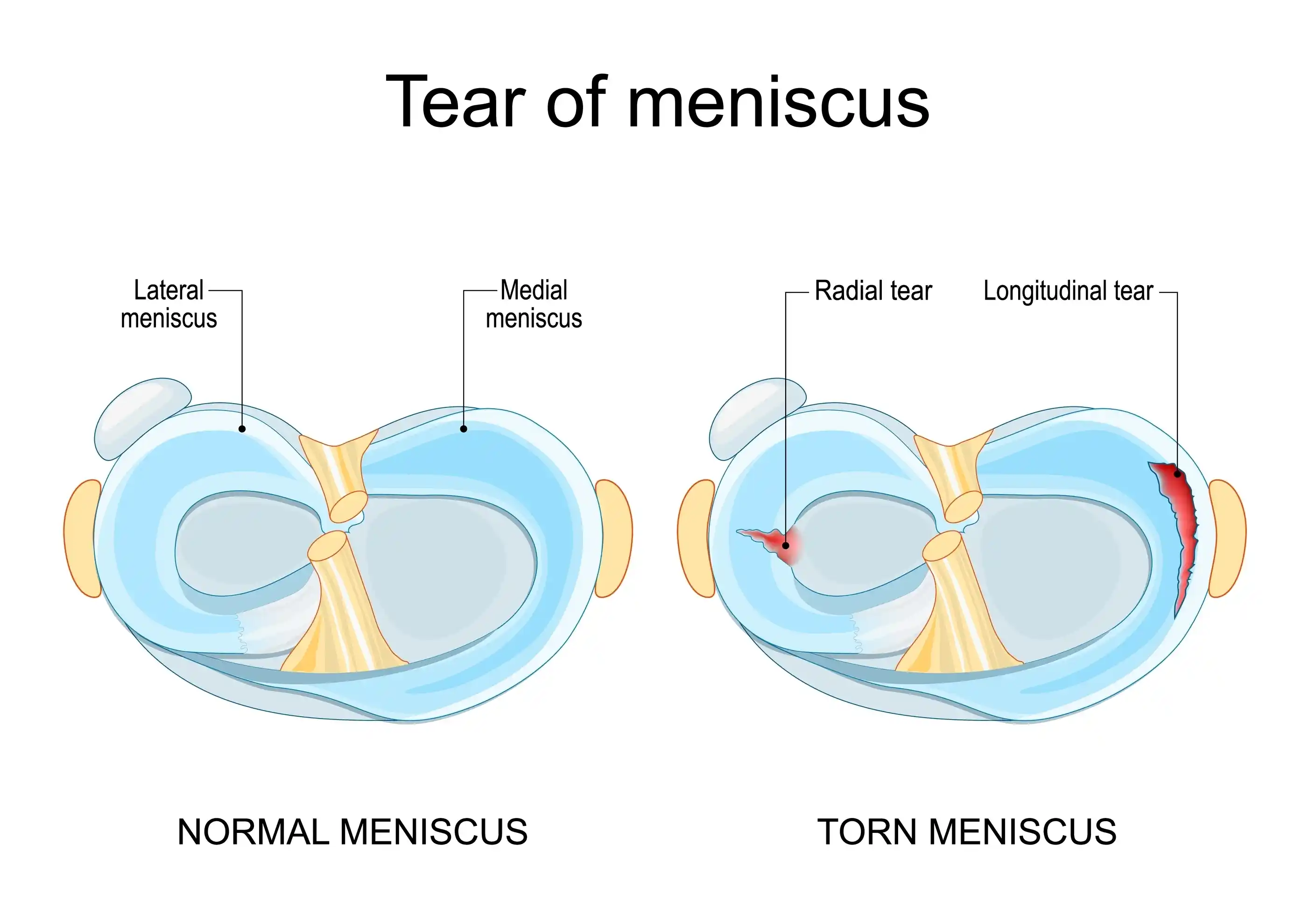
Pristyn Care La Midas, Main, Nathupur Rd, nr. 38, DLF Phase 3, Sector 24, Gurugram, Haryana 122002The meniscus is a C-shaped piece of cartilage located inside each knee. Every knee has two menisci—one on the inner (medial) side and one on the outer (lateral) side. These structures cushion the knee joint, absorb shock, improve stability, and protect the bones from excessive wear.
A meniscus tear occurs when this cartilage is damaged due to sudden twisting movements, sports injuries, falls, or age-related degeneration. While younger individuals often experience traumatic tears during sports, older adults may develop degenerative tears because the cartilage becomes weaker with age.
If left untreated, a torn meniscus can lead to chronic knee pain, repeated swelling, joint instability, and early osteoarthritis.
Free ACL Tear Surgery Cost Calculator
Fill details to get actual cost
The treatment approach depends largely on the type and location of the tear.
Occurs across the width of the meniscus and is one of the most common tear patterns.
The cartilage splits into upper and lower sections, often associated with degenerative changes.
Runs along the length of the meniscus and may be suitable for surgical repair.
A large displaced tear where part of the meniscus flips into the knee joint, often causing the knee to lock. This usually requires urgent surgery.
Creates a loose fragment that may catch inside the knee during movement.
A combination of multiple tear patterns commonly seen in older adults with degenerative arthritis.
Doctors classify meniscus injuries into different grades based on MRI findings.
Small internal degeneration without a complete tear.
Moderate degeneration that does not reach the cartilage surface.
A complete tear extending to the surface of the meniscus. Grade 3 tears often require surgical treatment if symptoms are severe.

 The patient consults an orthopedic specialist with symptoms such as knee pain, swelling, stiffness, clicking sounds, or difficulty moving the knee.Registration and consultation formalities are completed.The doctor reviews the patient's injury history, symptoms, and activity level.A physical examination of the knee is performed to assess movement and stability.
 The orthopedic surgeon examines the knee for tenderness, swelling, and range of motion.X-rays may be performed to rule out bone-related problems.MRI scans are commonly recommended to identify the location and severity of the meniscus tear.Based on the diagnosis, the doctor recommends non-surgical treatment or arthroscopic surgery.
 Minor meniscus tears may be managed with rest, ice application, compression, and elevation (RICE).Pain-relieving and anti-inflammatory medications may be prescribed.Physiotherapy exercises are advised to improve knee strength and flexibility.Activity modification and knee support may be recommended to reduce stress on the joint.
 The patient is taken to the operation theatre if surgery is required.Spinal or general anesthesia is administered to ensure a pain-free procedure.The surgeon makes small incisions around the knee joint and inserts an arthroscope (a small camera) to view the damaged meniscusDepending on the tear, the surgeon repairs the damaged meniscus with sutures or removes only the torn portion (partial meniscectomy).The knee joint is examined to ensure proper movement and stability.The small incisions are closed and covered with sterile dressings.
 The patient is shifted to the recovery room for monitoring.Nurses monitor blood pressure, pulse, oxygen levels, pain control, and knee condition.The knee may be supported with a bandage or brace as advised.The patient is guided regarding walking support and early knee movements.
 Most patients return home on the same day after arthroscopic meniscus surgery.Pain relief medicines and post-operative care instructions are provided.The patient is advised on wound care, weight-bearing restrictions, and knee exercises.Physiotherapy is started to restore knee strength, flexibility, and function.Follow-up appointments are scheduled to monitor healing and recovery.Patients should seek medical attention if they experience severe pain, increasing swelling, fever, wound discharge, or difficulty moving the knee.
A meniscus tear may develop due to trauma or gradual wear and tear.
Common causes include:

Diet & Lifestyle Consultation

Post-Surgery Recovery Follow up

Free Cab Facility

24*7 Patient Support
Certain individuals have a higher risk of developing meniscus tears.
Risk factors include:
Symptoms vary depending on the severity and location of the tear.
Common symptoms include:
Seek immediate medical attention if the knee becomes locked, you cannot bear weight, or swelling develops rapidly after injury.
An orthopedic surgeon diagnoses a meniscus tear using your medical history, physical examination, and imaging studies.
The doctor checks for:
Special clinical tests such as the McMurray Test, Thessaly Test, and Apley Compression Test may also be performed.
MRI is considered the gold standard for diagnosing meniscus tears because it clearly shows cartilage, ligaments, and soft tissues.
Although X-rays cannot detect meniscus tears directly, they help rule out fractures and arthritis.
Recommended occasionally when MRI cannot be performed.
Treatment depends on:
Treatment may be either non-surgical or surgical.
Small tears located in the outer portion of the meniscus often heal with conservative treatment.
Treatment options include:
Surgery may be recommended if:
Modern arthroscopic surgery allows faster recovery with minimal damage to surrounding tissues.
Proper preparation helps ensure a smoother surgery and faster recovery.
Following these instructions reduces surgical risks and promotes better healing.
Arthroscopic knee surgery is considered the gold standard for treating symptomatic meniscus tears because it requires only tiny incisions and offers faster recovery.
The procedure is performed under spinal or general anesthesia, ensuring complete comfort throughout the surgery.
The surgeon creates 2-3 small keyhole incisions around the knee.
A miniature camera (arthroscope) is inserted into the knee joint to examine the torn cartilage, ligaments, and surrounding structures.
Depending on the tear pattern, location, and blood supply, one of the following procedures is performed:
The torn cartilage is stitched back together using specialized anchors or sutures. This option preserves the meniscus and is preferred whenever possible.
Only the damaged portion of the meniscus is removed while preserving healthy cartilage.
Rarely required and considered only when most of the meniscus has already been removed or severely damaged.
The instruments are removed, incisions are closed with sutures or surgical strips, and a sterile dressing is applied.
Most arthroscopic procedures are completed within 30-90 minutes, and patients usually return home the same day.
Following your surgeon’s instructions significantly improves recovery.
Long-term knee health depends on maintaining healthy habits.
Typically, the success rate of advanced meniscus repair surgery may range from 70% to 90%. However, this is an average success rate which may vary depending on the expertise of the orthopedic surgeon, the type of technique used for repairing meniscus tear, etc.
In most cases, patients need to stay in the hospital for 1-2 days post-meniscus surgery. However, the stay in the hospital totally depends on the severity of the meniscus tear and the type of surgery performed by the orthopedic surgeon.
Yes. Most patients return to sports after completing rehabilitation, usually within 2-6 months, depending on the procedure.
Yes. Physiotherapy is essential for restoring strength, flexibility, balance, and knee function.
Whenever possible, meniscus repair is preferred because it preserves the natural cartilage and lowers the long-term risk of arthritis. Your surgeon will recommend the best option based on the tear.
You can resume regular activities within 10-14 days of meniscus surgery. However, the complete recovery may take six to eight months. It is always advised to consult your doctor if you feel any pain or discomfort during your recovery.
No. The meniscus tear surgery is performed under the influence of anesthesia which makes the procedure minimal pain. However, you may feel a little discomfort post-meniscus tear surgery which is easily manageable with prescribed medication as recommended by the surgeon.
It depends on the type of meniscus tear and the severity of the condition. If the meniscus tear is on the outer one-third of the meniscus, it may heal on its own. If the symptoms are severe, you must consult a healthcare provider to seek help.
 VR
VRVikram Rao

 Recommends
Recommends
Minor slip, got meniscus repair. Procedure quick, hospital stay minimal. After‑care good, minor confusion on follow‑up date but quickly sorted.
.svg) AR
ARAnusha Rathore
Recommends
Recommends
Pristyn Care's meniscus tear treatment was a game-changer for me. I injured my knee during a fall and was in excruciating pain. The team at Pristyn Care was quick to respond and provided excellent care. The meniscus tear surgery was a success, and the recovery was smoother than I expected. I'm grateful to Pristyn Care for their expertise and support throughout the treatment. My knee feels much better now!
.svg) VK
VKVartika Khattar
Recommends
Recommends
Pristyn Care's services and treatment for my meniscus tear was exceptional. The doctors were attentive and knowledgeable, making sure I understood the treatment plan. Pristyn Care's team provided the necessary support during my recovery, and their care contributed to my quick healing. Thanks to Pristyn Care, I can now move freely without any discomfort caused by the meniscus tear.
.svg)
Avail FREE Doctor Consultation

Consult with our expert surgeon for more than 50+ diseases

Once you share your details, our care coordinator will get in touch with you.

The coordinator will understand your symptoms and health condition in detail.

Your consultation will be scheduled at the earliest.
3M +
Happy Patients
150 +
Clinics
30 +
Cities

120Cr—Patient Savings Delivered
so patients focus on recovery, not bills.

Complete Transparency
No hidden charges or surprise bills

End-to-End Insurance Handling
Complete insurance processing support

Up to 20% Savings on Every Surgery
powered by smarter insurance handling

Easy EMI Options
Flexible payment plans available
120Cr—Patient Savings Delivered
so patients focus on recovery, not bills.
Complete Transparency
No hidden charges or surprise bills
Your Form Has Been Submitted Successfully.
Our care coordinator will call you shortly.


Book Your FREE Consultation
Consult with our expert surgeon for more than 50+ diseases
Once you share your details, our care coordinator will get in touch with you.
The coordinator will understand your symptoms and health condition in detail.
Your consultation will be scheduled at the earliest.
3M +
Happy Patients
150 +
Clinics
30 +
Cities