Select City

Call Us
Book FREE Appointment
Female infertility treatment helps women overcome fertility challenges and improve their chances of achieving a successful pregnancy. Depending on the underlying cause, treatment may include lifestyle modifications, fertility medications, ovulation induction, IUI, IVF, ICSI, or advanced reproductive procedures. Early diagnosis and personalized treatment by an experienced fertility specialist can significantly improve pregnancy outcomes.
Female infertility treatment helps women overcome fertility challenges and improve their chances of ...achieving a successful pregnancy. Depending on the underlying cause, treatment may include lifestyle modifications, fertility medications, ovulation induction, IUI, IVF, ICSI, or advanced reproductive procedures. Early diagnosis and personalized treatment by an experienced fertility specialist can significantly improve pregnancy outcomes.Read More




3M+
Happy Patients
50+
Disease
200+
Hospitals
30+
Cities

Free Cab Facility

No-Cost EMI

Support in Insurance Claim

1-day Hospitalization

USFDA-Approved Procedure
Choose Your City
It help us to find the best doctors near you.

Bangalore
Chennai
Delhi
Hyderabad
Mumbai
Delhi
Hyderabad
Pune
Mumbai
Bangalore
 Doctor Not Found
5.0/5
34 Years Experience
 Pristyn Care Ferticity, 12, Navjeevan Vihar, Geetanjali Enclave, Malviya Nagar, New Delhi, Delhi 110017
4.5/5
22 Years Experience
Pristyn Care Ferticity, Malviya Nagar, New Delhi4.5/5
16 Years Experience
Pristyn Care Ferticity, Malviya Nagar, New Delhi4.5/5
12 Years Experience
Pristyn Care Sheetla Hospital, Sector 8, GurgaonFemale infertility refers to the inability to conceive after 12 months of regular, unprotected intercourse. For women over 35 years of age, infertility is typically evaluated after six months of unsuccessful attempts to conceive.
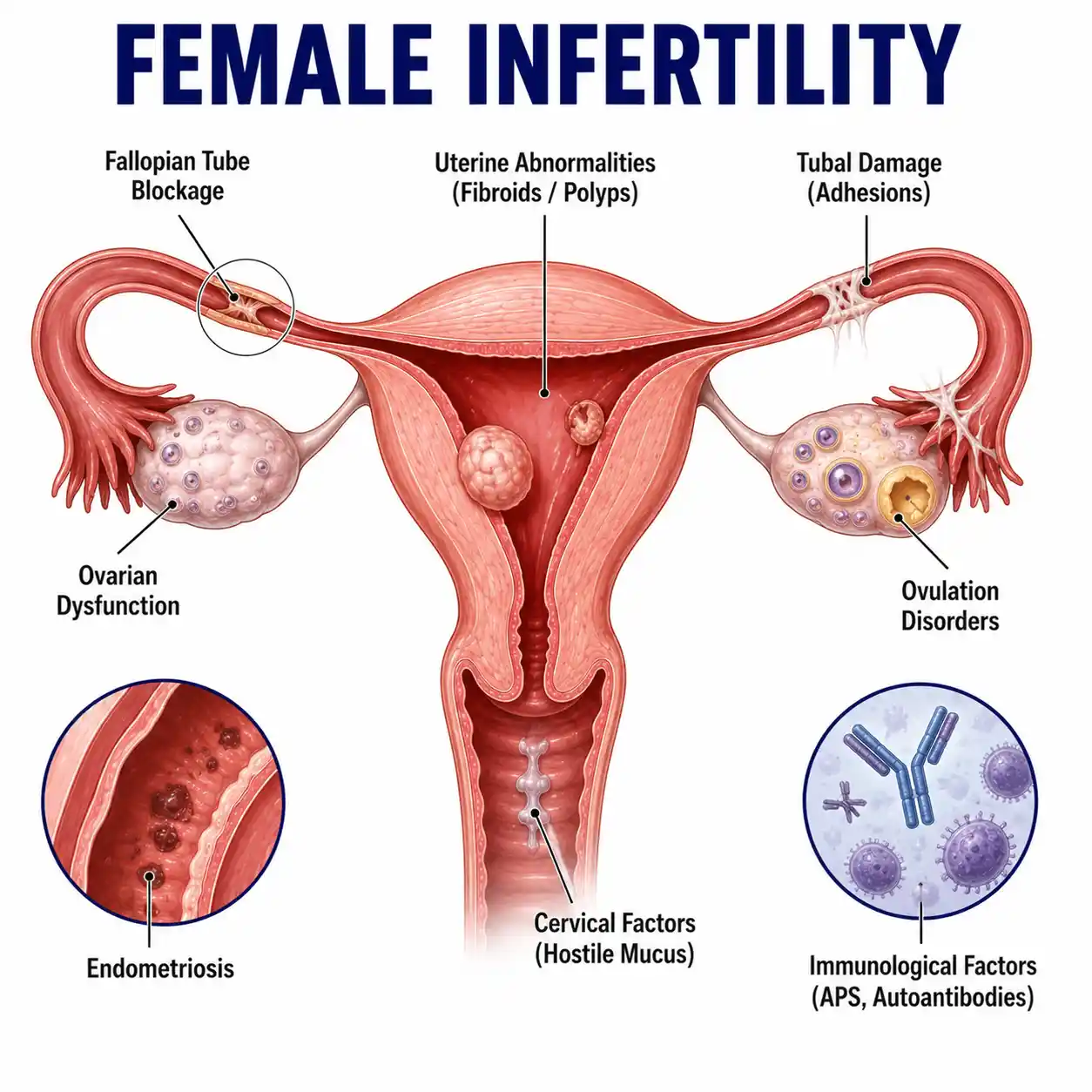
Female infertility can result from problems with ovulation, fallopian tubes, uterus, cervix, hormones, or age related decline in egg quality. In some cases, multiple factors may contribute to fertility challenges.
Free Female Infertility Surgery Cost Calculator
Fill details to get actual cost
Infertility affects millions of couples worldwide, and female factors contribute to a significant percentage of infertility cases. Fortunately, advancements in reproductive medicine have made it possible for many women to achieve pregnancy through personalized fertility treatment plans.
Understanding the underlying cause is the first step toward effective treatment.
Ovulation Disorders
Ovulation related problems are among the most common causes of female infertility.
Conditions include:
Fallopian Tube Damage or Blockage
Blocked or damaged fallopian tubes can prevent sperm from reaching the egg.
Common causes include:
Endometriosis
Endometriosis occurs when tissue similar to the uterine lining grows outside the uterus, affecting fertility by disrupting normal reproductive function.
Uterine Conditions
Structural abnormalities may interfere with implantation or pregnancy.
Examples include:
Age-Related Fertility Decline
Female fertility naturally declines with age, especially after 35 years, due to reduced egg quantity and quality.
Cervical Factors
Changes in cervical mucus or cervical abnormalities may affect sperm movement and fertilization.
Unexplained Infertility
In some women, all fertility tests appear normal, yet pregnancy does not occur. This condition is known as unexplained infertility.
The primary symptom of female infertility is difficulty becoming pregnant.
Additional symptoms may include:

Diet & Lifestyle Consultation

Post-Surgery Recovery Follow up

FREE Cab Facility

24*7 Patient Support
Consider consulting a fertility specialist if:
Accurate diagnosis helps fertility specialists identify the most effective treatment strategy.
Medical History and Physical Examination
Your fertility specialist will review:
Female Infertility Tests
Common fertility tests include:
Hormone Blood Tests
These tests evaluate:
Ovulation Assessment
Ovulation tracking helps determine whether eggs are being released regularly.
Transvaginal Ultrasound
Ultrasound assesses:
Hysterosalpingography (HSG)
An HSG evaluates whether the fallopian tubes are open and functioning properly.
This procedure allows direct visualization of the uterine cavity.
Laparoscopy
Laparoscopy may be recommended to diagnose:
Treatment depends on the cause, age, fertility goals, and overall reproductive health.
Lifestyle and Natural Fertility Optimization
Doctors may recommend:
Fertility Medications
Fertility drugs help stimulate ovulation and improve reproductive function.
Common medications include:
Ovulation Induction
Ovulation induction encourages egg release in women with ovulatory disorders and is often combined with fertility monitoring.
What Is IUI?
Intrauterine Insemination (IUI) involves placing specially prepared sperm directly into the uterus during ovulation.
Who Can Benefit From IUI?
IUI may be recommended for:
Advantages of IUI
What Is IVF?
In Vitro Fertilization (IVF) is one of the most effective fertility treatments available today.
The process involves:
Who Needs IVF?
IVF may be recommended for:
Benefits of IVF

 Patient arrives at the hospital or fertility center at the scheduled time.Registration and admission formalities are completed.Vital signs (blood pressure, pulse, temperature, and oxygen level) are checked.The fertility specialist reviews the patient's medical history, test results, and treatment plan.
 The fertility specialist performs a final evaluation of the patient's condition.The treatment plan is explained, and consent forms are signed.The anesthetist reviews the patient's condition if a surgical procedure is planned.An IV line is started for fluids and medications, if required.
 The patient is taken to the procedure room or operation theatre.Short general anesthesia or intravenous sedation is administered for procedures such as egg retrieval or hysteroscopy.The patient becomes pain-free and comfortable before the procedure begins.
 The fertility specialist performs the planned procedure, such as hysteroscopy, laparoscopy, or egg retrieval, depending on the underlying cause of infertility.Any abnormalities, such as uterine polyps, fibroids, adhesions, endometriosis, or blocked fallopian tubes, may be treated if indicated.If undergoing IVF, mature eggs are carefully retrieved from the ovaries using ultrasound guidance.The procedure is completed, and the treatment area is checked before transferring the patient to recovery.
 The patient is shifted to the recovery room.Nurses monitor blood pressure, pulse, oxygen level, and overall comfort.Mild cramping or light vaginal spotting may occur temporarily.Once fully awake and stable, the patient can start taking fluids.
 Most patients are discharged on the same day.Pain relief medications and post-procedure care instructions are provided, if needed.The patient receives guidance regarding medications, activity restrictions, and the next steps in the fertility treatment plan.A follow-up appointment is scheduled to review recovery and discuss further fertility treatment or pregnancy planning.
Intracytoplasmic Sperm Injection (ICSI) involves injecting a single sperm directly into an egg to facilitate fertilization.
ICSI is often used when:
Egg freezing allows women to preserve fertility for future pregnancy planning.
Women may consider egg freezing if:
In certain cases, surgery may improve fertility outcomes.
Hysteroscopic Surgery
Used to remove:
Laparoscopic Surgery
Can treat:
Success rates depend on:
Generally, younger women tend to achieve higher pregnancy success rates compared to older women.
The cost of female infertility treatment varies depending on:
A fertility specialist can provide a personalized treatment estimate after evaluation.
Consider the following factors:
Early intervention can:
The most common causes include ovulation disorders, PCOS, blocked fallopian tubes, endometriosis, age-related fertility decline, hormonal imbalances, and uterine abnormalities.
Symptoms may include inability to conceive, irregular periods, absent menstruation, painful periods, pelvic pain, hormonal imbalances, and recurrent miscarriages.
Diagnosis may involve blood tests, ultrasound scans, ovulation tracking, HSG, hysteroscopy, laparoscopy, and fertility hormone evaluation.
The best treatment depends on the underlying cause. Options may include fertility medications, IUI, IVF, ICSI, surgery, or lifestyle modifications.
Yes. Many women successfully conceive through fertility medications, ovulation induction, IUI, IVF, and other non-surgical fertility treatments.
No. IVF is one of several fertility treatments. Depending on the diagnosis, IUI, medications, surgery, or fertility preservation techniques may also be effective.
IUI places sperm directly into the uterus, while IVF involves fertilization outside the body in a laboratory before embryo transfer.
The cost varies based on the treatment type, fertility center, medications, and individual medical requirements.
Women under 35 should seek evaluation after one year of trying to conceive, while women over 35 should consider evaluation after six months.
Yes. Many women with PCOS achieve pregnancy successfully with lifestyle modifications, ovulation induction, IUI, IVF, or other fertility treatments.



 CV
CVCharu Verma

 Recommends
Recommends
The emotional support at Ferticity was as helpful as the medical side. Infertility is hard and having a kind team matters.
.svg) KB
KBKritika Basu
Recommends
Recommends
Ferticity’s approach to treating female infertility was holistic and empathetic. I always felt heard.
.svg)
Avail FREE Doctor Consultation

Consult with our expert surgeon for more than 50+ diseases

Once you share your details, our care coordinator will get in touch with you.

The coordinator will understand your symptoms and health condition in detail.

Your consultation will be scheduled at the earliest.
3M +
Happy Patients
150 +
Clinics
30 +
Cities

120Cr—Patient Savings Delivered
so patients focus on recovery, not bills.

Complete Transparency
No hidden charges or surprise bills

End-to-End Insurance Handling
Complete insurance processing support

Up to 20% Savings on Every Surgery
powered by smarter insurance handling

Easy EMI Options
Flexible payment plans available
120Cr—Patient Savings Delivered
so patients focus on recovery, not bills.
Complete Transparency
No hidden charges or surprise bills
Your Form Has Been Submitted Successfully.
Our care coordinator will call you shortly.


Book Your FREE Consultation
Consult with our expert surgeon for more than 50+ diseases
Once you share your details, our care coordinator will get in touch with you.
The coordinator will understand your symptoms and health condition in detail.
Your consultation will be scheduled at the earliest.
3M +
Happy Patients
150 +
Clinics
30 +
Cities
)