

Select City


Call Us
Book FREE Appointment
Demyelinating disorder treatment focuses on reducing inflammation, slowing disease progression, and preserving nerve function. Explore personalized treatment options, including medications, immunotherapy, rehabilitation, and supportive care.
Demyelinating disorder treatment focuses on reducing inflammation, slowing disease progression, and preserving nerve ...function. Explore personalized treatment options, including medications, immunotherapy, rehabilitation, and supportive care.Read More




3M+
Happy Patients
50+
Disease
200+
Hospitals
30+
Cities

Free Cab Facility

No-Cost EMI

Support in Insurance Claim

1-day Hospitalization

USFDA-Approved Procedure
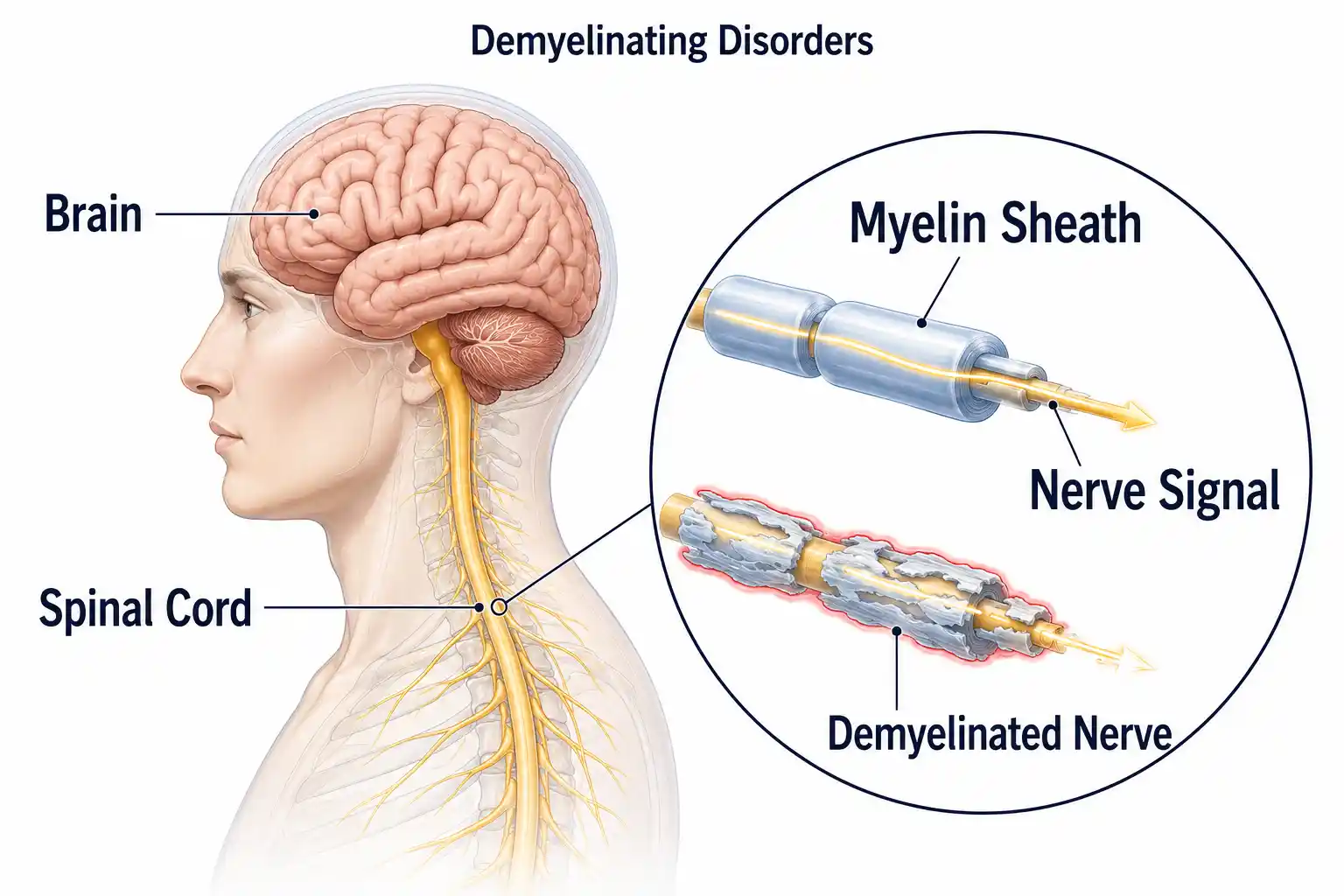
The myelin sheath is a fatty protective layer that insulates nerve fibers and enables rapid transmission of nerve impulses. When myelin is damaged, nerve signals become slowed or blocked, resulting in impaired communication within the nervous system.
Demyelinating disorders may affect the brain, spinal cord, optic nerves, or peripheral nerves. Some conditions primarily involve the central nervous system, while others affect the peripheral nervous system.
Common demyelinating disorders include:
Free Neurology Others Surgery Cost Calculator
Fill details to get actual cost
Symptoms vary depending on the nerves affected and the specific disorder.
Common symptoms include:
Symptoms may develop suddenly or progress gradually over time.
The exact cause varies depending on the specific disorder.
Common causes include:
In many cases, the immune system mistakenly attacks the myelin sheath, resulting in inflammation and nerve damage.
Factors that may increase the risk include:

Diet & Lifestyle Consultation

Post-Surgery Follow-Up

Free Cab Facility

24*7 Patient Support
Consult a healthcare professional if you experience:
Prompt neurological evaluation is essential to prevent irreversible nerve damage.
Diagnosis involves identifying the affected areas of the nervous system and determining the underlying cause.
Healthcare providers may recommend:
Assessment of:
Evaluation of:
MRI of the brain and spinal cord is one of the most important investigations for detecting areas of demyelination.
Cerebrospinal fluid analysis may help identify inflammatory markers associated with certain demyelinating diseases.
Blood investigations may include:
These tests measure how quickly electrical signals travel through the nervous system and can identify slowed nerve conduction caused by myelin damage.
Treatment depends on the specific diagnosis, severity of symptoms, and whether the condition is causing an acute relapse or long-term progression.
High-dose corticosteroids are commonly used during acute attacks to reduce inflammation and accelerate recovery.
These medications are usually administered intravenously for severe relapses, followed by oral treatment when appropriate.
For chronic autoimmune demyelinating disorders such as Multiple Sclerosis, disease-modifying therapies help:
The choice of therapy depends on the individual’s diagnosis, disease activity, and overall health.
Certain conditions may require medications that regulate or suppress the immune system to reduce ongoing damage to the myelin sheath.
These treatments are selected based on the underlying autoimmune condition and require regular monitoring.
Plasma exchange may be recommended for severe relapses that do not respond adequately to corticosteroids.
The procedure removes harmful antibodies from the bloodstream and may improve recovery in selected patients.
IVIG is commonly used in certain peripheral demyelinating disorders such as Guillain-Barré Syndrome and Chronic Inflammatory Demyelinating Polyneuropathy.
It helps regulate the immune response and reduce inflammation.
Additional medications may be prescribed to manage symptoms such as:
Treatment is individualized according to each patient’s symptoms.
Rehabilitation plays an important role in maintaining independence and improving function.
A multidisciplinary rehabilitation program may include:
Helps improve:
Supports independence in daily activities and recommends adaptive equipment when needed.
Beneficial for individuals experiencing:
Counseling and mental health support help patients cope with chronic neurological conditions and improve emotional well-being.
Healthy lifestyle habits can complement medical treatment.
These include:
Recovery depends on the specific demyelinating disorder.
Some conditions, such as Acute Disseminated Encephalomyelitis, may resolve with treatment, while others, including Multiple Sclerosis and CIDP, often require long-term management.
Regular follow-up helps:
Without appropriate treatment, demyelinating disorders may lead to:
Early treatment and rehabilitation can help minimize long-term disability.
Demyelinating disorders are neurological conditions in which the protective myelin sheath surrounding nerve fibers becomes damaged, disrupting communication between the brain, spinal cord, and the rest of the body.
Many demyelinating disorders are caused by autoimmune reactions in which the immune system mistakenly attacks the myelin sheath. Some may also develop following infections, inflammatory conditions, or due to genetic factors.
Some demyelinating disorders are temporary and may resolve with treatment, while chronic conditions such as Multiple Sclerosis require long-term management to control symptoms and slow disease progression.
Treatment depends on the specific disorder and may include corticosteroids, disease-modifying therapies, immunosuppressive medications, plasma exchange, intravenous immunoglobulin, and rehabilitation.
Demyelinating disorders are primarily managed by neurologists. Depending on the condition, rehabilitation specialists, physiotherapists, occupational therapists, and ophthalmologists may also be involved in care.
Yes. Physiotherapy plays an important role in improving mobility, muscle strength, balance, coordination, and overall physical function while helping maintain independence.
Most demyelinating disorders are not directly inherited, although certain genetic factors may increase susceptibility when combined with environmental triggers.
Many individuals can lead active and productive lives with early diagnosis, appropriate treatment, rehabilitation, and regular medical follow-up. Long-term outcomes depend on the specific disorder, disease severity, and response to treatment.

Avail FREE Doctor Consultation

Consult with our expert surgeon for more than 50+ diseases

Once you share your details, our care coordinator will get in touch with you.

The coordinator will understand your symptoms and health condition in detail.

Your consultation will be scheduled at the earliest.
3M +
Happy Patients
150 +
Clinics
30 +
Cities

120Cr—Patient Savings Delivered
so patients focus on recovery, not bills.

Complete Transparency
No hidden charges or surprise bills

End-to-End Insurance Handling
Complete insurance processing support

Up to 20% Savings on Every Surgery
powered by smarter insurance handling

Easy EMI Options
Flexible payment plans available
120Cr—Patient Savings Delivered
so patients focus on recovery, not bills.
Complete Transparency
No hidden charges or surprise bills
Your Form Has Been Submitted Successfully.
Our care coordinator will call you shortly.
Book Your FREE Consultation
Consult with our expert surgeon for more than 50+ diseases
Once you share your details, our care coordinator will get in touch with you.
The coordinator will understand your symptoms and health condition in detail.
Your consultation will be scheduled at the earliest.
3M +
Happy Patients
150 +
Clinics
30 +
Cities