Select City

Nasal valve collapse surgery is an advanced surgical treatment designed to correct narrowing or weakness of the nasal valve—the narrowest part of the nasal airway. When the nasal valve becomes weak or collapses during breathing, it can significantly restrict airflow and cause chronic nasal obstruction. At Pristyn Care, experienced ENT specialists and facial plastic surgeons provide comprehensive diagnosis and advanced surgical treatment for nasal valve collapse, helping patients breathe more comfortably and improve their quality of life.
Nasal valve collapse surgery is an advanced surgical treatment designed to correct narrowing ... Read More




Free Cab Facility

No-Cost EMI

Support in Insurance Claim

1-day Hospitalization

USFDA-Approved Procedure
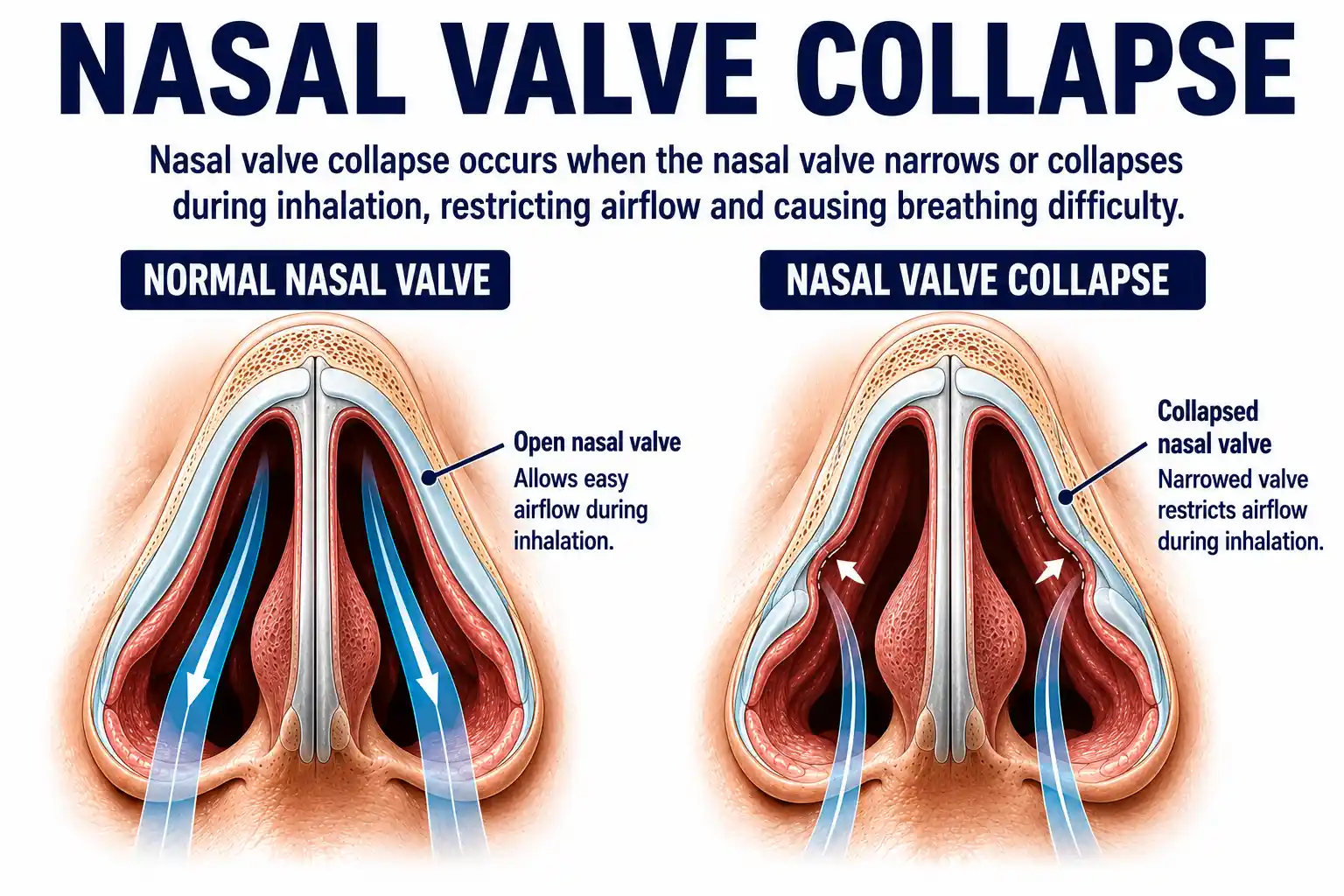
Nasal valve collapse (NVC) occurs when the structures that support the nasal airway become weak or narrow, causing the nasal passage to partially collapse during breathing.
The nasal valve is the most critical area responsible for regulating airflow through the nose. Even minor narrowing in this region can significantly affect breathing.
Nasal valve collapse may involve:
The internal nasal valve is located deeper inside the nose and is the narrowest part of the nasal airway. Collapse in this area often results in significant airflow restriction.
The external nasal valve is located near the nostrils and can collapse inward during inhalation due to weak cartilage support.
Both conditions can occur independently or together.
Free Deviated Nasal Septum Surgery Cost Calculator
Fill details to get actual cost
Nasal valve collapse surgery is a procedure that strengthens and widens the nasal valve area to improve airflow through the nose.
The surgery aims to:
Depending on the underlying cause, the procedure may involve cartilage grafting, structural reconstruction, implants, or septal correction.
Several factors can contribute to nasal valve dysfunction.
The symptoms of nasal valve collapse often mimic other nasal disorders, making accurate diagnosis important.
Common symptoms include:
Many patients report that symptoms are worse during deep inhalation.

Diet & Lifestyle Consultation

Post-Surgery Follow-Up

Free Cab Facility

24*7 Patient Support
Surgery may be recommended when conservative treatments fail to provide lasting relief.
You may be a candidate for surgery if:
Accurate diagnosis is essential for selecting the most effective treatment.
Your surgeon will review:
The external and internal nasal structures are examined to identify areas of weakness or collapse.
The surgeon gently pulls the cheek outward while you breathe through the nose.
Improvement in airflow may indicate nasal valve dysfunction.
A specialized instrument is used to support different parts of the nasal valve and identify the exact location of collapse.
In Nasal Endoscopy, a flexible endoscope is inserted into the nose to examine:
This test measures airflow resistance inside the nasal passages and helps quantify obstruction.
Sound waves are used to evaluate the cross-sectional dimensions of the nasal airway.
In selected cases, imaging studies help identify structural abnormalities contributing to obstruction.
The surgical technique is selected based on the location and severity of the collapse.
Spreader grafts are one of the most commonly performed procedures for internal nasal valve collapse.
Benefits include:
These cartilage grafts strengthen the outer sidewall of the nose.
They are particularly effective for:
These grafts reinforce the lower lateral cartilage and improve support of the nasal tip and external valve.
Cartilage may be obtained from:
The graft is used to strengthen weakened nasal structures.
Minimally invasive implants may be placed within the lateral nasal wall to provide structural support.
Benefits include:
Functional rhinoplasty combines structural correction with nasal valve reconstruction to improve breathing.
Many patients have both nasal valve collapse and a deviated septum.
Combining both procedures often provides optimal improvement in airflow.
Proper preparation helps ensure safe surgery and smooth recovery.
Your surgeon may recommend:
You may undergo:
The procedure is usually performed under local anaesthesia with sedation or general anaesthesia.
You will receive anaesthesia to ensure comfort during the procedure.
Incisions may be made:
The approach depends on the complexity of reconstruction.
The surgeon identifies weakened areas and performs:
The incisions are carefully closed and nasal dressings may be applied.
Patients are monitored before being discharged on the same day or after a short hospital stay.
Recovery varies depending on the surgical technique used.
Patients may experience:
Most swelling gradually decreases and breathing begins to improve.
The majority of patients notice significant improvement in nasal airflow.
Final results continue to improve as tissues heal completely.
Although generally safe, all surgical procedures carry some risks.
Potential complications include:
Bleeding: Minor bleeding is common during the initial recovery period.
Infection: Infections are uncommon but may require antibiotic treatment.
Persistent Nasal Obstruction: Some patients may continue experiencing symptoms if multiple factors contribute to airway blockage.
Scarring: Most incisions are hidden, but minor scar formation can occur.
Graft Displacement: In rare cases, cartilage grafts may shift position.
Changes in Nasal Appearance: Structural correction may subtly alter nasal shape.
Need for Revision Surgery: A small percentage of patients may require additional procedures for optimal results.
Patients often experience substantial improvements after treatment.
In India, nasal valve collapse surgery has been widely successful with an 85-90% success rate, as reported in various clinical studies. The success rate primarily depends on the expertise of the surgeon, the patient’s overall health, and adherence to post-operative care guidelines.
The recovery from nasal valve collapse surgery typically varies from patient to patient. However, most patients start feeling better within a week after surgery. A complete recovery, including total healing of the nasal tissues, may take around 3-6 months.
No particular age limit is set for nasal valve collapse surgery. The most important factor is the need for surgery based on the diagnosis and the overall health of the patient. However, any surgical procedure must be approached with caution for young children and elderly patients.
During the surgery, patients are usually under local or general anaesthesia, which means they do not feel any pain. Post-surgery, there might be some discomfort and slight pain, which is manageable with prescribed painkillers.
Returning to work post-surgery largely depends on your recovery and the nature of your job. If your job involves heavy physical activity or exposure to irritants like dust or fumes, it may be advisable to take some time off until you recover completely.
The primary aim of nasal valve collapse surgery is to improve nasal airflow and not to alter the shape of the nose. However, due to structural adjustments made during surgery, slight changes in the shape of your nose might occur, which usually are insignificant.
Exercising after nasal valve collapse surgery is usually advisable only after a certain recovery period. Heavy exercises, weight lifting, and intense workouts should be avoided for at least 3-4 weeks post-surgery. Always consult your doctor before starting any physical activity after surgery.
Yes, nasal valve collapse can occur in children as well as adults. However, it is more commonly seen in adults due to factors like ageing or injury.
Post-surgery, you will be advised to avoid strenuous activities for a couple of weeks and refrain from blowing your nose. It’s also essential to maintain good nasal hygiene to prevent infections. Your doctor will provide detailed instructions on lifestyle changes if necessary.
Before you undergo nasal valve collapse surgery, it can be helpful to clear all your doubts with the doctor. Consider asking questions about the surgeon’s experience, potential risks and complications, post-surgery care, expected recovery time, and any lifestyle changes you may need to make.