Select City

PCNL surgery effectively relieves kidney stones that are too large or too dense to be corrected with any other procedure. It relieves painful symptoms to improve the patient's quality of life. At Pristyn Care, our experienced doctors use advanced technology to perform PCNL surgery and ensure minimal discomfort.
PCNL surgery effectively relieves kidney stones that are too large or too dense ... Read More




Free Cab Facility

No-Cost EMI

Support in Insurance Claim

1-day Hospitalization

USFDA-Approved Procedure
Choose Your City
It help us to find the best doctors near you.

Bangalore
Delhi
Gurgaon
Hyderabad
Mumbai
Pune
Delhi
Hyderabad
Pune
Mumbai
Bangalore
 Pristyn Care ZOI Hospital, Ameerpet, Hyderabad
Pristyn Care Sheetla Hospital, Sector 8, Gurgaon
Pristyn Care ZOI Hospital, Ameerpet, Hyderabad
Pristyn Care ZOI Hospital, Ameerpet, Hyderabad
Pristyn Care ZOI Hospital, Ameerpet, Hyderabad
Pristyn Care Sheetla Hospital, Sector 8, Gurgaon
Pristyn Care ZOI Hospital, Ameerpet, Hyderabad
Pristyn Care ZOI Hospital, Ameerpet, Hyderabad
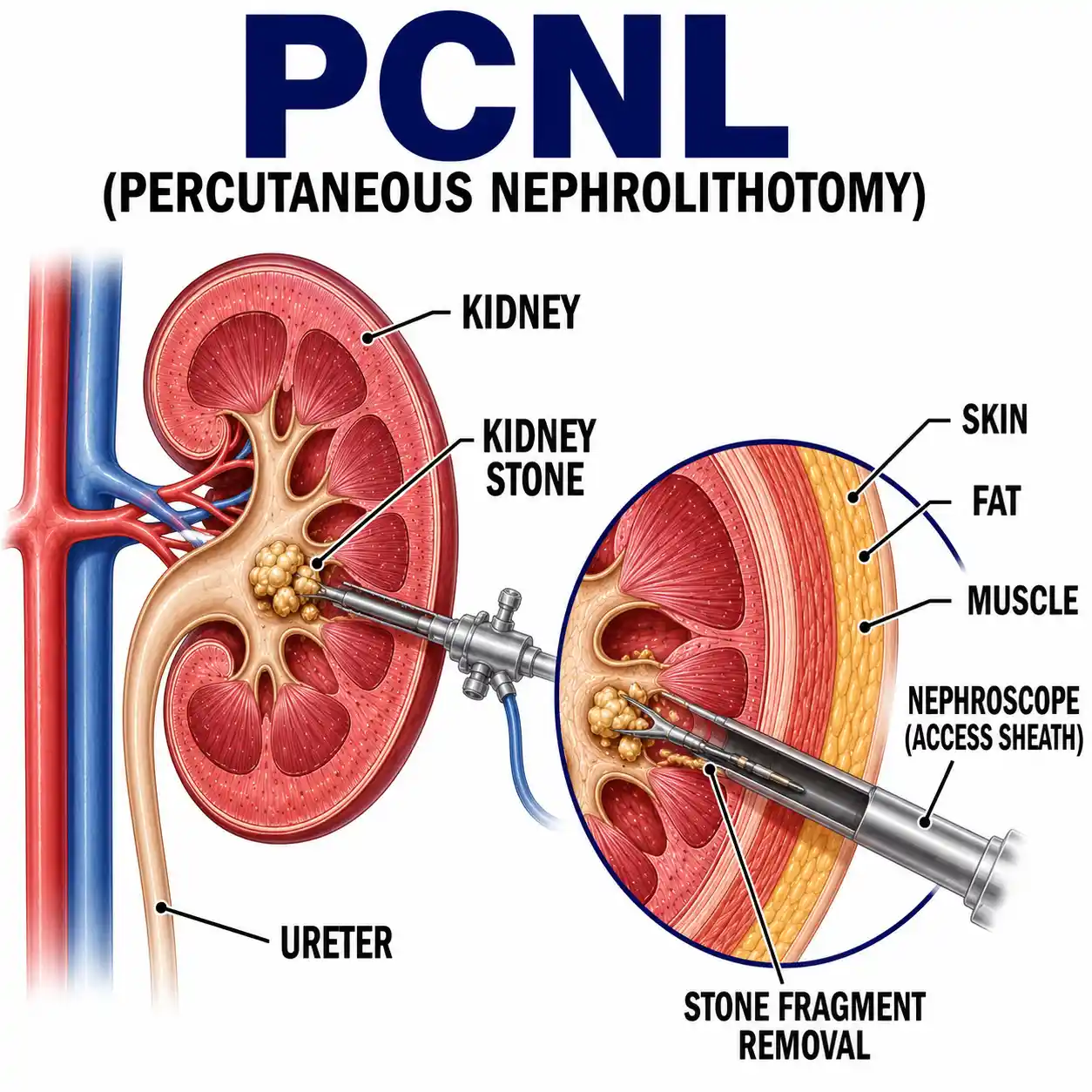
Percutaneous Nephrolithotomy (PCNL) is a minimally invasive procedure to remove the kidney stones that are too large to pass through the urinary tract naturally. Kidney stones or renal calculi form when chemical compounds in the urine crystallise. Most importantly, PCNL helps remove stones in the kidney or upper ureter that are too large to be treated with other treatment methods, such as shock wave lithotripsy or ureteroscopy.
Free Kidney Stones Surgery Cost Calculator
Fill details to get actual cost
Usually, PCNL is recommended when kidney stones are large, firm, or resistant to other forms of kidney stone treatment. It is considered for individuals with large renal calculi that can not be treated with medications and other treatment methods, such as shock wave lithotripsy or ureteroscopy. PCNL helps to improve kidney functioning and addresses pain and discomfort caused by the renal stone. PCNL surgery also helps to prevent complications, such as kidney damage, urinary tract infections, and urine flow obstruction.
Before the surgery, the doctor comprehensively understands the medical history of the patient and conducts a physical examination
The doctor conducts a thorough medical evaluation to assess the patient’s overall health and any other pre-existing medical conditions that may affect the surgery.
CT scans and X-rays are done to locate the renal calculi and determine their size.
Your doctor may ask you to discontinue certain blood-thinning medications before the procedure.
Patients are instructed not to eat or drink anything for a few hours before surgery, usually the night before.
What Happens During PCNL (Percutaneous Nephrolithotomy)?
 Step 1 · 30-60 mins
Hospital Admission
 The patient arrives at the hospital on the scheduled day of surgery.
Registration and admission formalities are completed.
Vital signs such as blood pressure, pulse, temperature, and oxygen levels are checked.
Blood tests, urine tests, CT scan/X-ray reports, and other pre-operative investigations are reviewed.
The patient arrives at the hospital on the scheduled day of surgery.
Registration and admission formalities are completed.
Vital signs such as blood pressure, pulse, temperature, and oxygen levels are checked.
Blood tests, urine tests, CT scan/X-ray reports, and other pre-operative investigations are reviewed.
 Step 2 · 20-40 mins
Pre-surgery Preparation
The urologist reviews the patient's medical history and kidney stone reports.
The anesthetist performs a final pre-anesthesia assessment.
Consent forms are signed after discussing the procedure, benefits, and possible risks.
An IV line is started for fluids, antibiotics, and medications.
The surgical area is cleaned and prepared.
 Step 3 · 10-15 mins
Anesthesia Administration
The patient is taken to the operation theatre.
General anesthesia is administered to ensure a pain-free procedure.
The patient is positioned appropriately to allow access to the affected kidney.
 Step 4 · 60-120 mins
PCNL Procedure Begins
The surgeon makes a small incision (about 1 cm) in the back to access the kidney.
A narrow tract is created from the skin to the kidney under imaging guidance.
A nephroscope is inserted through the tract to locate the kidney stone.
The stone is broken into smaller fragments using laser, ultrasonic, or pneumatic energy.
The stone fragments are removed using specialized instruments.
A nephrostomy tube or ureteral stent may be placed temporarily to aid drainage, if required.
The incision is dressed after ensuring there is no significant bleeding.
 Step 5 · 2-4 hours
Recovery Room Observation
The patient is shifted to the recovery room for close monitoring.
Nurses monitor blood pressure, pulse, oxygen levels, urine output, and pain control.
IV fluids, antibiotics, and pain medications are administered as needed.
The patient is observed until medically stable before transfer to the hospital room.
 Step 6 · 1–3 Days (Depending on Recovery)
Hospital Stay & Discharge
Most patients are discharged within 1–3 days, depending on their recovery.
Pain relief medicines and antibiotics are prescribed.
The nephrostomy tube or ureteral stent is removed as advised by the urologist.
Detailed instructions regarding hydration, activity restrictions, wound care, and follow-up appointments are provided.
Follow-up imaging may be recommended to confirm complete stone clearance and monitor kidney health.
The PCNL surgery typically lasts 3-4 hours and causes minimal post-operative pain. The surgery also requires a shorter hospital stay, and patients can resume their work routine and daily activities within 1-2 weeks. Also, PCNL surgery has a higher success rate for stone removal in a single setting than other methods, such as ESWL, which require multiple attempts.
The patient is given anaesthesia, and the doctor ensures they are asleep and do not experience pain during the procedure. Depending on the patient’s medical condition, general or regional anaesthesia is given.
Once you are asleep, the doctor makes a small incision(<=1cm) in the back to access the kidney. Through the incision, the doctor inserts specialised instruments to break the kidney stones.
A small video camera called a nephroscope is inserted through the incision. It helps to locate and remove the kidney stone. Sometimes a lithotripter(shock-wave device) is also used to break the stone into smaller pieces before removal.
In some cases, laser or ultrasound energy is used to break the stone into smaller pieces.
The incisions are closed with sutures and covered with a dressing once the stone is removed.

Diet & Lifestyle Consultation

Post-Surgery Follow-Up

Free Cab Facility

24*7 Patient Support
You are being put under observation in a recovery area until the patient is stable and wakes up from anaesthesia.
Some patients may experience pain or discomfort after the procedure, which is managed with pain-relieving medications prescribed by the doctor.
Consuming plenty of fluids is essential for maintaining hydration. It also helps to flush out any remaining fragments of the stone.
The patients are advised to avoid heavy weight lifting and strenuous activities for some time after pcnl surgery for kidney stone.
To monitor the patient’s recovery and discuss preventive measures, the doctor schedules regular follow-up appointments.
The following are the possible risks and complications associated with the PCNL surgery.
The patient may experience minor bleeding during and after the procedure.
There is a risk of infection in the kidney or urinary tract.
PCNL surgery might cause minor damage to surrounding organs, including the intestines, blood vessels, or colon, during instrument insertion.
The patient may temporarily experience blood in urine after PCNL surgery.
In several complex cases, the surgery can not remove all the fragments of the kidney stone.
Sometimes patients may experience risks associated with the administered anaesthesia.
PCNL offers several advantages over other stone removal methods. Here are some of the key benefits of percutaneous nephrolithotomy:
PCNL surgery offers a high success rate in the effective removal of large and complex renal calculi in a single procedure.
PCNL can remove large and complex kidney stones even in unfavourable kidney locations.
Percutaneous Nephrolithotomy (PCNL) is a minimally invasive surgical procedure and requires only a small incision.
PCNL surgery offers quick healing and recovery, with minimal post-operative pain.
Depending on the complexity of the procedure, the PCNL surgery may allow a shorter hospital stay or, in some cases, the same-day discharge.
PCNL with DJ Stenting is a surgical treatment to remove large and complex kidney stones. During a Percutaneous Nephrolithotomy (PCNL), a surgeon locates and removes stones using a nephroscope. At the end of the procedure, the surgeon implants the stent.
PCNL stent removal procedure is not painful as the patient is administered local anaesthesia to reduce pain and discomfort. The procedure is carried out using a minimally invasive cystoscopy, where the surgeon uses a tiny scope to remove the stent from the bladder.
The keyhole surgery for kidney stones is often referred to as the percutaneous nephrolithotomy. It is a minimally invasive procedure that uses small incisions to remove large kidney stones. The surgery is performed under general anaesthesia, and the patient doesn’t experience pain and discomfort.
Although the mini pcnl surgery recovery time is usually 2-4 weeks, most patients return to their normal routine within a week or two. However, the complete recovery depends on the stone size and the patient’s medical condition.
PCNL is a minimally invasive procedure that removes large or complex kidney stones that cannot pass through the urinary tract naturally. Left pcnl refers to removing a stone from the left kidney while making an incision on the right side.
Open nephrolithotomy and open pyelolithotomy are both open surgical procedures to remove large and complex kidney stones. An open nephrolithotomy procedure refers to the removal of a stone from within the kidney, and an open pyelolithotomy removes the stone from within the renal pelvis or from the ureter.
PCNL drain is a temporary tube that helps drain urine from the kidney after the PCNL procedure. The drain is an essential part of the recovery process, allowing the kidney to heal properly by maintaining normal urine flow.



Ravi kant

 Recommends
Specially thanks to pristyn care elantis Lajpat nagar For my kidney stone surgery , stone size 35 mm ,lazor surgery by Dr Danish Hussain , Dr danish hussain uro sergion very coprative dr and very nice person and all staff of pristyn care include nurse's, cleaner ,coordinator , very good Thanx to all
Inderjeet kaur
Recommends
The dr. was caring and professional, providing clear explanations about the procedure and the recovery process. They recommended PCNL as the best option for my 22mm kidney stone. The surgery was carried out with great skill, and the thoughtful care I received during my recovery was commendable.
Arijit Nautiyal
Recommends
Dealing with kidney stones was challenging, but Pristyn Care's urologist provided excellent care. The PCNL procedure was successful, and I'm thankful for the relief. Pristyn Care's expertise in managing kidney stones is commendable.
Vikrant Chopra
Recommends
I've tried a lot of home remedies for the treatment of kidney stones, but nothing worked. Then I contacted the experienced surgeon of pristyn care. Based on their experience and my test reports, they suggested PCNL surgery. Now, I'm free from kidney stones and living a healthy lifestyle.
Priyadarshini Trivedi
Recommends
Choosing Pristyn Care for my PCNL treatment was the best decision I made. The urologist was knowledgeable and approachable, making me feel comfortable discussing my health concerns. They recommended PCNL based on my kidney stone characteristics, and it was the right choice. Pristyn Care's follow-up care and regular check-ins ensured a smooth recovery. Thanks to their support, I am now free from the pain and discomfort caused by the kidney stone.
Vidur Rajawat
Recommends
I don’t know how long I will be going to face this kidney stone. But after talking to the doctors at Pristyn Care, I felt comfortable with the decision. The procedure was quick and painless, and I'm now able to enjoy a better quality of life.
.svg)









.svg)
.svg)