

Select City


Call Us
Book FREE Appointment
Vertigo treatment focuses on relieving dizziness, improving balance, and preventing recurring episodes. Explore treatment options including medications, vestibular rehabilitation, repositioning maneuvers, lifestyle changes, and surgery when needed.
Vertigo treatment focuses on relieving dizziness, improving balance, and preventing recurring episodes. Explore ... treatment options including medications, vestibular rehabilitation, repositioning maneuvers, lifestyle changes, and surgery when needed. Read More




3M+
Happy Patients
50+
Disease
200+
Hospitals
30+
Cities

Free Cab Facility

No-Cost EMI

Support in Insurance Claim

1-day Hospitalization

USFDA-Approved Procedure
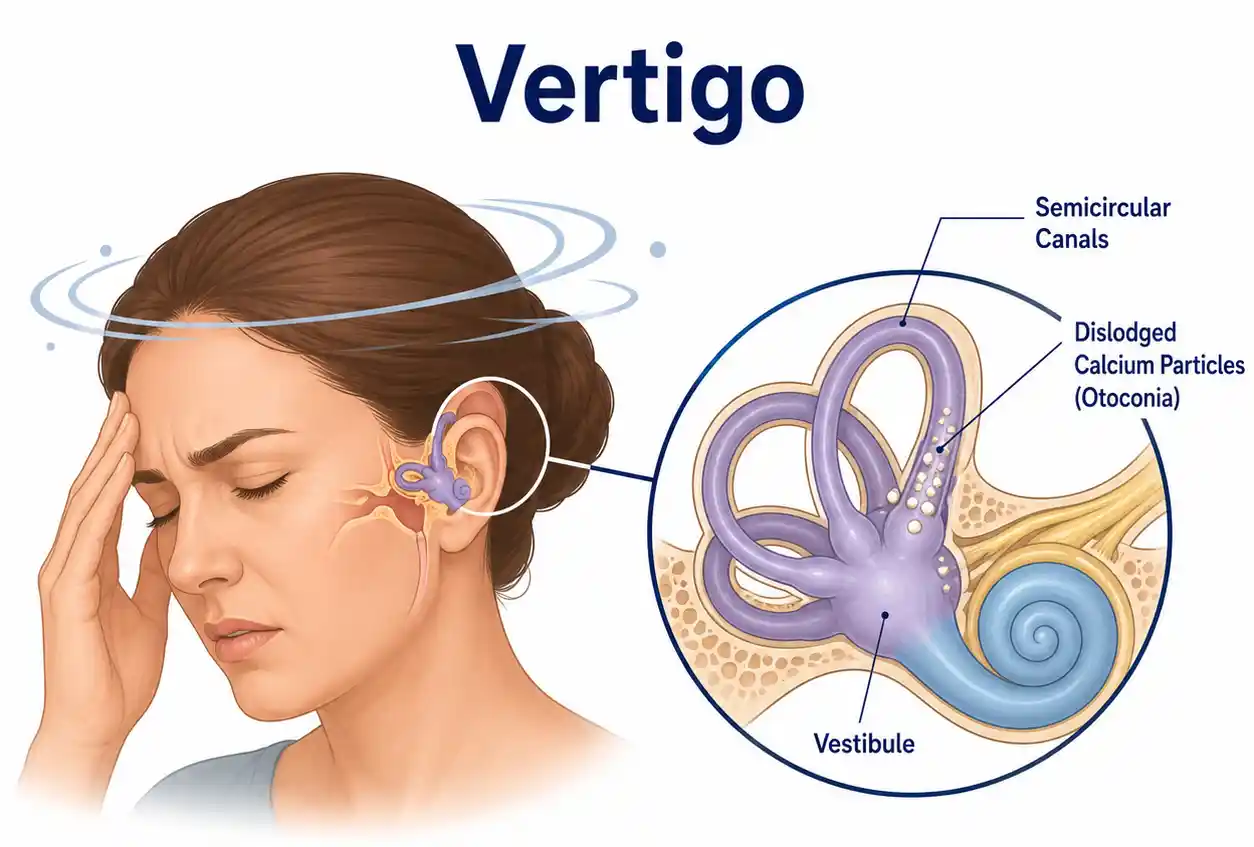
Vertigo is a type of dizziness characterized by the sensation that you or your surroundings are spinning or moving, even when you are completely still. Unlike general lightheadedness, vertigo specifically results from disturbances in the body’s balance system, known as the vestibular system.
The condition commonly arises due to disorders of the inner ear but may also occur because of neurological conditions, head injuries, infections, or reduced blood flow to certain areas of the brain.
Free Headache or migraine Surgery Cost Calculator
Fill details to get actual cost
Symptoms may vary depending on the underlying cause but commonly include:
Seek immediate medical attention if vertigo is accompanied by sudden weakness, difficulty speaking, severe headache, vision changes, chest pain, or loss of consciousness.
Several conditions can lead to vertigo.
Common causes include:
You may have a higher risk of developing vertigo if you have:

Diet & Lifestyle Consultation

Post-Surgery Follow-Up

Free Cab Facility

24*7 Patient Support
Consult a healthcare provider if you experience:
Diagnosis involves identifying the underlying cause through a detailed medical evaluation.
Your doctor may recommend:
Evaluation of:
Assessment of:
Tests such as the Dix-Hallpike maneuver help diagnose BPPV.
Performed when hearing loss or tinnitus is present.
These assess how well the inner ear balance system is functioning.
MRI or CT scans may be recommended if a neurological condition is suspected.
May be performed to identify infections or metabolic disorders contributing to dizziness.
Treatment depends on the underlying cause, severity of symptoms, and overall health.
Doctors may prescribe medications to relieve symptoms such as dizziness, nausea, or vomiting.
Depending on the cause, medications may include:
Medications are usually intended for short-term symptom control rather than long-term management.
For patients with BPPV, the Epley maneuver is one of the most effective treatments.
This procedure involves a series of carefully guided head movements that help move displaced calcium crystals within the inner ear back to their normal position, relieving vertigo symptoms.
Many patients experience significant improvement after one or two treatment sessions.
Vestibular rehabilitation is a specialized form of physical therapy designed to improve balance and reduce dizziness.
Exercises focus on:
Simple lifestyle measures can help reduce vertigo episodes.
These include:
Recovery depends on the underlying cause.
Many cases of BPPV improve quickly with repositioning maneuvers, while vestibular neuritis and labyrinthitis may take several weeks to recover. Chronic conditions such as Meniere’s disease or vestibular migraine require ongoing management and regular follow-up.
With appropriate treatment and rehabilitation, most patients experience significant improvement in symptoms and quality of life.
Untreated vertigo may lead to:
Prompt diagnosis and treatment help minimize these complications.
Many causes of vertigo, such as BPPV, can be effectively treated. Some chronic conditions require long-term management rather than a permanent cure.
The best treatment depends on the underlying cause and may include medications, the Epley maneuver, vestibular rehabilitation, or treatment of the underlying condition.
Vertigo is often caused by inner ear disorders, but it can occasionally indicate a serious neurological condition such as a stroke. Persistent or severe symptoms should always be evaluated by a doctor.
Episodes may last from a few seconds to several hours or even days, depending on the underlying cause.
Stress does not directly cause vertigo but can worsen symptoms or trigger episodes in people with certain vestibular disorders.
Yes. Some conditions, particularly BPPV and Meniere’s disease, may recur, although repeat treatment is often effective.
Depending on the cause, vertigo may be treated by an ENT specialist, neurologist, or vestibular rehabilitation specialist.
Yes. Vestibular rehabilitation exercises prescribed by a healthcare professional can improve balance, reduce dizziness, and decrease the likelihood of recurrent episodes.

Avail FREE Doctor Consultation

Consult with our expert surgeon for more than 50+ diseases

Once you share your details, our care coordinator will get in touch with you.

The coordinator will understand your symptoms and health condition in detail.

Your consultation will be scheduled at the earliest.
3M +
Happy Patients
150 +
Clinics
30 +
Cities

120Cr—Patient Savings Delivered
so patients focus on recovery, not bills.

Complete Transparency
No hidden charges or surprise bills

End-to-End Insurance Handling
Complete insurance processing support

Up to 20% Savings on Every Surgery
powered by smarter insurance handling

Easy EMI Options
Flexible payment plans available
120Cr—Patient Savings Delivered
so patients focus on recovery, not bills.
Complete Transparency
No hidden charges or surprise bills
Your Form Has Been Submitted Successfully.
Our care coordinator will call you shortly.

Book Your FREE Consultation
Consult with our expert surgeon for more than 50+ diseases
Once you share your details, our care coordinator will get in touch with you.
The coordinator will understand your symptoms and health condition in detail.
Your consultation will be scheduled at the earliest.
3M +
Happy Patients
150 +
Clinics
30 +
Cities
)