Select City

Pterygium, commonly known as surfer's eye, is a non-cancerous growth of tissue on the white part of the eye that can gradually extend over the cornea. Mild cases can often be managed with lubricating eye drops and lifestyle changes, while advanced cases may require pterygium removal surgery to restore vision, reduce discomfort, and prevent recurrence. If you notice a white growth on your eye, persistent redness, irritation, or blurred vision, consult an experienced ophthalmologist for an accurate diagnosis and the most suitable treatment. At Pristyn Care, our experienced eye surgeons provide comprehensive pterygium treatment in India, including advanced surgical techniques such as conjunctival autograft surgery and amniotic membrane transplantation, helping patients achieve faster recovery and excellent visual outcomes.
Pterygium, commonly known as surfer's eye, is a non-cancerous growth of tissue on ... Read More




Free Cab Facility

No-Cost EMI

Support in Insurance Claim

1-day Hospitalization

USFDA-Approved Procedure
Choose Your City
It help us to find the best doctors near you.

Aurangabad
Bangalore
Chennai
Coimbatore
Delhi
Hyderabad
Indore
Jaipur
Kochi
Madurai
Mumbai
Nashik
Noida
Patna
Pune
Vijayawada
Visakhapatnam
Delhi
Hyderabad
Pune
Mumbai
Bangalore
 C-2/390, Pankha Rd, C4 D Block, Janakpuri
1325, Huda Colony, Sector 46, Gurugram, Haryana 122002
Matriyash Kamalkunj, 1206/B3, off Jangali Maharaj Road, Deccan Gymkhana, Pune, Maharashtra 411004
Model Town, Delhi, 110033
C-2/390, Pankha Rd, C4 D Block, Janakpuri
1325, Huda Colony, Sector 46, Gurugram, Haryana 122002
Matriyash Kamalkunj, 1206/B3, off Jangali Maharaj Road, Deccan Gymkhana, Pune, Maharashtra 411004
Model Town, Delhi, 110033
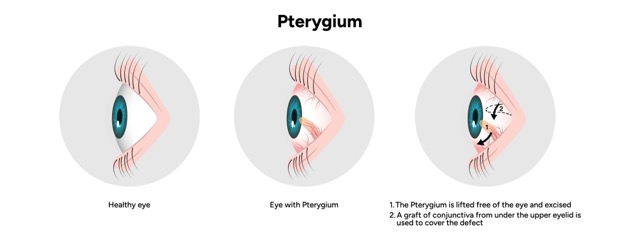
Pterygium is a wedge-shaped growth of conjunctival tissue that develops on the surface of the eye and gradually extends towards the cornea. Since prolonged exposure to sunlight is one of the major causes, it is often referred to as surfer’s eye.
Although pterygium is usually benign, it can become larger over time and lead to:
Small pterygium may remain stable for years, whereas larger growths can interfere with vision and may require pterygium eye surgery.
Free Cataract Surgery Cost Calculator
Fill details to get actual cost
Recognizing the symptoms early helps prevent progression and complications.
Common Symptoms of Pterygium
Patients may experience:
Large pterygium may partially cover the cornea, significantly affecting vision.
Although the exact cause is not completely understood, several environmental factors increase the risk.
Common Causes Include
People working outdoors, including farmers, construction workers, fishermen, athletes, and surfers, have a higher risk of developing pterygium.
You may be more likely to develop pterygium if you:

Diet & Lifestyle Consultation

Post-Surgery Follow-Up

Free Cab Facility

24*7 Patient Support
Based on severity and progression, pterygium may be classified as:
Atrophic Pterygium
Progressive Pterygium
Consult an ophthalmologist immediately if you notice:
Early evaluation helps determine whether pterygium treatment without surgery is sufficient or surgery is necessary.
Diagnosis is usually straightforward and performed during a comprehensive eye examination.
Medical History
Your doctor will ask about:
Slit Lamp Examination
A slit lamp allows detailed examination of:
Visual Acuity Test
Measures whether vision has been affected.
Corneal Topography
This evaluates changes in corneal shape caused by pterygium-induced astigmatism.
Tear Film Evaluation
Dry eye assessment helps determine associated ocular surface disease.
Not every patient requires surgery.
Non-Surgical Treatment May Be Recommended If:
Surgery May Be Recommended If:
Timely pterygium removal surgery helps preserve vision and reduces the risk of permanent corneal damage.
Yes. Mild pterygium can often be managed without surgery.
Conservative Treatment Options
These treatments help relieve symptoms but do not remove the pterygium. Surgery remains the only definitive treatment for removing the abnormal tissue.
Non-surgical treatment focuses on relieving symptoms rather than removing the growth. It is suitable for patients with mild or early-stage pterygium.
Artificial Tears and Lubricating Eye Drops
Lubricating eye drops help reduce:
Regular lubrication also improves comfort during prolonged screen use and exposure to dry environments.
Anti-inflammatory Eye Drops
Short-term steroid or non-steroidal anti-inflammatory eye drops may be prescribed to reduce:
These medications should only be used under an ophthalmologist’s supervision.
UV Protection
Since ultraviolet exposure is one of the biggest risk factors for pterygium progression, doctors recommend:
Lifestyle Modifications
Patients are advised to:
Although these measures improve symptoms, they cannot remove existing pterygium tissue.
Your eye specialist may recommend pterygium removal surgery if:
Surgery removes the abnormal tissue and helps restore both comfort and vision.
Several advanced surgical techniques are available today. Your surgeon selects the most suitable procedure based on the size, location, and recurrence risk of the pterygium.
Conjunctival autograft surgery is considered the gold standard for pterygium removal.
After removing the abnormal tissue, the surgeon takes a small piece of healthy conjunctiva from another area of the same eye and places it over the surgical site.
The graft is secured using:
This technique is widely recommended because it provides excellent long-term results.
Amniotic Membrane Transplant for Pterygium
Patients with larger pterygium or insufficient healthy conjunctival tissue may benefit from an amniotic membrane transplant.
After removing the pterygium, the surgeon places a specially processed amniotic membrane over the exposed area.
The membrane acts as a natural biological dressing that promotes healing.
Bare Sclera Excision
This older technique involves removing the pterygium without placing a graft.
Although technically simpler, it has:
For this reason, it is now less commonly recommended.
Many patients search for laser treatment for pterygium.
Currently, laser treatment alone is not considered the standard treatment for removing pterygium.
Modern pterygium surgery is performed using microsurgical instruments under high-powered operating microscopes. In some specialized centers, lasers may assist with certain steps, but complete removal still requires conventional microsurgery.
If complete removal is required, conjunctival autograft surgery remains the preferred approach.
Pterygium surgery is usually performed as a daycare procedure.
Step 1: Preoperative Assessment
Your ophthalmologist performs:
Step 2: Local Anaesthesia
The eye is numbed using local anaesthetic eye drops or injections.
Most patients remain awake but comfortable during the procedure.
Step 3: Removal of Pterygium
The abnormal tissue is carefully separated and removed from the cornea and sclera while preserving healthy tissue.
Step 4: Graft Placement
Depending on the selected technique:
The graft is secured using tissue glue or fine sutures.
Step 5: Completion of Surgery
The eye is cleaned and protected with:
Patients are generally discharged on the same day.
Most pterygium removal surgeries take approximately 30 to 60 minutes.
The exact duration depends on:
Patients usually return home within a few hours after surgery.
Modern pterygium treatment offers several important advantages.
Vision Benefits
Symptom Relief
Cosmetic Improvement
Long-Term Protection
You may be an ideal candidate if you have:
A comprehensive eye examination helps determine whether surgery is the most appropriate treatment option.
The best treatment depends on the size of the pterygium and your symptoms. Mild cases can be managed with lubricating eye drops and UV protection, while larger or vision-threatening pterygium usually requires surgical removal. An ophthalmologist can recommend the most suitable treatment.
Yes, early-stage pterygium can often be managed with artificial tears, anti-inflammatory eye drops, and protecting the eyes from UV rays. However, these treatments only relieve symptoms and do not remove the growth. Surgery is the only permanent treatment.
Laser treatment is not the standard treatment for pterygium. Most patients benefit from surgical removal using advanced techniques like conjunctival autograft surgery, which offers better long-term results and lower recurrence rates.
Conjunctival autograft surgery involves removing the pterygium and covering the affected area with healthy tissue taken from the patient’s own eye. This technique reduces the chances of recurrence and promotes faster healing with better cosmetic results.
Amniotic membrane transplantation uses a specially processed amniotic membrane to cover the surgical area after pterygium removal. It helps reduce inflammation, supports healing, and is often recommended for large or recurrent pterygium cases.
Conjunctival autograft surgery has the lowest recurrence rate among commonly performed pterygium surgeries. When performed by an experienced eye surgeon, it provides excellent long-term outcomes and reduces the risk of the growth returning.
Pterygium surgery usually takes around 20 to 45 minutes and is performed as a day-care procedure. Most patients can return home the same day after a short observation period.
No. The procedure is performed under local anaesthesia, so patients generally do not feel pain during surgery. Mild irritation or a foreign body sensation may occur for a few days after the procedure.
Most patients recover within 2 to 4 weeks, although complete healing may take up to 6 to 8 weeks. Following your doctor’s instructions and using prescribed eye drops helps ensure a smooth recovery.
Pterygium surgery has a high success rate, especially with advanced techniques like conjunctival autograft surgery. Most patients experience relief from symptoms, improved appearance, and a low chance of recurrence.


Rashi Deshpande

 Recommends
I had pterygium removal surgery at Pristyn Care, and it was a wonderful experience. The eye specialist was skilled and reassuring, making me feel at ease throughout the procedure. The post-operative care was also excellent, and my eye is healing beautifully. Thank you, Pristyn Care, for your exceptional service!
Angad Kejriwal
Recommends
Choosing Pristyn Care for pterygium treatment was the right decision. The ophthalmologist explained the procedure clearly, and the surgery went smoothly. Pristyn Care's support during my vision correction journey was commendable.
Mudita Rathod
Recommends
When I found out I needed pterygium surgery, I was anxious and uncertain about the process. Pristyn Care proved to be a true blessing throughout this journey. From the very beginning, they showed genuine care and professionalism. The pre-surgery preparations were comprehensive, ensuring I was mentally and physically prepared. The actual surgery was quick, painless, and flawlessly executed. The team's constant support during my recovery was heartening, and they provided clear instructions to follow at home. Now, my eye feels comfortable, and the appearance has improved significantly. Pristyn Care is undoubtedly a game-changer in healthcare, and I'm forever grateful for their expertise and dedication.
Nitin Naik
Recommends
Pterygium had me worried about my eyesight, but Pristyn Care's treatment erased those concerns. Their specialized care and advanced techniques were impressive. The treatment was comfortable, and my eyes have experienced a remarkable transformation. Pristyn Care is the ultimate choice!
Dileep
Recommends
Amazing service by mohith Pandey
Dinesh
Recommends
I had gone through Pristyn service a couple of times already but this time I was stuck with a few things and once mohith started handling the case !! He absolutely nailed it , full marks to him and Pristyn !!
.svg)






.svg)
.svg)