

Select City


Call Us
Book FREE Appointment
Sperm freezing, or sperm cryopreservation is beneficial for those undergoing medical treatments, surgeries, or delaying fatherhood. The process involves collecting, freezing, and storing sperm, ensuring its availability for future fertility treatments like IVF. With numerous advantages, sperm freezing offers flexibility and peace of mind for reproductive planning. Book an appointment with Pristyn Care's expert fertility specialists today to explore your options for sperm freezing and secure your future fertility.
Sperm freezing, or sperm cryopreservation is beneficial for those undergoing medical treatments, surgeries, ... or delaying fatherhood. The process involves collecting, freezing, and storing sperm, ensuring its availability for future fertility treatments like IVF. With numerous advantages, sperm freezing offers flexibility and peace of mind for reproductive planning. Book an appointment with Pristyn Care's expert fertility specialists today to explore your options for sperm freezing and secure your future fertility. Read More




3M+
Happy Patients
50+
Disease
200+
Hospitals
30+
Cities

Free Cab Facility

No-Cost EMI

Support in Insurance Claim

1-day Hospitalization

USFDA-Approved Procedure
Sperm freezing, also known as sperm cryopreservation, is a scientifically advanced medical procedure where a man’s sperm is collected, tested, and then frozen at extremely low temperatures for future use.
This procedure allows the preservation of male fertility by ensuring that healthy sperm are available when you decide to start or expand your family. Understanding this process can provide clarity about the practicalities involved, assuring you that it’s more approachable than it may initially appear.
Free Ivf Surgery Cost Calculator
Fill details to get actual cost
The importance of sperm freezing in fertility preservation cannot be overstated. In today’s fast-paced world, many men are delaying fatherhood due to professional commitments or personal reasons. Also, it offers a way for cancer patients who require treatments like chemotherapy or radiotherapy, which can affect their fertility adversely.
By choosing to freeze your sperm, you’re essentially securing your chance to have biological children in the future – no matter what life throws at you. It empowers men by providing them with control over their reproductive timeline, ensuring that when the time is right, they can fulfill their dream of parenthood.
Sperm freezing, also known as “sperm cryopreservation,” is a procedure that enables men to preserve their sperm for future use. There are several reasons why one might opt for sperm freezing.
While the idea of freezing sperm might sound futuristic or unnecessary to some, there are several groups of individuals who should consider this option:
As the need and circumstances vary from person to person, it’s advisable to discuss your specific situation with your doctor before deciding.

Diet & Lifestyle Consultation

Post-Surgery Follow-Up

Free Cab Facility

24*7 Patient Support
Understanding the sperm freezing process can help alleviate any anxiety or worries you may have about the procedure. It’s typically a simple and quick process.
The sperm freezing price varies depending on the clinic and the duration of storage, but it’s often considered a worthwhile investment for preserving future fertility. Remember, if you have any questions or concerns about the process, it’s best to consult your doctor.

 Patient arrives at the fertility clinic or hospital at the scheduled time.
Registration and consultation formalities are completed.
The fertility specialist reviews the patient's medical history and discusses fertility preservation goals.
Consent forms and cryopreservation documents are completed.
Patient arrives at the fertility clinic or hospital at the scheduled time.
Registration and consultation formalities are completed.
The fertility specialist reviews the patient's medical history and discusses fertility preservation goals.
Consent forms and cryopreservation documents are completed.
 The fertility specialist explains the sperm collection and freezing process.
The patient receives instructions for semen sample collection.
A private collection room is provided.
If required, alternative sperm retrieval methods are discussed.
The fertility specialist explains the sperm collection and freezing process.
The patient receives instructions for semen sample collection.
A private collection room is provided.
If required, alternative sperm retrieval methods are discussed.
 A semen sample is collected, usually through masturbation in a sterile container.
If ejaculation is not possible, sperm may be retrieved using a suitable medical procedure.
The sample is labeled and immediately sent to the laboratory for processing.
A semen sample is collected, usually through masturbation in a sterile container.
If ejaculation is not possible, sperm may be retrieved using a suitable medical procedure.
The sample is labeled and immediately sent to the laboratory for processing.
 The laboratory evaluates the semen sample for sperm count, motility, and quality.
A cryoprotective solution is added to protect the sperm during freezing.
The processed sample is divided into storage vials or straws.
The samples are gradually frozen using a controlled process and stored in liquid nitrogen at ultra-low temperatures for long-term preservation.
The laboratory evaluates the semen sample for sperm count, motility, and quality.
A cryoprotective solution is added to protect the sperm during freezing.
The processed sample is divided into storage vials or straws.
The samples are gradually frozen using a controlled process and stored in liquid nitrogen at ultra-low temperatures for long-term preservation.
 The patient meets with the fertility specialist to review the procedure.
The storage details and future use of the frozen sperm are explained.
Any questions regarding fertility preservation or assisted reproduction are addressed.
The patient is cleared to resume normal daily activities.
The patient meets with the fertility specialist to review the procedure.
The storage details and future use of the frozen sperm are explained.
Any questions regarding fertility preservation or assisted reproduction are addressed.
The patient is cleared to resume normal daily activities.
 Most patients leave the clinic on the same day.
The patient receives documentation confirming successful cryopreservation and storage.
Instructions regarding storage duration, renewal, and future sample use are provided.
A follow-up appointment is scheduled if additional sperm banking sessions or fertility treatment are planned.
Most patients leave the clinic on the same day.
The patient receives documentation confirming successful cryopreservation and storage.
Instructions regarding storage duration, renewal, and future sample use are provided.
A follow-up appointment is scheduled if additional sperm banking sessions or fertility treatment are planned.
Freezing sperm, also known as sperm cryopreservation, is a valuable medical advancement that has offered numerous benefits to men around the world. Here are some advantages to give you a comprehensive idea:
However, while the advantages are significant, it’s also important to understand that the process comes at a cost.
While freezing sperm provides multiple benefits, it’s essential to be aware of certain risks and limitations associated with the process:
Even with these considerations, freezing sperm could be a viable option under certain circumstances. Let’s explore when one should consider this intervention.
Sperm freezing is not an everyday topic of conversation. However, certain circumstances make it a practical consideration:
While the decision to freeze sperm is a highly personal one and dependent on individual circumstances, it’s worth discussing with your doctor if any of the above situations apply to you.
Freezing sperm, or what is technically known as sperm cryopreservation, is a process that you may consider for a variety of reasons, such as medical treatments, surgery, or lifestyle choices. Preparation for this procedure is not complex but does require some steps.
Once your sperm has been frozen, it can be stored indefinitely until you decide to use it. Here’s what you can expect after the freezing:
So, whether you’re planning a medical procedure that may impact fertility or simply want to preserve your sperm for future use, knowing what to expect can make the process less daunting.
Sperm freezing, also known as sperm banking, is a process where a man’s sperm is collected and preserved in a frozen state for future use. This process allows the sperm to be used at a later date to achieve pregnancy through various fertility treatments.
Yes, sperm freezing is considered to be quite safe. In many cases, it offers a reliable solution for those who may face fertility issues in the future. However, like any medical procedure, it does have some potential risks and should be discussed thoroughly with your doctor.
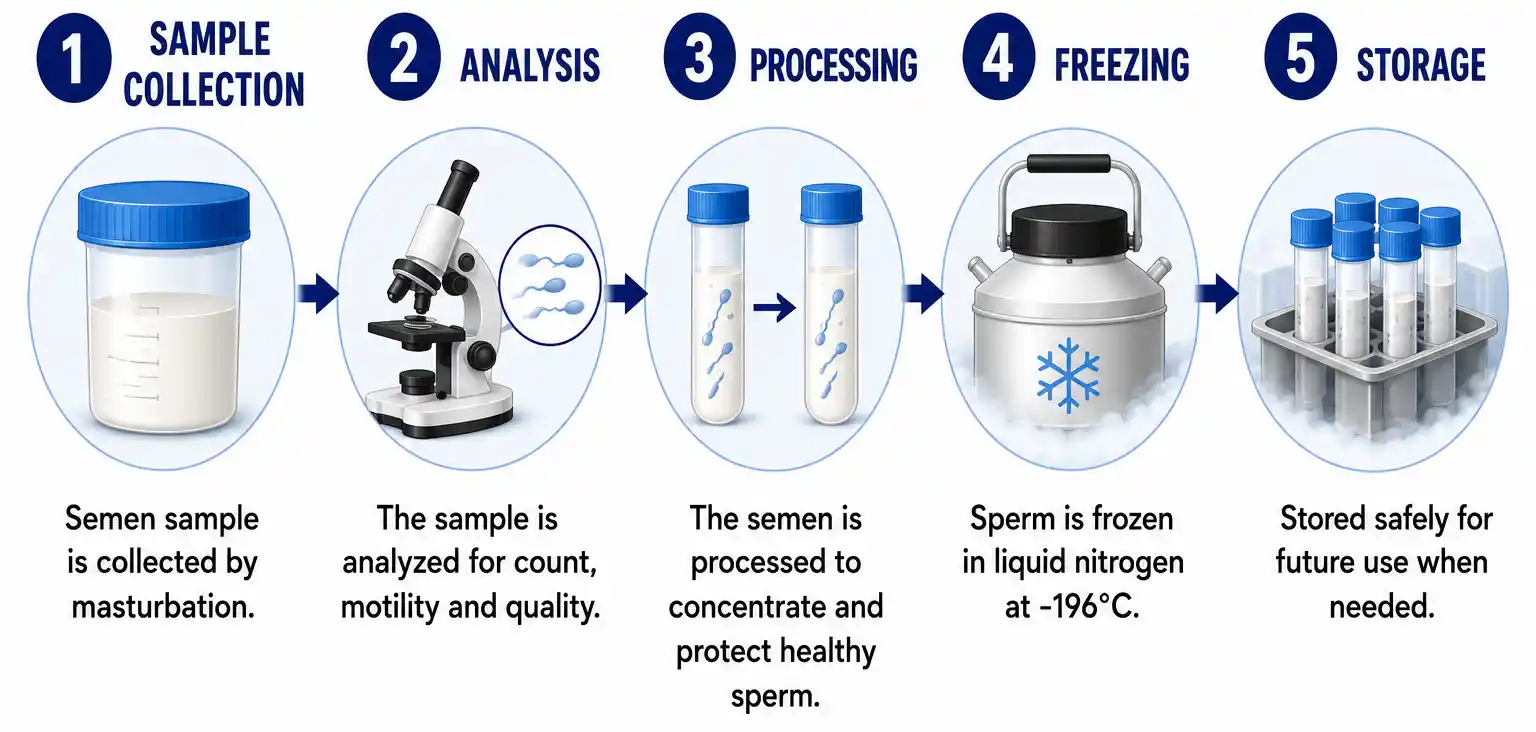
The sperm freezing process begins with a semen sample being collected from the patient through masturbation. This sample is then tested and, if found to be healthy, it’s mixed with a special solution to protect the sperm during freezing. The sample is then divided into smaller portions (known as straws), which are sealed and stored in liquid nitrogen at a temperature of -196°C.
Most men can consider freezing their sperm if they’re worried about their future fertility. This procedure is commonly considered by men who are about to undergo medical treatments like chemotherapy or radiation therapy that can affect fertility, those who have professions with risk of testicular trauma or men who are planning a vasectomy.
Theoretically, frozen sperm can be stored indefinitely without losing its potential to fertilise an egg. Sperm that has been frozen for decades has been successfully used in fertility treatments.
Though freezing and thawing may cause some damage to the sperm, most of them survive the process without any significant loss in quality. The special solution used during freezing helps protect the sperm from damage.
The success rate of using frozen sperm is comparable to that of fresh sperm. The success depends on various factors like the age and fertility health of the female partner, the fertility treatment used, and the overall quality and quantity of the frozen sperm.
While most men can freeze their sperm, some may face challenges. Men with low sperm counts or poor sperm quality may find the freezing process less effective. Also, those with certain infectious diseases may not be eligible for sperm freezing.
The sperm freezing price varies depending on the facility and location, but typically it includes fees for initial consultation, semen analysis, processing and freezing, and annual storage. It’s best to discuss costs with your healthcare provider or fertility specialist.
To prepare for sperm freezing, doctors might suggest abstaining from ejaculation for 2-3 days before providing a sample. This helps in ensuring the best possible quantity and quality of sperm for freezing. A good diet, regular exercise, avoiding smoking, and excessive alcohol intake can also contribute towards better outcomes.




Avail FREE Doctor Consultation

Consult with our expert surgeon for more than 50+ diseases

Once you share your details, our care coordinator will get in touch with you.

The coordinator will understand your symptoms and health condition in detail.

Your consultation will be scheduled at the earliest.
3M +
Happy Patients
150 +
Clinics
30 +
Cities

120Cr—Patient Savings Delivered
so patients focus on recovery, not bills.

Complete Transparency
No hidden charges or surprise bills

End-to-End Insurance Handling
Complete insurance processing support

Up to 20% Savings on Every Surgery
powered by smarter insurance handling

Easy EMI Options
Flexible payment plans available
120Cr—Patient Savings Delivered
so patients focus on recovery, not bills.
Complete Transparency
No hidden charges or surprise bills
Your Form Has Been Submitted Successfully.
Our care coordinator will call you shortly.

Book Your FREE Consultation
Consult with our expert surgeon for more than 50+ diseases
Once you share your details, our care coordinator will get in touch with you.
The coordinator will understand your symptoms and health condition in detail.
Your consultation will be scheduled at the earliest.
3M +
Happy Patients
150 +
Clinics
30 +
Cities