

Select City


Call Us
Book FREE Appointment
Muscle disorder treatment focuses on relieving symptoms, improving muscle strength, and restoring mobility. Explore personalized treatment options, including medications, physical therapy, rehabilitation, lifestyle changes, and surgery when needed.
Muscle disorder treatment focuses on relieving symptoms, improving muscle strength, and restoring mobility. ... Explore personalized treatment options, including medications, physical therapy, rehabilitation, lifestyle changes, and surgery when needed. Read More



3M+
Happy Patients
50+
Disease
200+
Hospitals
30+
Cities

Free Cab Facility

No-Cost EMI

Support in Insurance Claim

1-day Hospitalization

USFDA-Approved Procedure
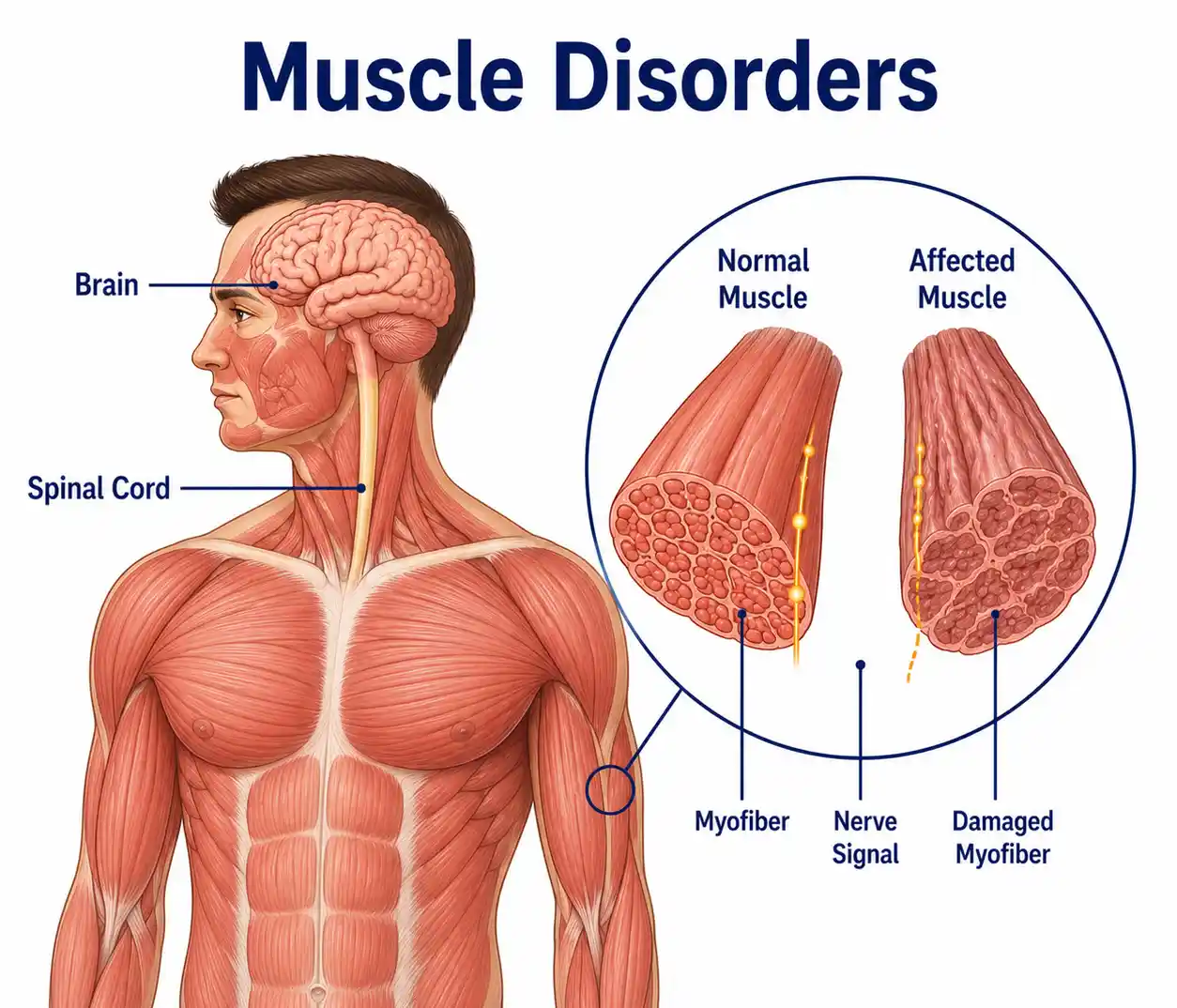
Muscle disorders are conditions that interfere with the normal contraction, strength, endurance, or function of muscles. They may be inherited, acquired, inflammatory, metabolic, or related to disorders of the nerves supplying the muscles.
Some muscle disorders progress slowly over time, while others develop suddenly due to injury, infection, or autoimmune disease.
Common muscle disorders include:
Free Neurology Others Surgery Cost Calculator
Fill details to get actual cost
Symptoms vary depending on the specific condition and severity.
Common symptoms include:
Muscle disorders can develop due to several medical conditions and injuries.
Common causes include:
Factors that may increase the risk include:

Diet & Lifestyle Consultation

Post-Surgery Follow-Up

Free Cab Facility

24*7 Patient Support
Consult a healthcare professional if you experience:
Early evaluation can help identify serious muscle diseases and prevent long-term complications.
Diagnosis involves identifying the underlying cause of muscle dysfunction.
Healthcare providers may recommend:
Assessment includes:
Evaluation of:
Blood investigations may include:
EMG evaluates electrical activity within muscles and helps distinguish muscle disorders from nerve disorders.
These tests assess nerve function when a neuromuscular disorder is suspected.
MRI helps identify muscle inflammation, tears, or structural abnormalities.
A muscle biopsy may be performed to confirm inflammatory, genetic, or metabolic muscle diseases.
Genetic analysis may be recommended for inherited muscle disorders such as muscular dystrophy.
Treatment depends on the underlying diagnosis, severity of symptoms, and overall health.
Management often combines medications, rehabilitation, and supportive care.
Treatment may include medications to reduce inflammation, improve muscle function, or manage associated symptoms.
Depending on the diagnosis, medications may include:
Treatment plans are individualized according to the specific muscle disorder.
Physical therapy is an essential component of treatment.
It helps improve:
Exercise programs are carefully tailored to avoid overexertion while maintaining muscle function.
Occupational therapy helps individuals maintain independence in daily activities through adaptive techniques and assistive devices.
Patients experiencing swallowing or speech difficulties due to muscle weakness may benefit from specialized rehabilitation.
Surgery may be considered in selected situations, such as:
The type of surgery depends on the underlying condition.
Healthy habits can support muscle function and recovery.
These include:
Recovery depends on the underlying cause.
Acute muscle injuries may recover within weeks, while inherited and autoimmune muscle disorders often require lifelong management.
Regular follow-up helps:
Without appropriate treatment, muscle disorders may lead to:
Early diagnosis and rehabilitation help reduce these complications.
Muscle disorders are conditions that affect the muscles’ ability to contract, generate strength, or function normally, resulting in weakness, pain, stiffness, or impaired movement.
Muscle disorders may be caused by genetic conditions, autoimmune diseases, infections, injuries, metabolic disorders, vitamin deficiencies, medications, or neurological diseases.
Some muscle disorders, such as those caused by infections or vitamin deficiencies, may be reversible with appropriate treatment. Others, including inherited muscle diseases, require long-term management to slow progression and improve quality of life.
Muscle disorders are primarily managed by neurologists, physiatrists, rheumatologists (for inflammatory muscle diseases), orthopedic surgeons (for injuries), and rehabilitation specialists.
Yes. Carefully supervised exercise and physical therapy can improve strength, flexibility, endurance, and mobility. Exercise programs should always be tailored to the individual’s diagnosis and functional capacity.
Some muscle disorders, such as muscular dystrophy and certain metabolic myopathies, are inherited. Others develop due to autoimmune diseases, infections, injuries, or other acquired medical conditions.
Seek urgent medical care if you experience sudden severe muscle weakness, difficulty breathing, difficulty swallowing, rapidly progressing paralysis, severe muscle pain with dark-colored urine, or symptoms following a major injury, as these may indicate a serious medical emergency requiring prompt treatment.
Avail FREE Doctor Consultation

Consult with our expert surgeon for more than 50+ diseases

Once you share your details, our care coordinator will get in touch with you.

The coordinator will understand your symptoms and health condition in detail.

Your consultation will be scheduled at the earliest.
3M +
Happy Patients
150 +
Clinics
30 +
Cities

120Cr—Patient Savings Delivered
so patients focus on recovery, not bills.

Complete Transparency
No hidden charges or surprise bills

End-to-End Insurance Handling
Complete insurance processing support

Up to 20% Savings on Every Surgery
powered by smarter insurance handling

Easy EMI Options
Flexible payment plans available
120Cr—Patient Savings Delivered
so patients focus on recovery, not bills.
Complete Transparency
No hidden charges or surprise bills
Your Form Has Been Submitted Successfully.
Our care coordinator will call you shortly.
Book Your FREE Consultation
Consult with our expert surgeon for more than 50+ diseases
Once you share your details, our care coordinator will get in touch with you.
The coordinator will understand your symptoms and health condition in detail.
Your consultation will be scheduled at the earliest.
3M +
Happy Patients
150 +
Clinics
30 +
Cities