Select City

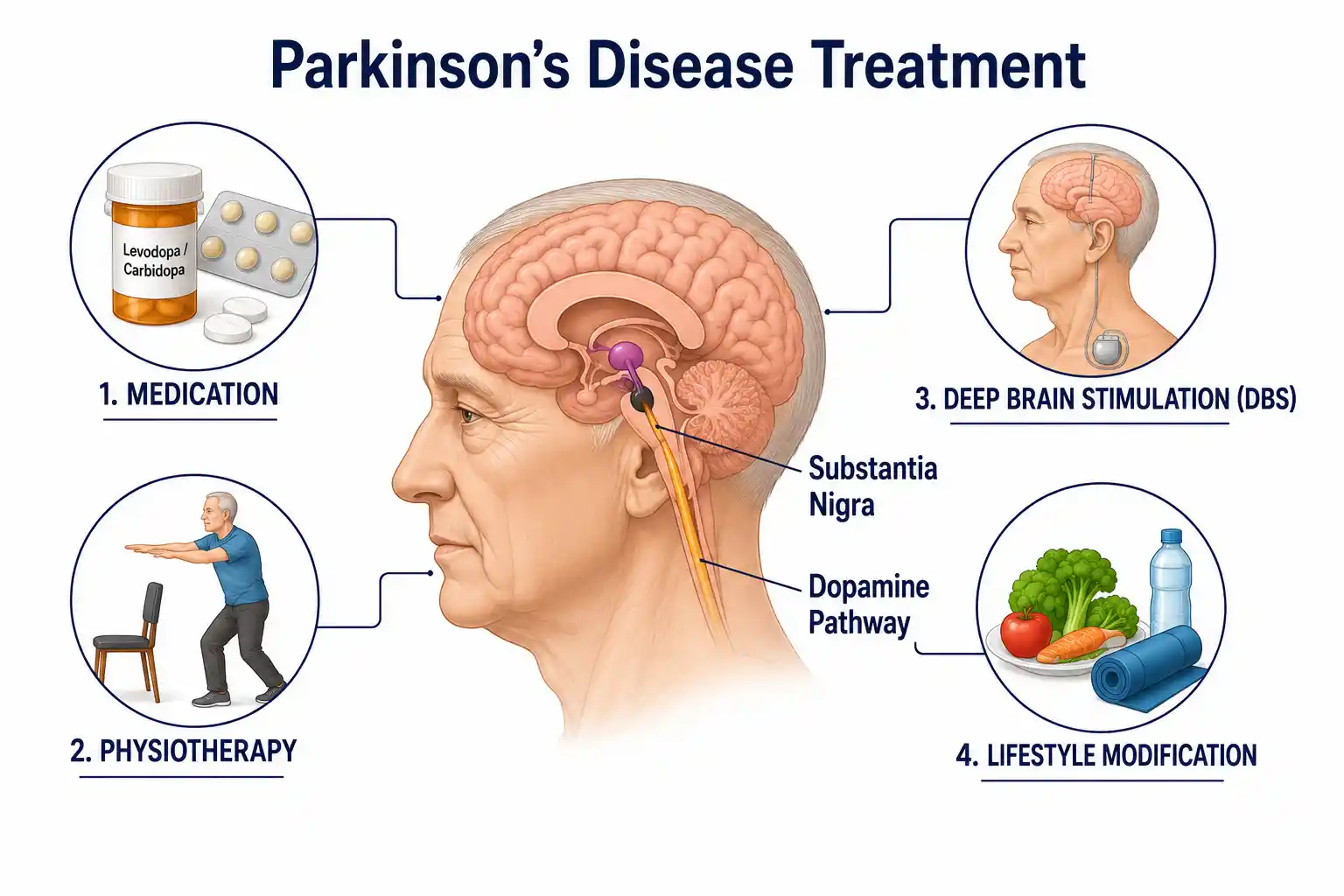
Parkinson's disease treatment focuses on managing symptoms, improving mobility, and enhancing quality of life. Explore the available treatment options, including medications, therapies, and advanced procedures like Deep Brain Stimulation (DBS).
Parkinson's disease treatment focuses on managing symptoms, improving mobility, and enhancing quality of ... Read More




Free Cab Facility

No-Cost EMI

Support in Insurance Claim

1-day Hospitalization

USFDA-Approved Procedure
Parkinson’s disease is a chronic neurodegenerative disorder caused by the gradual loss of dopamine-producing nerve cells in a part of the brain called the substantia nigra. Dopamine is responsible for coordinating smooth and controlled body movements.
As dopamine levels decrease, patients may develop tremors, muscle stiffness, slow movements, balance problems, and other neurological symptoms. Parkinson’s disease typically progresses slowly over several years, and symptoms vary from person to person.
Although Parkinson’s disease commonly affects people above 60 years of age, younger individuals can also develop early-onset Parkinson’s disease.
Free Neurology Others Surgery Cost Calculator
Fill details to get actual cost
Symptoms usually begin gradually and worsen over time.
Common symptoms include:
Non-motor symptoms may include:
The exact cause of Parkinson’s disease is not fully understood. It is believed to result from a combination of genetic and environmental factors.
Possible causes include:
In most cases, Parkinson’s disease develops without a clearly identifiable cause.
Certain factors increase the likelihood of developing Parkinson’s disease.
These include:

Diet & Lifestyle Consultation

Post-Surgery Follow-Up

Free Cab Facility

24*7 Patient Support
Consult a neurologist if you experience:
Early diagnosis allows treatment to begin before symptoms become severely disabling.
There is no single laboratory test that confirms Parkinson’s disease. Diagnosis is primarily based on medical history, neurological examination, and assessment of symptoms.
Your neurologist may recommend:
Assessment of:
Evaluation of:
To rule out other neurological disorders:
In uncertain cases, a DaT scan may help evaluate dopamine activity in the brain.
Performed to exclude other conditions that may mimic Parkinson’s disease.
Treatment depends on:
Most patients require a combination of medications, physical therapy, lifestyle modifications, and regular follow-up.
Medications are the first line of treatment.
Common medicines include:
The most effective medication for improving movement symptoms.
Helps manage:
These medications mimic dopamine in the brain.
Examples include:
Help prevent dopamine breakdown.
Examples:
Increase the effectiveness of Levodopa.
May help reduce involuntary movements and improve mild symptoms.
Medication schedules are individualized and adjusted over time based on symptom control and side effects.
When medications become less effective or symptoms fluctuate significantly, advanced therapies may be considered.
These include:
DBS is a surgical procedure in which electrodes are implanted into specific areas of the brain.
A small battery-operated device placed under the chest skin sends electrical impulses to regulate abnormal brain activity.
DBS can help reduce:
Not every patient is a suitable candidate. A neurologist and neurosurgeon perform detailed evaluation before recommending surgery.
Some patients may benefit from continuous intestinal or subcutaneous medication delivery systems that provide steady dopamine replacement.
Rehabilitation plays an important role throughout treatment.
Patients may benefit from:
Improves:
Helps patients maintain independence during daily activities.
Improves:
Supports healthy weight, medication absorption, and bowel health.
Lifestyle modifications can improve overall functioning.
Doctors commonly recommend:
Parkinson’s disease requires lifelong management.
Regular follow-up appointments allow neurologists to:
Many patients continue leading active and independent lives for years with proper treatment.
Without appropriate management, Parkinson’s disease may lead to:
Early treatment helps minimize these complications.
Pristyn Care focuses on patient-centered neurological care through experienced specialists and comprehensive support.
Our services include:
No. Parkinson’s disease cannot currently be cured, but treatment can effectively control symptoms and improve quality of life.
Treatment usually includes medications, physical therapy, speech therapy, lifestyle modifications, and advanced therapies such as Deep Brain Stimulation for selected patients.
Most cases are not inherited, although certain genetic mutations may increase the risk.
Yes. Regular exercise improves mobility, balance, flexibility, strength, and overall function.
Surgery such as Deep Brain Stimulation may be recommended when medications no longer provide adequate symptom control or cause significant side effects.
Many individuals live for decades after diagnosis. Life expectancy depends on age, overall health, disease progression, and access to appropriate treatment.
Yes. Some patients may develop mild cognitive impairment or dementia in later stages of the disease.
A neurologist specializes in diagnosing and treating Parkinson’s disease. Patients requiring surgery are additionally evaluated by a neurosurgeon.
While Parkinson’s disease itself is primarily a movement disorder, many patients experience muscle pain, stiffness, cramps, or joint discomfort that can be managed with appropriate treatment.
Yes. With timely diagnosis, appropriate medications, rehabilitation, and regular medical follow-up, most patients can achieve good symptom control and maintain independence for many years.