Select City

Call Us
Book FREE Appointment
URSL is considered the best treatment method for kidney stones that are small or medium in size. It’s minimally invasive and has a high success rate, and offers quick respite from kidney stones while keeping the patient at ease. At Pristyn Care, the expert urologists treat kidney stones with URSL procedure and help restore the patient’s health.
URSL is considered the best treatment method for kidney stones that are small ...or medium in size. It’s minimally invasive and has a high success rate, and offers quick respite from kidney stones while keeping the patient at ease. At Pristyn Care, the expert urologists treat kidney stones with URSL procedure and help restore the patient’s health. Read More


3M+
Happy Patients
50+
Disease
200+
Hospitals
30+
Cities

Free Cab Facility

No-Cost EMI

Support in Insurance Claim

1-day Hospitalization

USFDA-Approved Procedure
Choose Your City
It help us to find the best doctors near you.

Bangalore
Delhi
Gurgaon
Hyderabad
Mumbai
Pune
Delhi
Hyderabad
Pune
Mumbai
Bangalore
 Doctor Not Found
4.5/5
29 Years Experience
 Pristyn Care ZOI Hospital, Ameerpet, Hyderabad
4.5/5
19 Years Experience
Pristyn Care Sheetla Hospital, Sector 8, Gurgaon4.5/5
15 Years Experience
Pristyn Care ZOI Hospital, Ameerpet, Hyderabad4.5/5
12 Years Experience
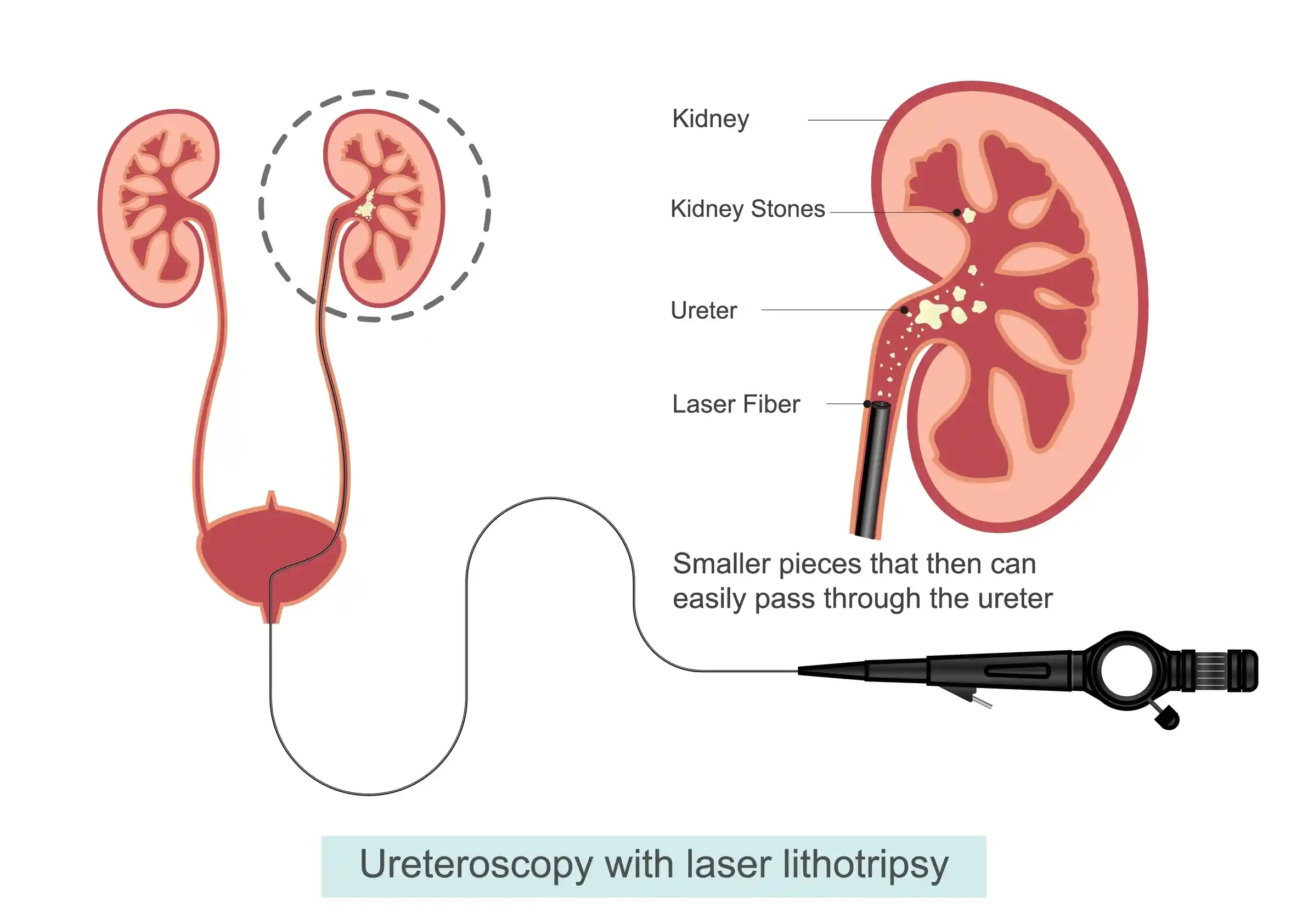
Pristyn Care ZOI Hospital, Ameerpet, HyderabadUreteroscopic lithotripsy is a minimally invasive procedure to treat kidney stones lodged in the ureters. Ureters are muscular, thin tubes, each about 25 to 30 centimeters long, that transport urine from the kidneys to the bladder. Ureters are essential to the urinary system, as they propel urine using the peristaltic waves, which are the rhythmic contractions of the muscles in the ureter walls.
Kidney stones can cause excruciating pain, obstruct urine flow, and may lead to severe complications, like kidney damage or urinary tract infections. To locate and treat these stones without making large incisions, URSL uses a ureteroscope, a thin, flexible device with a camera and equipment. This procedure effectively reduces the discomfort and health risks related to ureteral stones through precise visualization and management of stones.
Free Kidney Stones Surgery Cost Calculator
Fill details to get actual cost
Ureteroscopic lithotripsy (URSL) is usually advised for people who have:
Stones of Small to Medium Size
Generally less than 2 centimetres
Stones located anywhere in the ureter
Stones that have not responded to other treatments
Renal pelvis stones
Stones located in the renal pelvis or central collecting chamber of the kidney can be treated using URSL.
Obstruction and Pain
When kidney or ureteral stones have caused significant obstruction, causing symptoms such as hydronephrosis or impaired kidney functioning
Ureteroscopic lithotripsy (URSL) has many advantages over traditional kidney stone surgery:

 The patient arrives at the hospital.Registration and admission formalities are completed.Vital signs, including blood pressure, pulse, temperature, and oxygen levels, are checked.
 The urologist reviews the patient's medical history, imaging reports, and laboratory investigations.Blood tests, urine tests, and CT scan, X-ray, or ultrasound reports are evaluated.The procedure, expected outcomes, and possible risks are explained.Informed consent is obtained, and an IV line is started for fluids and medications.
 The patient is taken to the operating theatre.General or spinal anaesthesia is administered to ensure a pain-free procedure.The patient's vital signs are continuously monitored throughout the surgery.
 The urologist inserts a thin ureteroscope through the urethra and bladder into the ureter without making any external incision.The ureteric stone is located using the ureteroscope.A laser fibre (commonly a Holmium:YAG laser) or a pneumatic lithotripter is used to break the stone into small fragments.The stone fragments are removed using tiny baskets or graspers, or allowed to pass naturally through urine.If required, a DJ (Double-J) stent is placed in the ureter to ensure proper urine drainage and reduce swelling after the procedure.
 The patient is shifted to the recovery room for observation.Nurses monitor blood pressure, pulse, oxygen levels, urine output, and overall recovery.Once fully awake and stable, the patient can begin drinking fluids and gradually resume a light diet.Pain-relieving medications and antibiotics are provided if required.
 Most patients are discharged on the same day or within 24 hours.Medications for pain relief, infection prevention, and stent-related discomfort (if a stent has been placed) are prescribed.Patients are advised to drink plenty of water, avoid strenuous physical activities for a few days, and attend scheduled follow-up visits.If a DJ stent has been inserted, it is usually removed after a few days or weeks, depending on the doctor's recommendation.Patients should contact their doctor immediately if they experience persistent fever, severe pain, inability to pass urine, heavy blood in the urine, or persistent vomiting.
Diet & Lifestyle Consultation

Post-Surgery Follow-Up

Free Cab Facility

24*7 Patient Support
Ureteral stents are inserted to flush out the stones. Stents expand the ureteral passage and allow the stone to move out of the body easily through the ureter. The stent helps to maintain the urine flow, reduces complications, such as swelling or blockage, and promotes healing of the ureter. Depending on your specific medical conditions and the circumstances of your procedure, in some cases, the doctor may use a temporary ureteral stent during or after the ureteroscopic lithotripsy.
Like any medical procedure, URSL has some risks and potential complications, even though it is generally safe and successful. The primary risks and complications of URSL are listed below.
Using instruments inside the kidney and ureter during URSL can sometimes cause bleeding. Usually minor, this goes away on its own, but in rare instances, it may need additional interventions to control.
There is a slight chance of bacteria because of the tools in the urinary tract. Fever, chills, increased pain, or changes in the colour or odour of the urine are some signs of an infection. If an infection develops, prompt antibiotic therapy is essential.
The ureteral wall may unintentionally sustain damage when devices are inserted and moved inside the small ureter. There is still a chance of ureteral damage, which can necessitate additional care, even if urologists take measures and employ imaging methods to direct their actions.
After the URSL, swelling or tiny stone particles may temporarily block the ureter, resulting in symptoms like pain or trouble peeing. A temporary ureteral stent may be implanted in some situations to maintain urine flow until the obstruction clears.
Tiny residual stone particles may still be present in the urinary tract even after successful stone breakup and removal after URSL. These pieces may eventually enlarge or act as locations for repeated stone formation. To guarantee complete stone clearance, additional imaging tests could be advised.
Although rare, allergic reactions to medications used during URSL, such as anaesthesia or contrast dye, are possible. To reduce this risk, it’s important to let your healthcare practitioner know about existing allergies in advance.
If URSL is carried out under general anaesthesia, there are inherent risks related to the administration of anaesthesia, such as adverse reactions or respiratory issues.
Like most kidney stone procedures, URSL Surgery is also performed under anaesthesia and causes minimal pain or discomfort to the patient.
This procedure generally takes 30 to 45 minutes. However, the time may vary based on the location of the stones, their size, and other factors.
Yes. URSL surgery is performed when kidney stones can’t be managed through other methods, and it’s considered a medical necessity. Therefore, it is covered by most insurance companies.


 MB
MBMR.BALASAHEB BARKU GHANWAT

 Recommends
Recommends
I satisfied about doctor treatment Proper guide and treatment is very well. Thanku Gulhane Sir
.svg) JK
JKJitendra kumar
Recommends
Recommends
Thanks so much doctor sahab all staff member coparative nyc staff
.svg) SA
SAsandeep, 26 Yrs
Recommends
Recommends
i was so scared hearing about kidney stone surgery but this one was not even like a surgery. No cuts, no stitches. Just little discomfort after but manageable.
STSugam Thapa, 21 Yrs
Recommends
Recommends
Dr. Priyank and the entire Pristyn Care team explained the surgery procedure very well. I'm very thankful to them that everything went smoothly. Very happy with their service. Will recommend Pristyn Care to all my friends and family members.
RVRaju Vishwakarma
Recommends
Recommends
Before taking treatment from pristyn care, I was totally against the private hospitals. But my perception changed when I took treatment from pristyn care. They have provided different treatment options along with other non-operative services. Without any tension, I've recovered from the disease now.
AGArijit Goyal
Recommends
Recommends
Last month, I took URSL therapy from Pristyn care. The doctors were so compassionate and understanding, and with all the safety tips they completed the procedure and due to this the recovery was extremely good.
.svg)
Avail FREE Doctor Consultation

Consult with our expert surgeon for more than 50+ diseases

Once you share your details, our care coordinator will get in touch with you.

The coordinator will understand your symptoms and health condition in detail.

Your consultation will be scheduled at the earliest.
3M +
Happy Patients
150 +
Clinics
30 +
Cities

120Cr—Patient Savings Delivered
so patients focus on recovery, not bills.

Complete Transparency
No hidden charges or surprise bills

End-to-End Insurance Handling
Complete insurance processing support

Up to 20% Savings on Every Surgery
powered by smarter insurance handling

Easy EMI Options
Flexible payment plans available
120Cr—Patient Savings Delivered
so patients focus on recovery, not bills.
Complete Transparency
No hidden charges or surprise bills
Your Form Has Been Submitted Successfully.
Our care coordinator will call you shortly.


Book Your FREE Consultation
Consult with our expert surgeon for more than 50+ diseases
Once you share your details, our care coordinator will get in touch with you.
The coordinator will understand your symptoms and health condition in detail.
Your consultation will be scheduled at the earliest.
3M +
Happy Patients
150 +
Clinics
30 +
Cities