Select City
Select City

RIRS (Retrograde Intrarenal Surgery) is considered the best resort for treating complex cases of kidney stones. Itâs minimally invasive, involves no cuts or stitches, and is used for treating stones in both adults and children.
RIRS (Retrograde Intrarenal Surgery) is considered the best resort for treating complex cases ... Read More




Free Cab Facility

No-Cost EMI

Support in Insurance Claim

1-day Hospitalization

USFDA-Approved Procedure
Choose Your City
It help us to find the best doctors near you.

Bangalore
Delhi
Gurgaon
Hyderabad
Indore
Mumbai
Pune
Delhi
Hyderabad
Pune
Mumbai
Bangalore
 Pristyn Care ZOI Hospital, Ameerpet, Hyderabad
Manorama Ganj, Old Palasia, Indore, Madhya Pradesh 452003
Pristyn Care Sheetla Hospital, Sector 8, Gurgaon
Pristyn Care ZOI Hospital, Ameerpet, Hyderabad
Pristyn Care ZOI Hospital, Ameerpet, Hyderabad
Manorama Ganj, Old Palasia, Indore, Madhya Pradesh 452003
Pristyn Care Sheetla Hospital, Sector 8, Gurgaon
Pristyn Care ZOI Hospital, Ameerpet, Hyderabad
RIRS medical abbreviationâ (RIRS full form) – Retrograde Intrarenal Surgery, is a retrograde ureteroscopic technique for extracting kidney stones. In this procedure, surgeons make the urethra the pathway to reach the kidneys. It is a minimally invasive technique that involves no cuts or holes. The surgeons use an optic endoscope to reach the kidneys and locate the stones and then use a laser to reduce the stones to dust. This technique is generally used in cases of large or complex stones that lithotripsy canât treat. RIRS Surgery has high success rates, and the risk of complications is close to zero. Get in touch with Pristyn Careâs experienced urologists to get the best RIRS surgery in the country.
Free Kidney Stones Surgery Cost Calculator
Fill details to get actual cost
Before performing RIRS Surgery, the surgeons recommend some diagnostic tests which help them assess several factors, including the size and location of the stones, underlying diseases, and the patient’s overall health. All the patients need to have the test results with them on the day of the surgery. The commonly performed diagnostic tests before RIRS Surgery are :Â
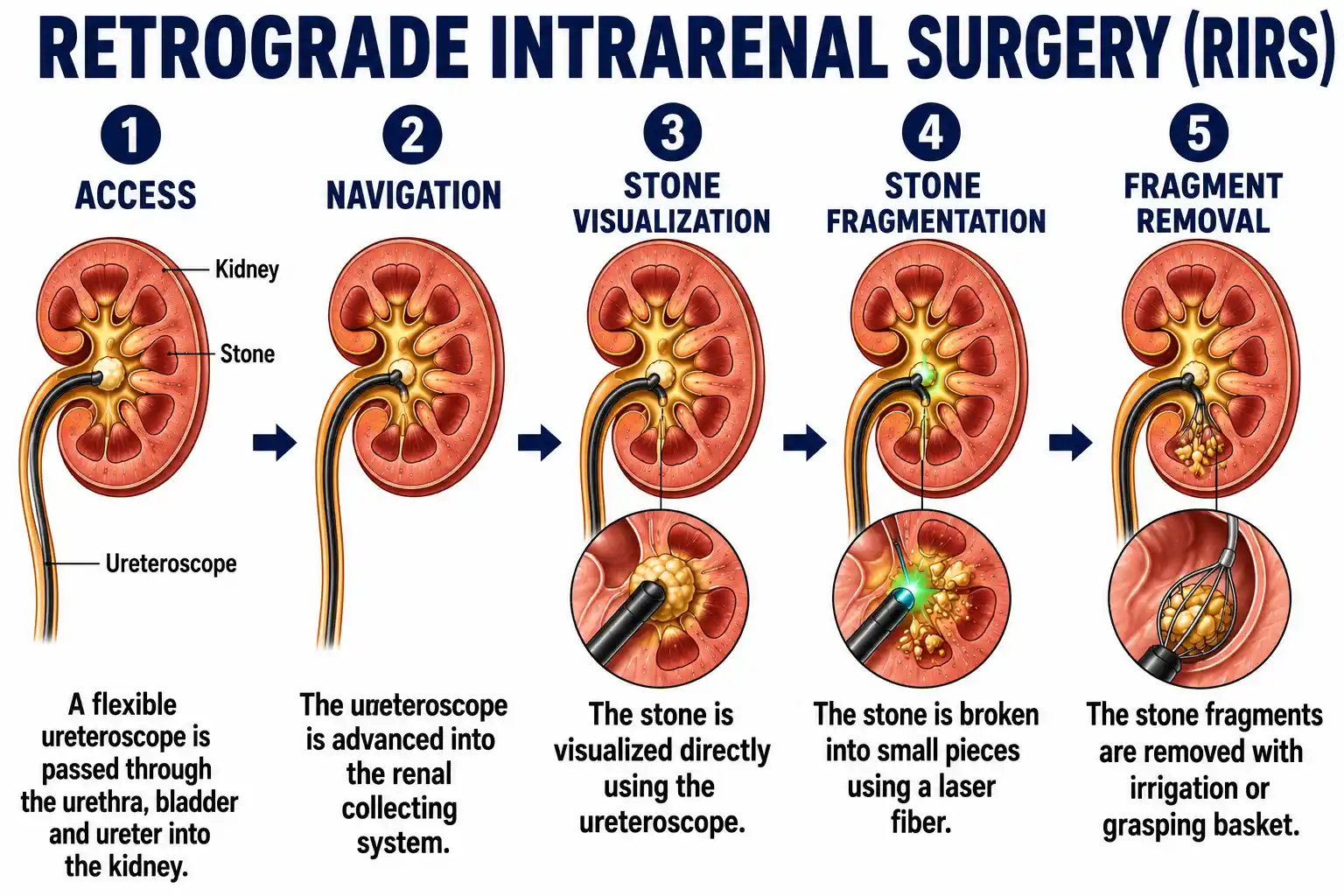
RIRS is performed in the following steps:Â
The patient is given anesthesia which keeps them sedated throughout the surgery. The doctor can use spinal or general anesthesia for this procedure, based on the patient’s preference.Â
In the next step, the surgeon inserts an endoscope, which is a long and flexible tube, into the urethra to reach the urine-collecting part of the kidneys. This is an x-ray-guided procedure, and the doctors can see the images externally on a screen. This allows the surgeon to perform the procedure with more precision.Â
The endoscope is then moved upwards in retrograde towards the kidneys to locate the stones. Upon locating the stones, the surgeons use a laser probe to break the kidney stones and reduce them into fine fragments.Â
The broken fragments are then collected in a ‘stone basket’ and ultimately extracted through the same passageway.Â
The surgeons may use double J stents- ureteral stents (RIRS DJ stenting) placed in the ureter before or after the surgery. In some cases, the stents are placed before the surgery to dilate the ureter to allow the endoscope to pass easily during the procedure. In other cases, the stent is placed after the surgery for 7 to 10 days to promote healing.Â
Being prepared for the surgery helps in ensuring a seamless surgical experience As with any other surgery, preparation is key for RIRS Surgery as it contributes to the efficacy of the procedure and reduces the risk of complications. Your doctor will give you some instructions to help you prepare for the surgery. Here’s how you can prepare for RIRS Surgery :Â
What Happens During RIRS (Retrograde Intrarenal Surgery)?
 Step 1 · 30-60 mins
Hospital Admission
 The patient arrives at the hospital.
Registration and admission formalities are completed.
Vital signs, including blood pressure, pulse, temperature, and oxygen levels, are checked.
The patient arrives at the hospital.
Registration and admission formalities are completed.
Vital signs, including blood pressure, pulse, temperature, and oxygen levels, are checked.
 Step 2 · 20-40 mins
Pre-surgery Preparation
The urologist reviews the patient's medical history, imaging reports, and laboratory investigations.
Blood tests, urine tests, and CT scan or ultrasound findings are evaluated.
The procedure, expected outcomes, and possible risks are explained.
Informed consent is obtained, and an IV line is started for fluids and medications.
 Step 3 · 10-15 mins
Anesthesia Administration
The patient is taken to the operating theatre.
General or spinal anaesthesia is administered to ensure a pain-free procedure.
The patient's vital signs are continuously monitored throughout the surgery.
 Step 4 · 45-90 mins
RIRS Procedure
The urologist inserts a thin, flexible ureteroscope through the urethra and bladder into the ureter and kidney without making any external incision.
The kidney stone is located using the flexible scope.
A laser fibre (usually a Holmium:YAG or Thulium laser) is used to break the stone into tiny fragments.
Small stone fragments may be removed using a retrieval basket, while the remaining fragments are left to pass naturally through urine.
If required, a DJ (Double-J) stent is placed in the ureter to ensure proper urine drainage and aid healing.
 Step 5 · 1-2 hours
Post-surgery Recovery
The patient is shifted to the recovery room for observation.
Nurses monitor blood pressure, pulse, oxygen levels, urine output, and overall recovery.
Once fully awake and stable, the patient can begin drinking fluids and gradually resume a light diet.
Pain-relieving medications and antibiotics are administered if required.
 Step 6 · Same Day or Within 24 Hours
Discharge
Most patients are discharged on the same day or within 24 hours.
Medications for pain relief, infection prevention, and stent-related discomfort (if a stent is placed) are prescribed.
Patients are advised to drink plenty of water, avoid strenuous activities for a few days, and attend follow-up visits.
If a DJ stent has been placed, it is usually removed after a few days or weeks, as advised by the urologist.
Patients should contact their doctor immediately if they experience persistent fever, severe pain, heavy bleeding in urine, inability to pass urine, or persistent vomiting.
The total recovery period after RIRS Surgery is generally quite short, and most patients can resume work and their day-to-day tasks within a day or two of the surgery. Since this procedure does not involve any cuts or stitches, the risk of complications is also minimal. Here are some tips that can help you recover quickly and avoid complications after RIRS Surgery :Â

Diet & Lifestyle Consultation

Post-Surgery Follow-Up

Free Cab Facility

24*7 Patient Support
RIRS Surgery is an advanced treatment technique for kidney stones with a high success rate. Listed below are some common benefits of RIRS Surgery :
Yes. Since untreated kidney stones can lead to complications in adults as well as kids, its surgery is considered a medical necessity and itâs thereby covered under health insurance. However, the insurance coverage can vary depending upon the terms and condition of the insurance provider.Â
In general, RIRS Surgery takes 1 to 2 hours to complete. However, the duration of the surgery can vary based on several factors including the size and number of stones, location of the stone, age and overall health of the patient, the total experience of the urologist, etc.Â
Not really. This surgery is performed under anesthesia, and therefore causes no discomfort. Additionally, it does not involve any cuts or stitches. However, patients might experience mild pain or discomfort after the surgery due to stent insertion, but it should be manageable.Â
Yes. RIRS Surgery is a safe and effective surgery for treating kidney stones in adults as well as kids. It has a low complication rate, and the recovery period is also quite short.



USHA RANI, 42 Yrs

 Recommends
The overall experience is ok ok.
USHA RANI, 42 Yrs
Recommends
Mere kidney me 9mm ka stone tha fr doctor ne RIRS suggest kiya. Surgery ekdum painless thi, bas 2-3 din tak halka burning feel hua jab urine pass karta tha. But now mai fully thik hu. Thank you.
Nitin yadav
Recommends
Kudos to @PristynCare for their outstanding support during my kidney stones treatment. Grateful to Dr. Garima Sawhney, Harsimarbir Singh and Dr. Vaibhav Kapoor for their expertise. Special thanks to Dr Naveen M N for the seamless coordination. #PristynCare #HealthcareExcellence
Rakesh, 26 Yrs
My kidney stone surgery was too expensive for me.
Shilpa Mantri
Recommends
My experience with Pristyn Care for RIRS surgery was fantastic. The doctors were highly skilled and understanding, making me feel understood and supported. They thoroughly assessed my condition and recommended a personalized treatment plan. Pristyn Care's team provided excellent post-operative care, ensuring my comfort and closely monitoring my progress. They were available for follow-ups and provided valuable advice. Thanks to Pristyn Care, my kidney stones are now treated, and I feel more relieved and healthier. I am grateful for their expertise and compassionate care during this transformative surgery.
.svg)









.svg)
.svg)