Select City

Call Us
Book FREE Appointment
Rectal prolapse is a proctological condition in which the rectum slides down the anus and often leads to potential complications such as strangulation of the rectum, bleeding, and ulceration. Therefore, timely treatment is a must. At Pristyn Care, we provide advanced surgical treatments for Rectal Prolapse and help patients get relief from the discomfort caused by this condition. Book your appointment with our proctologists now!
Rectal prolapse is a proctological condition in which the rectum slides down the ...anus and often leads to potential complications such as strangulation of the rectum, bleeding, and ulceration. Therefore, timely treatment is a must. At Pristyn Care, we provide advanced surgical treatments for Rectal Prolapse and help patients get relief from the discomfort caused by this condition. Book your appointment with our proctologists now!Read More




3M+
Happy Patients
50+
Disease
200+
Hospitals
30+
Cities

Free Cab Facility

No-Cost EMI

Support in Insurance Claim

1-day Hospitalization

USFDA-Approved Procedure
Choose Your City
It help us to find the best doctors near you.

Ahmedabad
Bangalore
Bhubaneswar
Chandigarh
Chennai
Coimbatore
Delhi
Hyderabad
Indore
Jaipur
Kochi
Kolkata
Kozhikode
Lucknow
Madurai
Mumbai
Patna
Pune
Raipur
Ranchi
Thiruvananthapuram
Vijayawada
Visakhapatnam
Delhi
Hyderabad
Pune
Mumbai
Bangalore
 Doctor Not Found
4.5/5
31 Years Experience
 Pristyn Care Elantis Hospital, Lajpat Nagar, Delhi
5.0/5
30 Years Experience
Opp.Badwani Plaza, Manorama Ganj, Old Palasia, Indore, Madhya Pradesh 4520034.5/5
25 Years Experience
Pristyn Care Eminent Hospital 6/1 Opp. Barwani Plaza, Manorama Ganj, Old Palasia, Indore - 4520184.5/5
23 Years Experience
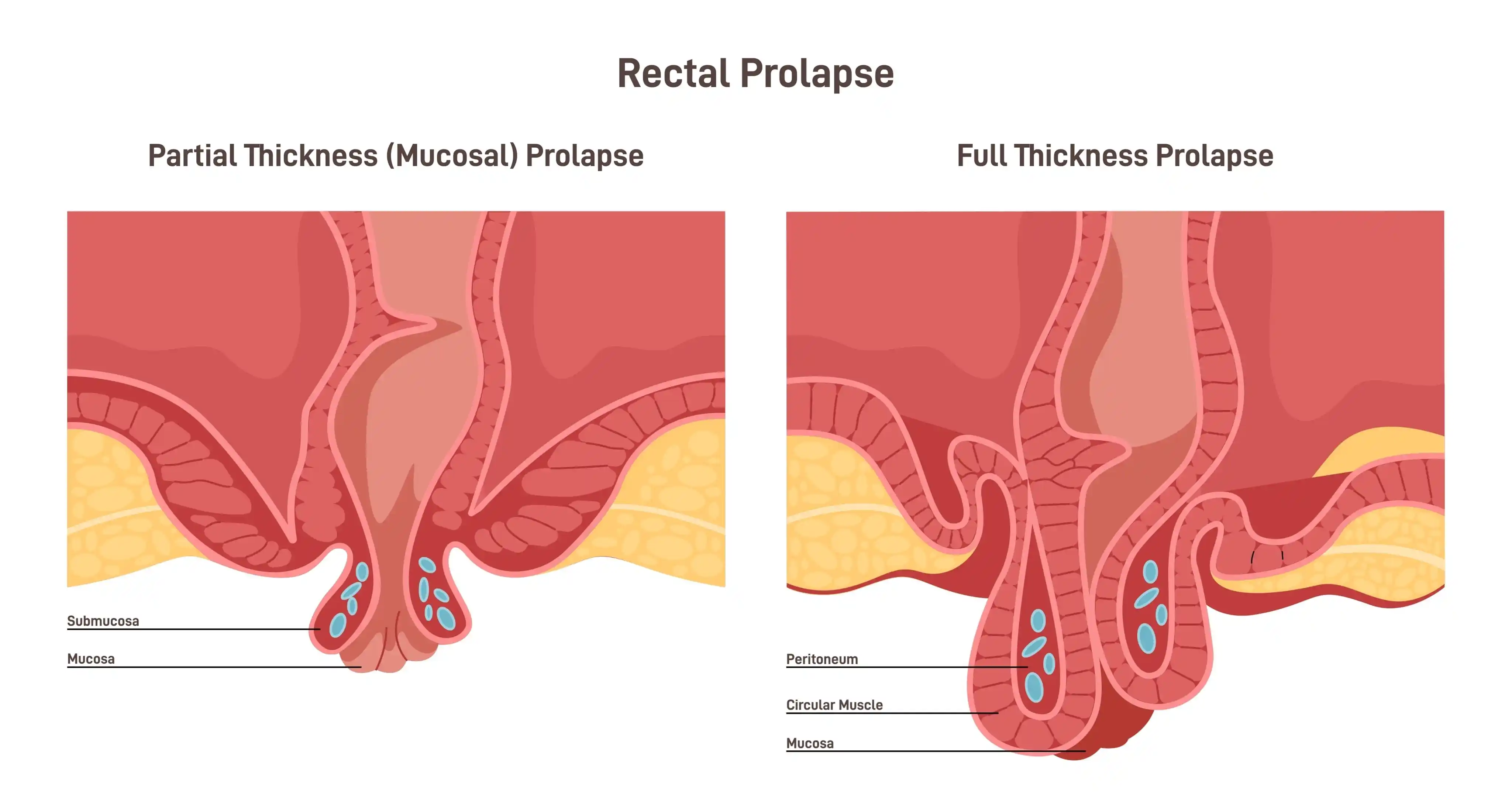
Pristyn Care Sheetla Hospital, Sector 8, GurgaonThe rectum is the last part of your colon where stool forms before a bowel movement. When poop arrives in the rectum, a network of muscles pushes it out through the anus, creating an urge to defecate. However, when rectal prolapse happens, the rectum itself moves along with it and slips into the anal canal, sometimes out the other side.
When the rectum bulges out through the anus, it forms a lump. Prolapse usually indicates that the rectum’s supporting muscles have degenerated or become weaker. Ageing may naturally cause some weakening or degradation, but additional strain on the muscles can hasten the process. During the initial stages, you experience the rectal prolapse only after a bowel movement, and you can push it back in. However, with time, the prolapse becomes severe and requires surgery.
Disease name
Surgery name
Duration
Treated by
Free Rectal Prolapse Surgery Cost Calculator
Fill details to get actual cost
Depending on the severity, rectal prolapse symptoms may include:
The following are the risk factors that may trigger the rectal prolapse.
Depending on the severity of rectal prolapse, it is graded as follows:

Diet & Lifestyle Consultation

Post-Surgery Recovery Follow up

Free Cab Facility

24*7 Patient Support
| Grades of rectal prolapse | |
| Grade I | Prolapse descends no lower than the top of a rectocele |
| Grade II | Prolapse reaches the rectocele level but stays above the anal canal. |
| Grade III | Prolapse enters the upper part of the anal canal |
| Grade IV | Prolapse descends into the lower part of the anal canal. |
| Grade V | The rectal wall visibly protrudes outside the anal canal |
Rectal prolapse is more likely to happen to someone who has any of the following:
Your doctor will examine your symptoms and medical history and perform the following diagnostic tests.
Before surgery for rectal prolapse
The various types of rectal prolapse treatment surgery include:
Delorme procedure. The procedure includes folding and sewing a portion of the rectal wall to itself to reinforce weak or damaged tissue. The patient will experience an improved bowel movement and decreased risk of recurrence after the surgery. During the procedure, the doctor will insert a proctoscope into the rectum to visualize the prolapse. The prolapsed tissue is then removed, using a scalpel or scissors and the edges of the remaining rectal tissue are sutured.
You might be able to manage rectal prolapse at home for a while if the symptoms aren’t too severe. To take care of it, you must manually push your rectum back inside. The doctor may advise you to lie on your side with your legs close to your chest and gently press your rectum back into position using a warm, damp towel. Prolapse will, however, get worse over time.
Rectal prolapse that is left untreated may cause several issues, such as:
Cord prolapse or umbilical cord prolapse is an obstetric emergency wherein the umbilical cord slips down through the open cervix during labour. It cuts off the oxygen supply of the baby through compression. The three main types of cord prolapse are occult, overt, and cord presentation.
The anal sphincter’s function is to regulate bowel movements and prevent leakage through two muscles, the internal anal sphincter and the external anal sphincter. Together, these muscles allow you to hold and control stool until you are in a suitable place to defecate and relax.
Cord prolapse management requires an immediate delivery, usually a C-section. Your doctor may attempt to relieve cord compression by moving you to a knee-to-chest position, which reduces the risk of oxygen loss temporarily.
Mucus from the anus indicates the presence of inflammation, infection, hemorrhoids or rectal prolapse. Consult a doctor for the proper diagnosis if it is persistent and accompanied by pain, cramps, or weight loss.



 PU
PUPunam

 Recommends
Recommends
I was very uncomfortable because of rectal prolapse and felt embarrassed to talk about it. After treatment, I feel much better, and my daily routine is normal again.
.svg) HK
HKHari krishna
Recommends
Recommends
Rectal prolapse ki wajah se baithne aur bathroom jaane mein problem ho rahi thi. Surgery ke baad kaafi relief mila. Recovery smooth, Rahi.
.svg) KA
KAK Akash kumar
Recommends
Recommends
The doctor explained my condition clearly and suggested the best treatment option. The procedure went well, and my symptoms have improved a lot.
TSTanweer Shaikh
Recommends
Recommends
Mujhe kaafi pain aur swelling feel hoti thi. Treatment ke baad discomfort almost khatam ho gaya. Ab confidence bhi wapas aa gaya hai.
TKT K Kiran
Recommends
Recommends
I was scared about surgery, but the team handled everything very professionally. The hospital stay was short, and I recovered faster than expected.
PMParth Misra
Recommends
Recommends
My experience with Pristyn Care for rectal prolapse treatment was absolutely wonderful. The caring and skilled medical team made the process comfortable, and the treatment was successful. I highly recommend Pristyn Care for its excellent care and efficient services.
.svg)
Avail FREE Doctor Consultation

Consult with our expert surgeon for more than 50+ diseases

Once you share your details, our care coordinator will get in touch with you.

The coordinator will understand your symptoms and health condition in detail.

Your consultation will be scheduled at the earliest.
3M +
Happy Patients
150 +
Clinics
30 +
Cities

120Cr—Patient Savings Delivered
so patients focus on recovery, not bills.

Complete Transparency
No hidden charges or surprise bills

End-to-End Insurance Handling
Complete insurance processing support

Up to 20% Savings on Every Surgery
powered by smarter insurance handling

Easy EMI Options
Flexible payment plans available
120Cr—Patient Savings Delivered
so patients focus on recovery, not bills.
Complete Transparency
No hidden charges or surprise bills
Your Form Has Been Submitted Successfully.
Our care coordinator will call you shortly.


Book Your FREE Consultation
Consult with our expert surgeon for more than 50+ diseases
Once you share your details, our care coordinator will get in touch with you.
The coordinator will understand your symptoms and health condition in detail.
Your consultation will be scheduled at the earliest.
3M +
Happy Patients
150 +
Clinics
30 +
Cities
)