Select City

Call Us
Book FREE Appointment
Turbinoplasty, also known as turbinate reduction surgery or turbinectomy, is a minimally invasive ENT procedure performed to reduce the size of enlarged nasal turbinates. Enlarged turbinates can cause chronic nasal congestion, difficulty breathing through the nose, snoring, sleep disturbances, and recurrent sinus infections. At Pristyn Care, experienced ENT specialists perform advanced turbinoplasty using modern techniques such as radiofrequency ablation, coblation, and endoscopic surgery to restore normal airflow and improve breathing with minimal discomfort and faster recovery.
Turbinoplasty, also known as turbinate reduction surgery or turbinectomy, is a minimally invasive ... ENT procedure performed to reduce the size of enlarged nasal turbinates. Enlarged turbinates can cause chronic nasal congestion, difficulty breathing through the nose, snoring, sleep disturbances, and recurrent sinus infections. At Pristyn Care, experienced ENT specialists perform advanced turbinoplasty using modern techniques such as radiofrequency ablation, coblation, and endoscopic surgery to restore normal airflow and improve breathing with minimal discomfort and faster recovery. Read More




3M+
Happy Patients
50+
Disease
200+
Hospitals
30+
Cities

Free Cab Facility

No-Cost EMI

Support in Insurance Claim

1-day Hospitalization

USFDA-Approved Procedure
Choose Your City
It help us to find the best doctors near you.

Bangalore
Chennai
Delhi
Hyderabad
Kochi
Mumbai
Pune
Delhi
Hyderabad
Pune
Mumbai
Bangalore
 Doctor Not Found
4.5/5
15+ Years Experience
 Kochi, Ernakulam, Kerala 682025
4.8/5
21+ Years Experience
Pristyn Care La Midas, Main, Nathupur Rd, nr. 38, DLF Phase 3, Sector 24, Gurugram, Haryana 122002
5.0/5
18+ Years Experience
Shop No, 1, petrol pump, Ground Floor, Shram Safalya Building, 2, Veer Savarkar Marg, near Teen, Naupada, Thane West, Thane, Maharashtra 400602
4.5/5
18+ Years Experience
3B/79, Ekta Recidency, Pipeline road, near Hanuman mandir, Oppo. Noble medical, Chembur (w), Tilak Nagar, Mumbai, Maharashtra - 400089.
Turbinates are long, narrow bony structures located inside the nasal cavity. They are covered with soft tissue called mucosa and play an important role in filtering, humidifying, and warming the air you breathe.
There are three pairs of turbinates inside the nose:
The inferior turbinates are the largest and are most commonly affected by chronic swelling or enlargement.
Free Turbinoplasty Surgery Cost Calculator
Fill details to get actual cost
Turbinoplasty is also known as turbinectomy. It is a surgical procedure that reduces the size of enlarged nasal turbinates while preserving their normal function. The goal is to improve airflow through the nasal passages and relieve chronic nasal blockage.
Unlike traditional turbinectomy, modern turbinoplasty techniques preserve most of the turbinate tissue and focus on reducing excess tissue volume rather than removing the entire turbinate.
The procedure is often performed as a day-care surgery and typically takes 15 to 45 minutes depending on the surgical technique used.
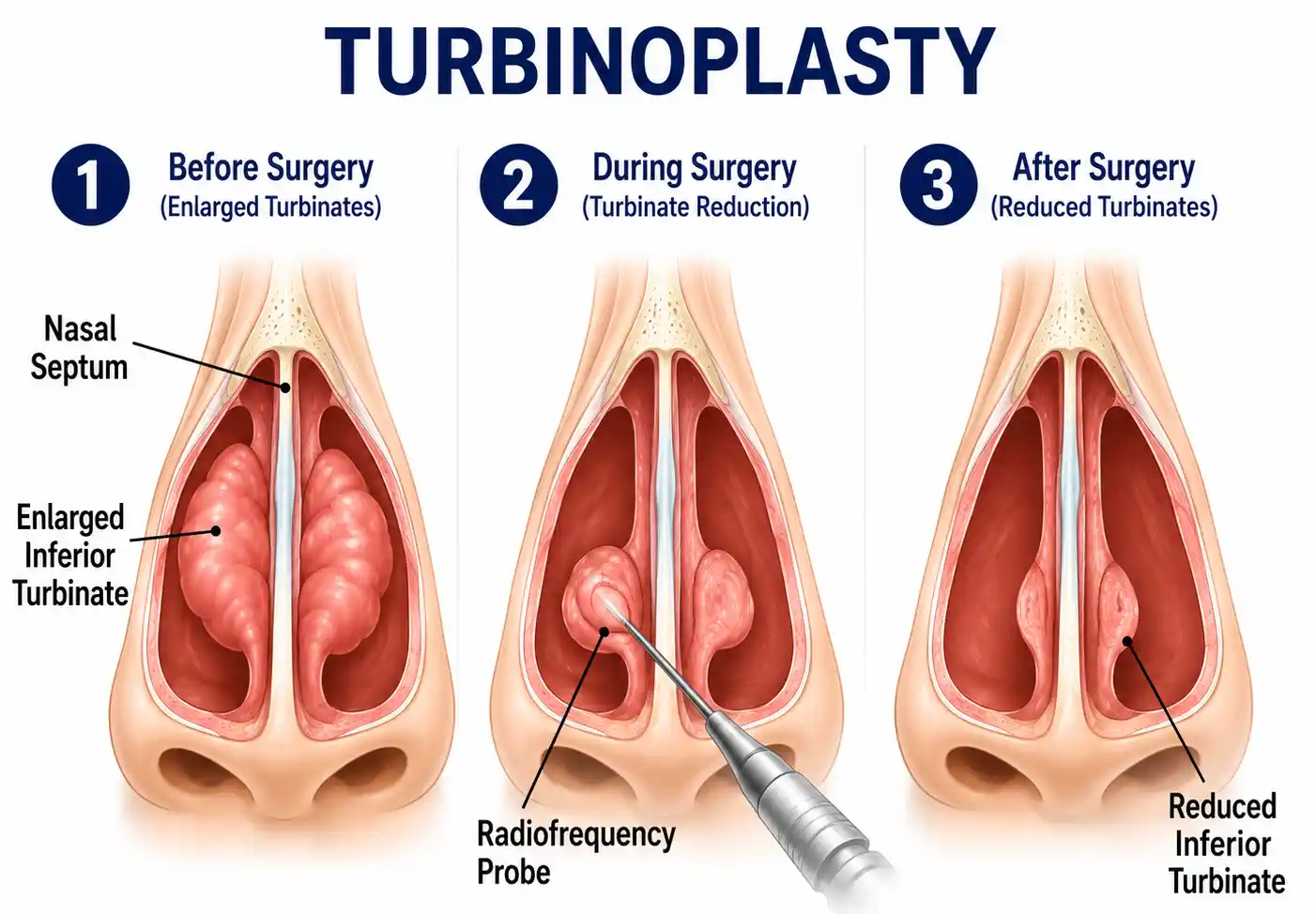
Turbinoplasty may be recommended when enlarged turbinates cause persistent nasal obstruction that does not improve with medications or other conservative treatments.
You may need evaluation by an ENT specialist if you experience:
If these symptoms persist despite medications, turbinate reduction surgery may be considered.

Diet & Lifestyle Consultation

Post-Surgery Follow-Up

Free Cab Facility

24*7 Patient Support
Several conditions can cause the turbinates to become swollen or enlarged.
A detailed ENT assessment helps determine the cause and severity of turbinate enlargement.
Your doctor will evaluate:
A physical examination helps assess the degree of turbinate enlargement and nasal obstruction.
A thin endoscope is inserted into the nose to examine:
Patients with suspected allergic rhinitis may undergo allergy evaluation.
A CT scan may be recommended if chronic sinus disease or structural abnormalities are suspected.
Modern turbinate reduction techniques focus on preserving nasal function while improving airflow.
Radiofrequency energy is used to shrink the turbinate tissue from within.
Benefits include:
Coblation uses low-temperature radiofrequency energy and saline solution to reduce tissue volume.
Benefits include:
A specialized surgical instrument removes excess turbinate tissue while preserving the mucosal lining.
Performed under endoscopic guidance, this technique provides excellent precision and visibility.
In selected cases, a portion of the turbinate bone and soft tissue is surgically removed to create more space in the nasal airway.
Many patients have both enlarged turbinates and a deviated nasal septum.
In such cases, turbinoplasty may be combined with septoplasty to:
Combining both procedures often provides better results than treating either condition alone.
You may be a suitable candidate if:
Your ENT surgeon will provide detailed pre-operative instructions.
You may be advised to:
Your doctor may recommend:
Turbinoplasty is typically performed as a day-care procedure.
The procedure may be performed under:
The choice depends on the technique used and patient preference.
An endoscope is inserted into the nose to provide a magnified view of the nasal cavity.
The surgeon uses radiofrequency, coblation, microdebrider, or surgical instruments to reduce the size of the turbinate.
The procedure is designed to preserve the mucosal lining so the nose continues to warm, filter, and humidify inhaled air.
The surgery is completed without any visible external incisions or scars.
Most patients are discharged on the same day.
Recovery after modern turbinate reduction surgery is usually quick and comfortable.
You may experience:
Most patients notice gradual improvement in breathing.
Swelling continues to decrease and airflow improves significantly.
Full healing typically occurs within 4 to 8 weeks, depending on the surgical technique used.
Turbinoplasty is generally considered a safe procedure when performed by experienced ENT surgeons.
Possible complications include:
Turbinoplasty offers several functional and quality-of-life benefits.
Inflammation and allergies often trigger recurrent swelling of the mucous membranes of the turbinates despite nasal surgery. It is very likely that mucosa could become inflamed and swollen once again after surgical reduction because bone tissue removed from the turbinates will not grow back.
Nasal congestion or discharge is very common for the first few weeks after surgery. Nasal passage or breathing will return to normal after two to three weeks after surgery.
The air flow through the nasal passage can be significantly blocked. This extreme level of blockage leads to snoring problems, recurring nose bleeding, sleep apnea etc and mouth breathing.
The main function of turbinates is to warm and humidify the inhaled air, so turbinates can not be completely removed. The removal of it can result in a very dry and crusty nose. Usually, it may regrow after the surgery and the procedure needs to be repeated.
In some instances, the turbinates swell up due to environmental irritants. Chronic sinusitis, which causes persistent inflammation in the nasal passages, may also trigger chronic swelling of the turbinates.
The results are generally long-lasting. However, ongoing allergies or chronic inflammation may cause turbinate enlargement to recur in some patients.
Yes. The primary goal of turbinoplasty is to improve nasal airflow and make breathing easier.
If one or both of the upper turbinates are swollen or being pushed on, it may feel pressure under the eyes and pain near the eye, on the eye nerve, or at the base of the skull. Alternatively, some people experience a migraine headache from obstruction to blood flow.
Sinus Headaches are often caused when turbinates swell up. This swelling can cause excess mucus to build up and block the sinuses. The facial pressure you feel is due to swollen turbinates. Medical treatments may help, which include oral decongestants and nasal sprays.
 TM
TM
Tarala Mrudula

 Recommends
Recommends
ENT doctor very experienced she will make sure of every problem to solve related to patient situation. Very nice and good doctor I'm done with surgery now I'm recovering in her guidance. Over all doctor and pristyn care coordination is well and good 😊👍 Thank you
.svg) AN
AN
aditya nilesh shewale
Recommends
Recommends
Dr. Explain us thoroughly about the illness. Explain everything in very simple manner. Nice to meet her .
.svg) AK
AK
Anil kumar
Recommends
Recommends
Good Experienced and best doctor
Avail FREE Doctor Consultation

Consult with our expert surgeon for more than 50+ diseases

Once you share your details, our care coordinator will get in touch with you.

The coordinator will understand your symptoms and health condition in detail.

Your consultation will be scheduled at the earliest.
3M +
Happy Patients
150 +
Clinics
30 +
Cities

120Cr—Patient Savings Delivered
so patients focus on recovery, not bills.

Complete Transparency
No hidden charges or surprise bills

End-to-End Insurance Handling
Complete insurance processing support

Up to 20% Savings on Every Surgery
powered by smarter insurance handling

Easy EMI Options
Flexible payment plans available
120Cr—Patient Savings Delivered
so patients focus on recovery, not bills.
Complete Transparency
No hidden charges or surprise bills
Your Form Has Been Submitted Successfully.
Our care coordinator will call you shortly.


Book Your FREE Consultation
Consult with our expert surgeon for more than 50+ diseases
Once you share your details, our care coordinator will get in touch with you.
The coordinator will understand your symptoms and health condition in detail.
Your consultation will be scheduled at the earliest.
3M +
Happy Patients
150 +
Clinics
30 +
Cities