

Select City


Call Us
Book FREE Appointment
Female hair transplant is an advanced hair restoration treatment that helps women regain natural hair density, restore a receding hairline, and address thinning hair caused by female pattern hair loss, traction alopecia, or localized bald patches. If you are experiencing persistent hair thinning and non-surgical treatments have not delivered satisfactory results, a hair transplant for women may provide a long-lasting and natural-looking solution. Modern techniques such as FUE hair transplant, FUT hair transplant, and PRP-assisted hair restoration can help restore hair growth while maintaining a natural hairline and scalp appearance.
Female hair transplant is an advanced hair restoration treatment that helps women regain ...natural hair density, restore a receding hairline, and address thinning hair caused by female pattern hair loss, traction alopecia, or localized bald patches. If you are experiencing persistent hair thinning and non-surgical treatments have not delivered satisfactory results, a hair transplant for women may provide a long-lasting and natural-looking solution. Modern techniques such as FUE hair transplant, FUT hair transplant, and PRP-assisted hair restoration can help restore hair growth while maintaining a natural hairline and scalp appearance.Read More




3M+
Happy Patients
50+
Disease
200+
Hospitals
30+
Cities

Free Cab Facility

No-Cost EMI

Support in Insurance Claim

1-day Hospitalization

USFDA-Approved Procedure
A female hair transplant is a cosmetic hair restoration procedure in which healthy hair follicles are extracted from a donor area and transplanted into areas affected by hair thinning or baldness.
Unlike men, women often experience diffuse thinning across the scalp rather than complete bald patches. Therefore, careful evaluation is necessary to determine whether a woman is a suitable candidate for hair transplant surgery.
The procedure is designed to:
Free Hair Transplant Surgery Cost Calculator
Fill details to get actual cost
Hair loss in women can occur due to various medical, hormonal, genetic, and lifestyle-related factors.
Common Causes of Female Hair Loss
Identifying the underlying cause helps determine the most effective female hair restoration treatment.
Not every woman experiencing hair loss is an ideal candidate for hair transplant surgery.
You may be a suitable candidate if:
Women with severe diffuse thinning across the entire scalp may require alternative hair restoration approaches before considering transplantation.
Female Pattern Baldness
Female pattern baldness usually presents as gradual thinning over the crown and top of the scalp. Hair transplantation can improve density in selected cases.
Receding Hairline in Women
A female hairline transplant can restore a natural hairline and improve facial aesthetics.
Traction Alopecia
Women who experience hair loss from tight braids, buns, extensions, or chemical treatments may benefit from surgical restoration.
Hair Loss Due to Scars
Hair transplant surgery can restore hair growth in areas affected by burns, injuries, or previous surgeries.
Alopecia in Women
Certain forms of stable alopecia can be treated through hair transplantation after thorough evaluation by a hair restoration specialist.

Diet & Lifestyle Consultation

Post-Surgery Follow-Up

Free Cab Facility

24*7 Patient Support
Before recommending surgery, the specialist conducts a detailed assessment that may include:
This evaluation helps determine the best treatment plan and expected outcomes.
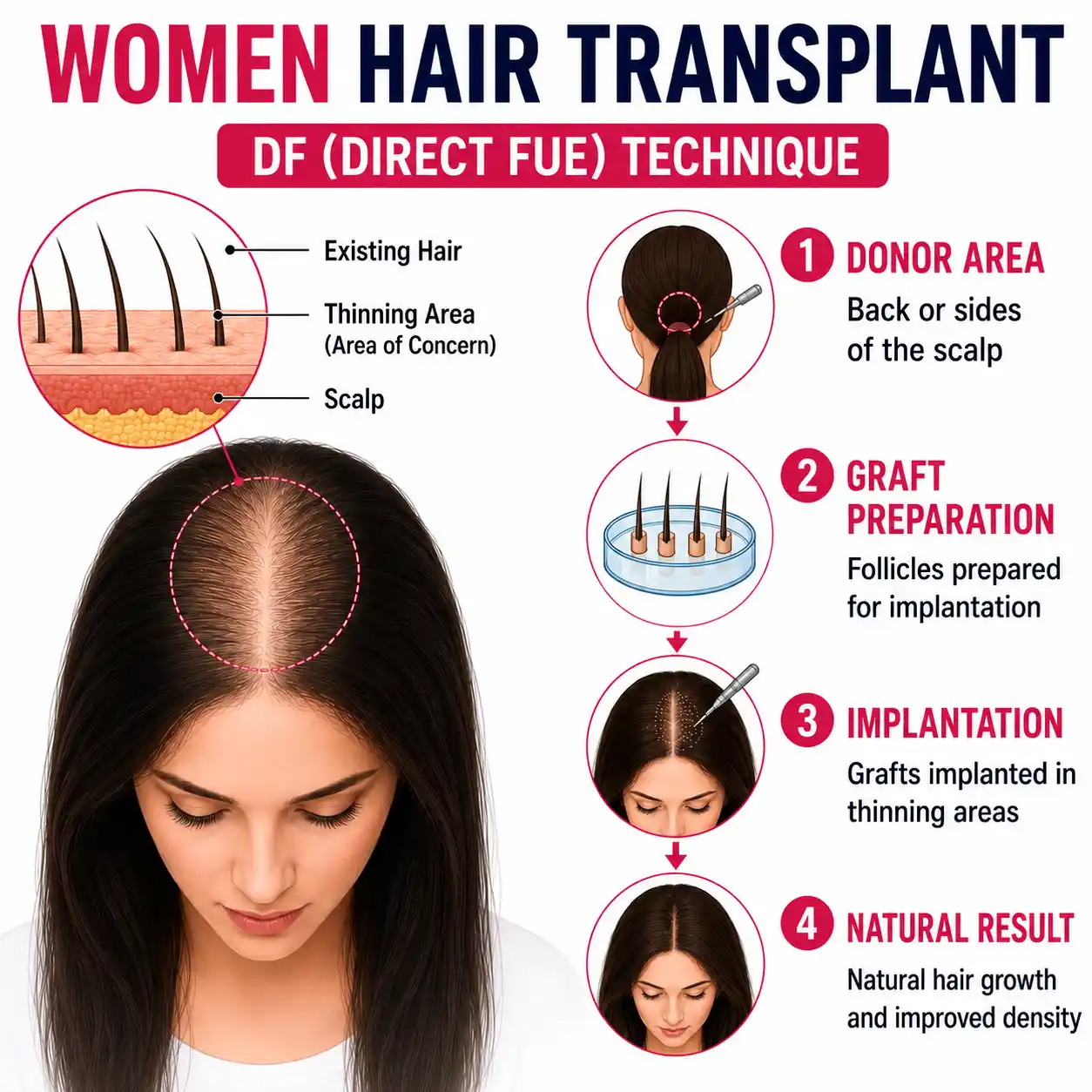
FUE Hair Transplant for Women
Follicular Unit Extraction (FUE) is one of the most commonly performed hair transplant procedures for women.
Procedure
Individual follicular units are extracted from the donor area.
Tiny recipient sites are created.
Hair follicles are implanted carefully.
Benefits
No linear scar
Faster healing
Minimal discomfort
Natural-looking results
Quick recovery
FUT Hair Transplant for Women
Follicular Unit Transplantation (FUT) involves removing a strip of scalp from the donor area.
Procedure
Benefits
Female Hairline Transplant
Hairline restoration focuses specifically on rebuilding a receding or uneven hairline using carefully placed grafts.
PRP and Hair Transplant for Women
Platelet-Rich Plasma (PRP) therapy is often combined with hair transplant surgery.
Benefits include:
Step 1: Consultation and Planning
The surgeon evaluates:
Step 2: Preparation
Step 3: Hair Follicle Extraction
Hair follicles are harvested using FUE or FUT techniques.
Step 4: Graft Preservation
Extracted grafts are carefully preserved in specialized solutions.
Step 5: Recipient Site Creation
Tiny incisions are created in the thinning area according to natural hair growth patterns.
Step 6: Graft Implantation
Each graft is placed precisely to achieve natural density and direction.
Step 7: Recovery and Follow-Up
The patient receives post-procedure instructions and scheduled follow-up visits.
Permanent Solution for Female Hair Loss
Transplanted follicles continue to grow naturally for many years.
Natural-Looking Results
Advanced implantation techniques create a realistic hairline and natural density.
Improved Confidence
Hair restoration often improves self-esteem and overall appearance.
Minimal Maintenance
Unlike temporary solutions, transplanted hair grows naturally and can be treated like normal hair.
Enhanced Hair Volume
The procedure significantly improves scalp coverage and hair thickness.
Patients typically experience:
First Month
Temporary shedding of transplanted hairs (shock loss)
2 to 4 Months
Initial new hair growth begins
6 Months
Noticeable improvement in density
9 to 12 Months
Significant hair growth and visible transformation
12 to 18 Months
Final results become fully visible
Most women recover quickly after the procedure.
Recovery Timeline
First Week
Two Weeks
Healing of donor and recipient areas
One Month
Temporary shedding phase
Three to Six Months
New hair growth starts
Twelve Months
Full cosmetic results develop
For optimal long-term outcomes:
The female hair transplant cost in India typically ranges between ₹60,000 and ₹1,50,000 or more depending on individual requirements.
Factors Affecting Women Hair Transplant Cost
Women Hair Transplant Cost in Major Cities
The cost may vary across Delhi, Mumbai, Bangalore, Hyderabad, Pune, Chennai, and other metropolitan cities depending on the clinic and surgeon.
When selecting a female hair transplant clinic, consider:
Seeking treatment early can:
Women noticing persistent hair thinning should consult a hair restoration specialist as soon as possible.
Yes. Women with suitable donor hair and specific patterns of hair loss can benefit from hair transplant surgery.
Hair transplantation can be effective in selected cases of female pattern baldness when sufficient donor hair is available.
The cost generally ranges from ₹60,000 to ₹1,50,000 or more depending on the number of grafts, technique used, and clinic location.
FUE is often preferred because it leaves minimal visible scarring and offers quicker recovery. However, the best technique depends on individual hair characteristics.
Yes. Women with localized thinning and a healthy donor area can achieve improved density through hair transplantation.
PRP is not mandatory but is often recommended to enhance healing and improve graft survival.
Yes. Female hairline transplant procedures are specifically designed to restore a natural and aesthetically pleasing hairline.
Most women can return to normal activities within a few days, while complete hair growth results typically develop over 9–12 months.
Transplanted follicles are generally permanent and continue producing hair for many years, making it one of the most effective long-term hair restoration treatments.
Some forms of stable alopecia can be treated successfully with hair transplant surgery. A specialist evaluation is necessary to determine eligibility.




Avail FREE Doctor Consultation

Consult with our expert surgeon for more than 50+ diseases

Once you share your details, our care coordinator will get in touch with you.

The coordinator will understand your symptoms and health condition in detail.

Your consultation will be scheduled at the earliest.
3M +
Happy Patients
150 +
Clinics
30 +
Cities

120Cr—Patient Savings Delivered
so patients focus on recovery, not bills.

Complete Transparency
No hidden charges or surprise bills

End-to-End Insurance Handling
Complete insurance processing support

Up to 20% Savings on Every Surgery
powered by smarter insurance handling

Easy EMI Options
Flexible payment plans available
120Cr—Patient Savings Delivered
so patients focus on recovery, not bills.
Complete Transparency
No hidden charges or surprise bills
Your Form Has Been Submitted Successfully.
Our care coordinator will call you shortly.

Book Your FREE Consultation
Consult with our expert surgeon for more than 50+ diseases
Once you share your details, our care coordinator will get in touch with you.
The coordinator will understand your symptoms and health condition in detail.
Your consultation will be scheduled at the earliest.
3M +
Happy Patients
150 +
Clinics
30 +
Cities