Select City


USFDA-Approved Procedures

Support in Insurance Claim

No-Cost EMI

1-day Hospitalization
Kidney Stone Diagnosis & Treatment
If your symptoms indicate the presence of kidney stones, the urologist may ask you to undergo diagnostic tests to confirm your case and recommend a proper treatment plan.
Blood tests – To determine calcium and uric acid levels to check overall kidney health.
Urine test – A 24-hour urine culture is done to find out if there is any kidney or urinary infection.
Imaging tests – CT scans, ultrasounds, and MRIs allow the doctor to assess the size and location of kidney stone in the urinary tract
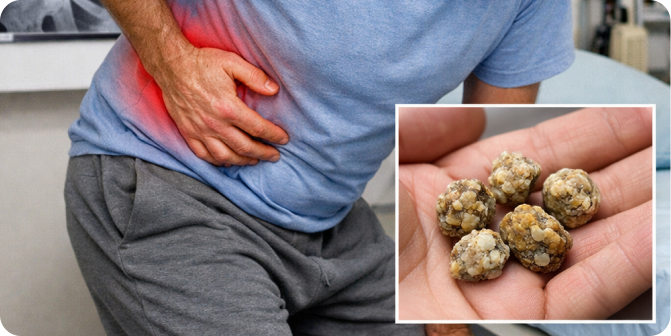
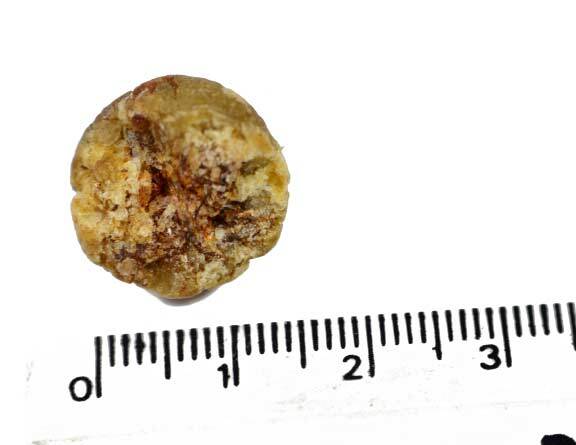
A 16 mm kidney stone requires surgery to be removed. The following are some of the surgical options for kidney stones out of which the kidney stone doctor would determine the best procedure after diagnosing the condition.
ESWL (Extracorporeal Shock Wave Lithotripsy): It is a non-invasive surgery involving the usage of high-intensity sound waves which are directed to disintegrate kidney stones into tiny fragments that can further pass out with urine. Doctors recommend ESWL when oral medication is ineffective and is suitable for 6-8 mm kidney stones.
Ureteroscopic Lithotripsy (URSL): It is an advanced procedure to remove kidney stones that are not dissolved by non-surgical treatment. In URSL, the surgeon uses an exact laser treatment to remove the kidney stone lodged in the ureter. It is recommended for kidney stones of 7-10 mm.
Retrograde Intrarenal Surgery (RIRS): This advanced surgical technique removes moderate to large kidney stones (up to 14 mm). This method is preferred to break stones lodged inside the kidney, ureter, or urinary bladder. In RIRS, the surgeon uses a ureteroscope to remove kidney stones with negligible risks.
PCNL (Percutaneous Nephrolithotomy): It is a minimally invasive technique preferred to remove large stones in the kidneys or upper ureter. In PCNL, the surgeon makes a minor incision that enables the doctor to break stones into smaller fragments. This procedure is performed for kidney stones of 16 to 20 mm.
Delivering Seamless Surgical Experience in India
We offer treatment through various non-invasive and minimally-invasive methods, including RIRS, ESWL, PCNL, etc., to ensure patients' comfort by reducing complications and downtime.
We are associated with the top hospitals in the city. This lets our doctors provide the best treatments for kidney stones using the most cutting-edge technology and ensure the best treatment outcomes. Our associated hospitals are well-equipped with all the facilities that the patients may need for a hassle-free treatment journey.
Our team consists of the best urologists in the city, who are highly trained in treating even the most complex cases of kidney stones. They have 8+ years of experience in providing effective diagnosis and treatment for kidney stones.
We accept all insurance for kidney stone treatment. We also have a dedicated insurance team to assist patients throughout the insurance claim procedure and make the process smooth for the patients.
Yes. A 16 mm stone is considered a large kidney stone and carries a high risk of medical complications. Because it is much wider than the ureter, it frequently causes complete urinary tract obstructions, severe kidney swelling (hydronephrosis), and recurrent UTIs. If left untreated, it can lead to permanent kidney damage or a life-threatening systemic blood infection called urosepsis.
Virtually never. The tubes that carry urine from your kidneys to your bladder (ureters) are only about 3 to 4 mm wide. While tiny stones under 5 mm frequently pass on their own, a 16 mm stone is roughly the size of a marble. It is physically too large to travel through your urinary tract without getting stuck, meaning medical intervention is almost always required to break it up or remove it.
Treatment depends on the stone’s location, hardness, and your overall health, but the most effective options include:
PCNL (Percutaneous Nephrolithotomy):
URS (Ureteroscopy) with Laser Lithotripsy:
ESWL (Shock Wave Lithotripsy):
Your urologist will recommend the most suitable approach based on imaging and symptoms.
Procedure time: Usually 45 minutes to 2 hours, depending on the method
Hospital stay:
Recovery time:
Ignoring a stone of this size can cause irreversible damage. Over time, the persistent blockage causes urine to back up, creating intense pressure that leads to renal atrophy (the permanent shrinking and death of functional kidney tissue). Additionally, stagnant urine behind the stone inevitably becomes infected. An infected, obstructed kidney can quickly trigger urosepsis, a medical emergency that can lead to rapid organ failure if not treated immediately with IV antibiotics and drainage.
A 16 mm kidney stone is considered large and potentially dangerous. Stones of this size rarely pass on their own and can lead to serious complications if not treated promptly. Here’s a clear breakdown of the risks:
A 16 mm stone can get lodged in the ureter (the tube connecting the kidney to the bladder), blocking the flow of urine.
This can cause:
If the blockage is complete, it becomes a medical emergency requiring immediate intervention.
When urine cannot drain properly due to obstruction, it accumulates in the kidney, leading to hydronephrosis (swelling of the kidney).
Why this is dangerous:
A blocked urinary tract creates a favorable environment for bacterial growth, increasing the risk of infection.
Warning signs include:
If infection spreads to the kidney (pyelonephritis) or bloodstream, it can become life-threatening (sepsis).
Long-standing obstruction and repeated infections can result in progressive kidney damage.
Possible outcomes:
Seek urgent medical care if you notice any of the following symptoms:
These signs may indicate urinary obstruction, infection, or kidney damage, all of which can become serious quickly if not treated.
| Sr.No. | Doctor Name | Registration Number | Ratings | Experience | Book Appointment |
|---|---|---|---|---|---|
| 1 | Dr. Sumit Sharma | HN-008812 | 5.0 | 25 + Years | Book Appointment |
| 2 | Dr. Gulhane Parag Vijay | 2009/03/1451 | 4.9 | -- | Book Appointment |
| 3 | Dr. Salecha Priyank | TSMC/FMR/20123 | 4.8 | 17 + Years | Book Appointment |
| 4 | Dr. Sudhakar G V | 37963 | 5.0 | 32 + Years | Book Appointment |
| 5 | Dr. Saurabh Mittal | DMC/R/4942 | 4.5 | 18 + Years | Book Appointment |
| 6 | Dr. Naveen M N | 82731 | 5.0 | 17 + Years | Book Appointment |
| 7 | Dr. Manjegowda Dileep | 95147 | 4.8 | 16 + Years | Book Appointment |
| 8 | Dr. Raju R | 90344 | 5.0 | 15 + Years | Book Appointment |
| 9 | Dr. Varun Kumar Katiyar | 101138 | 5.0 | 14 + Years | Book Appointment |
| 10 | Dr. Ramakrishna Rajesh | APMC/FMR/88365 | 4.5 | 13 + Years | Book Appointment |
| 11 | Dr. Prasad Mangesh Bhrame | 2016/07/1656 | 4.5 | 11 + Years | Book Appointment |
sashi rekha

 Recommends
Best place best staff experience very happy
Dhanesh, 30 Yrs
Recommends
Treatment se pehle pain unbearable tha, ab kaafi relief hai. Overall experience achha raha.
Vignesh
Recommends
Stone problem ke liye aaya tha, pehle bahut pain hota tha. Ab treatment ke baad condition kaafi better hai
Harsh Verma Rana
Recommends
Exceptional PCNL treatment at Pristyn Care, Indore. highly experienced surgeon and the support staff was friendly.
.svg)

Check out our app!


Social Media









 (4) (1).jpg/1682933853454_ban-Icon.png)
.jpeg/1777541472938_ban-Icon.png)





.svg)
.svg)