Select City

Call Us
Book FREE Appointment
Kidney stones cause unbearable pain that can result in kidney damage. We perform minimal pain kidney stone removal surgeries as daycare procedures approved by USFDA with a very high success rate. Contact us to book an appointment with some of the top urologists near you for the removal of 5 mm Kidney Stone.
... Read More



USFDA-Approved Procedures

Support in Insurance Claim

No-Cost EMI

1-day Hospitalization
4.5/5
29+ Years Experience
 Pristyn Care ZOI Hospital, Ameerpet, Hyderabad
4.5/5
19+ Years Experience
Manorama Ganj, Old Palasia, Indore, Madhya Pradesh 4520034.5/5
19+ Years Experience
Pristyn Care Sheetla Hospital, Sector 8, Gurgaon4.5/5
15+ Years Experience
Pristyn Care ZOI Hospital, Ameerpet, Hyderabad4.5/5
12+ Years Experience
Pristyn Care ZOI Hospital, Ameerpet, Hyderabad4.5/5
12+ Years Experience
Pristyn Care ZOI Hospital, Ameerpet, HyderabadKidney Stone Diagnosis & Treatment
Kidney Stone Diagnosis & Treatment
Kidney stone diagnosis includes a physical examination along with the following tests:
A 5 mm kidney stone does not need surgical removal unless it gets stuck in the ureter and causes excruciating pain. In such a case, any of the following advanced surgeries can be performed:
Delivering Seamless Surgical Experience in India
We offer treatment through various non-invasive and minimally-invasive methods, including RIRS, ESWL, PCNL, etc., to ensure patients' comfort by reducing complications and downtime.
We are associated with the top hospitals in the city. This lets our doctors provide the best treatments for kidney stones using the most cutting-edge technology and ensure the best treatment outcomes. Our associated hospitals are well-equipped with all the facilities that the patients may need for a hassle-free treatment journey.
Our team consists of the best urologists in the city, who are highly trained in treating even the most complex cases of kidney stones. They have 8+ years of experience in providing effective diagnosis and treatment for kidney stones.
We accept all insurance for kidney stone treatment. We also have a dedicated insurance team to assist patients throughout the insurance claim procedure and make the process smooth for the patients.
By itself, a 5mm kidney stone is not inherently life-threatening, but it can quickly become dangerous if it causes a complete blockage in the urinary tract. When a stone gets tightly wedged in the narrow ureter, it obstructs the flow of urine, causing it to back up and swell the kidney—a condition known as hydronephrosis. If left untreated for several weeks, this persistent blockage can lead to permanent kidney damage or a severe, life-threatening systemic infection called urosepsis.
If a 5mm stone is capable of clearing your system on its own, it typically takes anywhere from 2 to 4 weeks to travel from the kidney, down the ureter, and out through the bladder. If the stone has not progressed after 4 to 6 weeks of active monitoring, the likelihood of it passing naturally drops significantly, and medical intervention is usually recommended to protect your kidney health.
Yes, a 5mm kidney stone can absolutely pass naturally without surgical intervention. Statistically, a stone of this size has an approximate 50% to 60% chance of passing on its own. Because 5mm is right at the threshold of the average internal diameter of a human ureter, success largely depends on the exact shape of your stone, your physical anatomy, and how aggressively you maintain your hydration.
To remove a 5mm stone without undergoing surgery, urologists typically utilize Medical Expulsive Therapy (MET). This approach involves a combination of:
Prescription Alpha-Blockers: Medications like Tamsulosin that relax the smooth muscles of the ureter wall, effectively widening the pipe so the stone can slide down more easily.
Aggressive Hydration: Drinking at least 3 liters of water daily to generate enough fluid pressure to flush the stone out.
Anti-inflammatory Management: Using medications like Ibuprofen to reduce internal swelling and control pain waves during passage.
It generally takes anywhere from 6 months to 2 years for a kidney stone to aggregate and grow into a 5mm mass. The exact timeline depends heavily on your unique urine chemistry. If you are chronically dehydrated and your urine has a very high concentration of minerals like calcium, oxalate, or uric acid, microscopic crystals can rapidly fuse together into a medium-sized stone in just a few months.
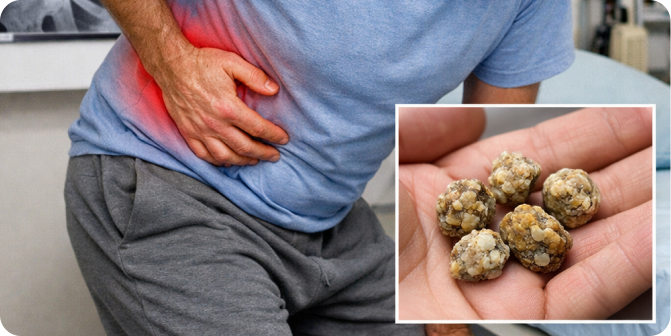
The pain is medically classified as renal colic. It is characteristically felt as a sharp, stabbing, and severe pain in your flank (the lower back and side, just under the ribs). As the stone moves down the ureter toward the bladder, the pain will often shift forward into the lower abdomen and radiate down into the groin. Because the ureter contracts in spasms to push the stone, the pain typically comes and goes in intense, unpredictable waves.
While it is rare to pass a 5mm stone without noticing any pain while it travels down the narrow ureter, it is entirely possible to pass it out of the bladder during urination with very little discomfort. Because the urethra is wider than the ureter, the stone often drops into the toilet seamlessly. You might only notice a brief “pop” or a split-second pinch, or you might actually hear the stone hit the porcelain.
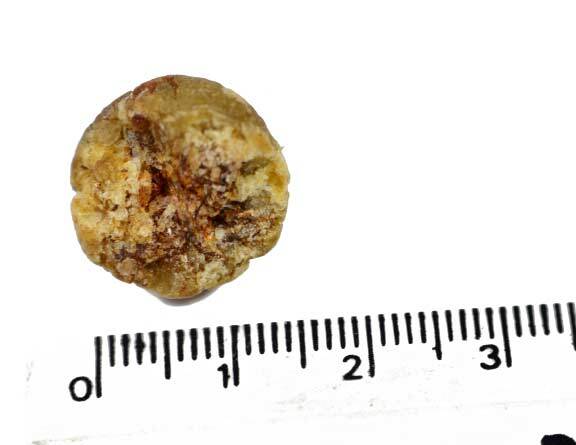
If you catch the stone when it passes, do not throw it away. Strain your urine, place the stone in a clean, dry container, and bring it to your urologist. They will send it to a laboratory for a stone analysis to determine its precise chemical composition (such as calcium oxalate, uric acid, or struvite). Knowing exactly what the stone is made of is the single most important step in creating a personalized diet and lifestyle plan to make sure you never form one again.
1.Symptoms of a 5mm Kidney Stone
A stone sitting quietly inside the kidney often causes zero symptoms. However, the moment it moves or attempts to enter the narrow ureter, it triggers distinct clinical signs:
Severe Flank Pain: Intense, sharp pain in the back and side, just under the ribs. This pain frequently radiates downwards toward the lower abdomen and groin. It typically comes in waves (renal colic) as the ureter spasms to push the stone out.
Hematuria (Blood in Urine): The sharp edges of the crystalline stone scrape against the delicate lining of the urinary tract, turning urine pink, red, or brown.
Nausea and Vomiting: The kidneys and the gastrointestinal tract share common nerve pathways. Intense renal pain frequently triggers severe nausea and vomiting.
Urinary Changes: As the stone nears the bladder, it irritates the bladder wall, causing a persistent, urgent need to urinate, alongside increased frequency and a burning sensation (dysuria).
2.Risk Factors and Prevention Tips
Preventing a recurrence is critical, as a person who forms one kidney stone has a 50% chance of developing another within 5 to 7 years.
Key Risk Factors
Chronic Dehydration: Low fluid intake concentrates minerals, encouraging crystallization.
High-Sodium Diets: Excess salt forces the kidneys to excrete more calcium into the urine.
Obesity and Sedentary Lifestyle: Shifts systemic metabolic properties, increasing urinary acid levels.
Prevention & Hydration Protocols
The 3-Liter Fluid Rule: Consume enough water to output 2.5 liters of clear urine daily.
Citrus Infusions: Regularly add fresh lemon or lime juice to your water. Citrus fruits are rich in citric acid, which binds to urinary calcium and physically prevents new crystals from growing.
Moderate Oxalate and Sodium: Limit highly processed salty foods, and balance high-oxalate foods (like spinach, nuts, and beets) by pairing them with dietary calcium so they bind in the gut rather than the kidneys.
3.What happens if you avoid kidney stone treatment?
Many people delay kidney stone treatment without realizing the risks and complications they may face by doing so. Untreated kidney stones may lead to conditions like hydronephrosis, where the kidney becomes swollen due to urine accumulation. Kidney stone obstructs the urine flow and leads to urine retention in the kidneys, triggering kidney infections. Untreated kidney stones can also clog the ureters, affecting the passage of urine. Chronic kidney stones can also cause fever, chills, and blood in urine which can be highly dangerous.
| Sr.No. | Doctor Name | Registration Number | Ratings | Experience | Book Appointment |
|---|---|---|---|---|---|
| 1 | Dr. Naveenchandra Ravindra Acharya | APMC/FMR/78818 | 4.5 | 29+ + Years | Book Appointment |
| 2 | Dr. Aseem Kapadia | 8816 | 4.5 | 19+ + Years | Book Appointment |
| 3 | Dr. Yogesh Taneja | HN-013952 | 4.5 | 19+ + Years | Book Appointment |
| 4 | Dr. Praveen Kumar Krosuri | APMC/FMR/77340 | 4.5 | 15+ + Years | Book Appointment |
| 5 | Dr. Mohammad Jahangir | APMC/FMR/94154 | 4.5 | 12+ + Years | Book Appointment |
| 6 | Dr. Mamidala Srinivas | APMC/FMR/93996 | 4.5 | 12+ + Years | Book Appointment |
| 7 | Dr. Sumit Sharma | HN-008812 | 5.0 | 25+ + Years | Book Appointment |
| 8 | Dr. Gulhane Parag Vijay | 2009/03/1451 | 4.9 | -- | Book Appointment |
| 9 | Dr. Salecha Priyank | TSMC/FMR/20123 | 4.6 | 17+ + Years | Book Appointment |
| 10 | Dr. Saurabh Mittal | DMC/R/4942 | 4.5 | 18+ + Years | Book Appointment |
| 11 | Dr. Manjegowda Dileep | 95147 | 4.8 | 16+ + Years | Book Appointment |
| 12 | Dr. Srikant Pai | 2012092597 | 5.0 | 15+ + Years | Book Appointment |
| 13 | Dr. Raju R | 90344 | 4.8 | 15+ + Years | Book Appointment |
| 14 | Dr. Sunil Kaduba Palve | 2022/01/0005 | 5.0 | 14+ + Years | Book Appointment |
| 15 | Dr. Varun Kumar Katiyar | 101138 | 5.0 | 14+ + Years | Book Appointment |
| 16 | Dr. Shyam Mohan | 2012051153 | 4.5 | 14+ + Years | Book Appointment |
| 17 | Dr. Danish Hushain | 64731 | 4.5 | 13+ + Years | Book Appointment |
| 18 | Dr. Kushal Kumar T R | 109545 | 4.5 | 13+ + Years | Book Appointment |
| 19 | Dr. Gagandeep Talwar | HN 29407 | 4.5 | 12+ + Years | Book Appointment |
| 20 | Dr. Prasad Mangesh Bhrame | 2016/07/1656 | 4.5 | 11+ + Years | Book Appointment |
 JK
JKJaya krushna nayak, 31 Yrs

 Recommends
Recommends
Good behaviour
.svg) SR
SRsashi rekha
Recommends
Recommends
Best place best staff experience very happy
.svg) DH
DHDhanesh, 30 Yrs
Recommends
Recommends
Treatment se pehle pain unbearable tha, ab kaafi relief hai. Overall experience achha raha.
VIVignesh
Recommends
Recommends
Stone problem ke liye aaya tha, pehle bahut pain hota tha. Ab treatment ke baad condition kaafi better hai
.svg)

Check out our app!


Surgery
Social Media


© Copyright Pristyncare 2026. All Right Reserved.
Avail FREE Doctor Consultation

Untreated Kidney Stones can cause severe pain, infection, or kidney damage.

Kidney Stones can block urine flow & cause intense pain
Delay may lead to infection, fever, or kidney damage
Early treatment prevents emergency procedures

Ignoring Kidney Stone symptoms may lead to serious complications

Takes less than 10 seconds • No spam • 100% confidential

120Cr—Patient Savings Delivered
so patients focus on recovery, not bills.

Complete Transparency
No hidden charges or surprise bills

End-to-End Insurance Handling
Complete insurance processing support

Up to 20% Savings on Every Surgery
powered by smarter insurance handling

Easy EMI Options
Flexible payment plans available
120Cr—Patient Savings Delivered
so patients focus on recovery, not bills.
Complete Transparency
No hidden charges or surprise bills
Thanks for booking!
Our care coordinator will call you shortly.
Get much more with Pristyn Care App


Book Slot for Covid Precaution Dose


Access/Share your and family’s Vaccination Certificate anytime


Create your Ayushman Bharat health account