Select City

Restore mobility of the knee joint by getting rid of the affected one. Undergo advanced and minimally invasive total knee replacement Surgery or partial knee replacement Surgery. Book your appointment today with Pristyn Care to get in touch with a highly experienced orthopedic surgeon to undergo safest knee replacement Surgery.
Restore mobility of the knee joint by getting rid of the affected one. ... Read More




Free Cab Facility

No-Cost EMI

Support in Insurance Claim

1-day Hospitalization

USFDA-Approved Procedure
Choose Your City
It help us to find the best doctors near you.

Bangalore
Delhi
Hyderabad
Indore
Jaipur
Kochi
Mumbai
Pune
Delhi
Hyderabad
Pune
Mumbai
Bangalore
 Pristyn Care Elantis, Ring Road, Lajpat Nagar
Pristyn Care Diyos Hospital, Safdarjung Enclave, Delhi
Manorama Ganj, Old Palasia, Indore, Madhya Pradesh 452003
Pristyn Care Sheetla Hospital, Sector 8, Gurgaon
Pristyn Care Elantis, Ring Road, Lajpat Nagar
Pristyn Care Diyos Hospital, Safdarjung Enclave, Delhi
Manorama Ganj, Old Palasia, Indore, Madhya Pradesh 452003
Pristyn Care Sheetla Hospital, Sector 8, Gurgaon
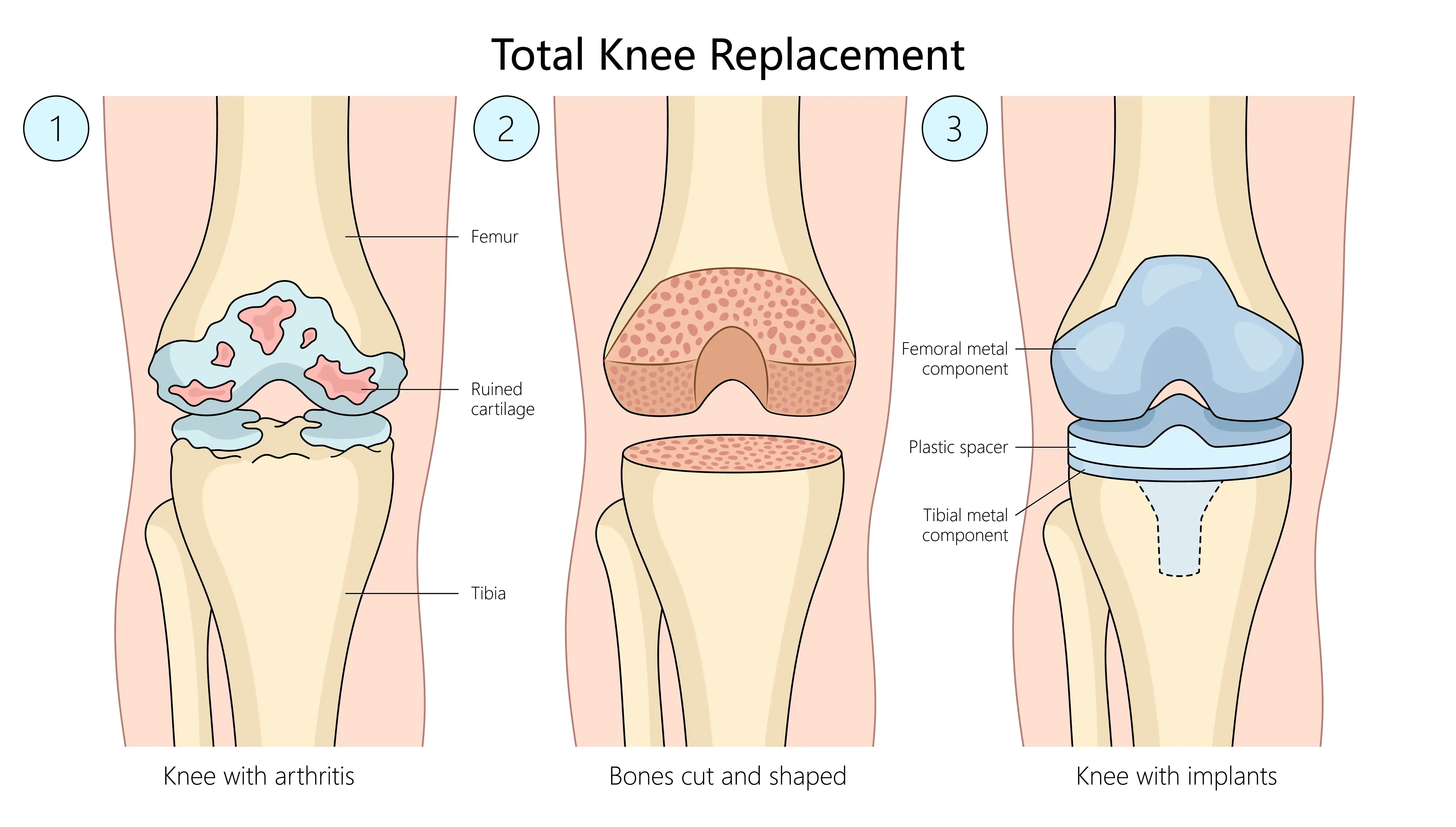
Knee replacement is a procedure in which a damaged or worn-out knee joint is replaced with an artificial implant, called a prosthesis. This procedure, also known as knee replacement arthroplasty, helps relieve pain and restore function in severely affected knees.
Disease name
Surgery name
Duration
Treated by
Free Knee Replacement Surgery Cost Calculator
Fill details to get actual cost
Your knee replacement specialist will recommend the most suitable procedure based on your condition. Here are the common types of knee replacement:
This is the most common and comprehensive option. The surgeon replaces all three parts of the knee joint, the inside (medial), outside (lateral), and under the kneecap (patellofemoral). Also called a full knee replacement operation or complete knee replacement, it relieves pain and restores function in severely damaged knees.
This option is suitable when only one or two areas of the knee joint are damaged. The surgeon replaces only the affected section, preserving healthy parts. Often chosen by younger patients or those with less extensive damage, partial knee surgery offers faster recovery and a more natural knee movement.
Robotic-assisted knee replacement
Some surgeons use robotic technology to improve the accuracy of implant placement, which may enhance joint function and recovery.
Implant types
Knee implants are made from materials like metal, plastic, or ceramic. The choice depends on the patient’s age, activity level, and joint condition.
If a previous knee replacement fails, revision surgery may be needed to replace or adjust the implant. This procedure is more complex and requires specialist care.
Knee replacement is usually recommended when non-surgical treatments no longer ease symptoms like pain, stiffness, or limited movement. While severe arthritis is the most common cause, other joint conditions may also require surgery to improve mobility and relieve discomfort.
Conditions that may Require Knee Replacement
This is the most common reason for total knee replacement. The cartilage that cushions the knee joint wears away over time, leading to bone-on-bone contact, pain, and stiffness.
An autoimmune condition that causes inflammation in the joints. Over time, it can damage cartilage and bone, making full knee replacement a suitable option.
Arthritis that develops after a serious knee injury. A fracture, ligament tear, or meniscus injury from a car accident, sports injury, or fall can lead to long-term joint damage.
In cases of bow-legged or knock-kneed alignment that causes joint stress and pain, a knee replacement arthroplasty can help restore proper alignment and function.
If you struggle with walking, climbing stairs, or getting up from a chair due to knee pain or stiffness, a complete knee replacement may be recommended to improve movement.

 The patient arrives at the hospital on the scheduled day of surgery.
Registration and admission formalities are completed.
Vital signs such as blood pressure, pulse, temperature, and oxygen levels are checked.
The orthopedic surgeon reviews the patient's medical history, X-rays, blood tests, and pre-operative investigations.
The patient arrives at the hospital on the scheduled day of surgery.
Registration and admission formalities are completed.
Vital signs such as blood pressure, pulse, temperature, and oxygen levels are checked.
The orthopedic surgeon reviews the patient's medical history, X-rays, blood tests, and pre-operative investigations.
 The orthopedic surgeon confirms the surgical plan and the type of knee implant to be used.
The anesthetist performs a final pre-anesthesia assessment.
The procedure, expected benefits, possible risks, and recovery process are explained.
Consent forms are signed, and an IV line is started for fluids, medications, and anesthesia.
The orthopedic surgeon confirms the surgical plan and the type of knee implant to be used.
The anesthetist performs a final pre-anesthesia assessment.
The procedure, expected benefits, possible risks, and recovery process are explained.
Consent forms are signed, and an IV line is started for fluids, medications, and anesthesia.
 Spinal anesthesia with sedation or general anesthesia is administered.
The patient is positioned comfortably, and the knee is cleaned with an antiseptic solution.
Sterile drapes are placed to prepare the surgical field.
Spinal anesthesia with sedation or general anesthesia is administered.
The patient is positioned comfortably, and the knee is cleaned with an antiseptic solution.
Sterile drapes are placed to prepare the surgical field.
 The surgeon makes an incision over the knee to access the damaged joint.
The worn-out cartilage and damaged bone are carefully removed.
The bone surfaces are reshaped to fit the artificial knee implant.
The metal and plastic prosthetic components are securely placed to restore joint function.
The surgeon checks the alignment, stability, and range of motion before closing the incision.
The surgeon makes an incision over the knee to access the damaged joint.
The worn-out cartilage and damaged bone are carefully removed.
The bone surfaces are reshaped to fit the artificial knee implant.
The metal and plastic prosthetic components are securely placed to restore joint function.
The surgeon checks the alignment, stability, and range of motion before closing the incision.
 The patient is shifted to the recovery room for close monitoring.
Nurses monitor vital signs, pain levels, circulation, and movement of the operated leg.
Pain medications, IV fluids, and blood clot prevention measures are started as required.
The patient is shifted to the recovery room for close monitoring.
Nurses monitor vital signs, pain levels, circulation, and movement of the operated leg.
Pain medications, IV fluids, and blood clot prevention measures are started as required.
 Most patients are discharged within 2–5 days, depending on their recovery.
Physiotherapy begins early to restore strength, flexibility, and mobility.
Patients are advised to take prescribed medications and perform rehabilitation exercises regularly.
Walking with a walker or crutches is gradually progressed as recommended by the surgeon.
Follow-up appointments are scheduled to monitor healing and implant function.
Patients should seek immediate medical attention if they experience severe pain, excessive swelling, fever, wound discharge, chest pain, shortness of breath, or signs of infection.
Most patients are discharged within 2–5 days, depending on their recovery.
Physiotherapy begins early to restore strength, flexibility, and mobility.
Patients are advised to take prescribed medications and perform rehabilitation exercises regularly.
Walking with a walker or crutches is gradually progressed as recommended by the surgeon.
Follow-up appointments are scheduled to monitor healing and implant function.
Patients should seek immediate medical attention if they experience severe pain, excessive swelling, fever, wound discharge, chest pain, shortness of breath, or signs of infection.
Knee replacement, whether it is a total knee replacement, partial knee replacement is generally safe and effective. However, like any major knee surgery, there are some risks involved. Most complications are rare and can often be managed with timely care.
Potential risks and complications to be aware of:
Certain health conditions can increase the chance of complications. You should inform your surgeon if you have:

Diet & Lifestyle Consultation

Post-Surgery Recovery Follow up

Free Cab Facility

24*7 Patient Support
Before undergoing knee replacement, your doctor will guide you through a few important steps to make sure you are ready for the procedure. Proper preparation helps reduce complications and supports a smoother recovery. Here is what happens before a total knee replacement or partial knee replacement:
Knee replacement can be done as a total knee replacement, partial knee replacement, depending on your condition and the surgeon’s recommendation.
On the day of your knee surgery, here is what happens:
Depending on the procedure, you may undergo a:
After your knee replacement, you will be shifted to a recovery room, where your medical team will carefully monitor your condition as the effects of anaesthesia wear off. Your vital signs, oxygen levels, and pain will be closely watched to ensure a smooth and safe recovery process.
Depending on the type of knee surgery you have had your stay may vary. Some patients return home on the same day, while others may require an overnight stay for observation.After a knee replacement operation:
Knee replacement is designed to help you regain mobility, reduce discomfort, and return to daily life with greater ease. Key Benefits of Knee Replacement:
Most people who undergo a full knee replacement operation report long-term or complete relief from chronic knee pain caused by arthritis or injury.
After knee surgery, it becomes easier to walk, climb stairs, and perform everyday tasks. Replacing the damaged joint surfaces helps restore natural movement.
Reduced pain and improved function often lead to better sleep, increased independence, and overall enhancement in daily living.
A well-performed total knee replacement can improve how your leg aligns and functions. This can prevent further strain on nearby joints and muscles.
Modern implants used in knee replacement are designed to last 15–20 years or more, especially when combined with techniques like robotic knee replacement that ensure precision.
Procedures like robotic knee replacement and partial knee surgery are minimally invasive, which often leads to quicker recovery and less post-operative discomfort.
Knee replacement is one of the most commonly performed orthopaedic procedures, especially for people with long-term knee joint damage due to arthritis or injury.
A knee replacement involves placing metal and plastic components to cap the ends of the bones forming the knee joint. These parts mimic the shape and function of a healthy knee.
A typical total knee replacement takes around 1 to 2 hours. The duration may vary slightly depending on whether it is a partial, or robotic replacement.
Most modern knee replacement implants last 15 to 20 years or more with proper care and follow-up.
Many patients return to light work or normal daily activities within 4 to 6 weeks after surgery, depending on the type of procedure and individual healing.
Following your surgeon’s instructions, attending physiotherapy, and staying active with gentle movement are key to a smooth recovery after knee replacement arthroplasty.
Contact your doctor if you notice severe pain, swelling, fever, or signs of infection near the surgical site during your recovery.
Most patients experience reduced pain, better mobility, and improved quality of life after a full or partial knee replacement.
The knee replacement cost in India varies depending on the type of implant, city, and hospital. Pristyn Care offers affordable packages for total knee replacement cost with financing and insurance support.
Yes. At Pristyn Care, we help patients with insurance approval, paperwork, and cashless hospitalisation for robotic knee replacement, complete knee replacement, and other procedures.

.jpg/1709040422595_ban-Icon.png)

Girdhar kumar

 Recommends
The knee replacement surgery helped reduce my pain significantly and I can move more comfortably now. Physiotherapy guidance and post-surgery care were handled really well
Nidhhi Agerwal
Recommends
From the very first consultation, the medical team at Pristyn Care made us feel comfortable and supported. The transparency and communication were outstanding. Thank you Pristyn Care Eminent Hospital
Harish Gupta
Recommends
I had computer‑navigated knee replacement. Precision was visible. Walking fine now.
Karthik B Raj, 24 Yrs
Recommends
Had my mother’s knee treatment done here. The doctor was very good and the physiotherapy helped a lot in recovery. Thank you to the whole team!
Rammurat jaiswal
Recommends
The entire treatment process was smooth, from consultation to recovery.
Guneet Singh
Recommends
Mere father ka knee replacement surgery yahan hua. Staff bahut cooperative tha aur recovery bhi kaafi achhi hui
.svg)










.svg)
.svg)