Select City
Select City

Have you been diagnosed with a hernia? Are you looking for minimally invasive laparoscopic surgery? Consult expert hernia surgeons at Pristyn Care.
Have you been diagnosed with a hernia? Are you looking for minimally invasive ... Read More




Free Cab Facility

No-Cost EMI

Support in Insurance Claim

1-day Hospitalization

USFDA-Approved Procedure
Choose Your City
It help us to find the best doctors near you.

Ahmedabad
Bangalore
Bhubaneswar
Chandigarh
Chennai
Coimbatore
Delhi
Hyderabad
Indore
Jaipur
Kochi
Kolkata
Kozhikode
Lucknow
Madurai
Mumbai
Patna
Pune
Raipur
Ranchi
Thiruvananthapuram
Vijayawada
Visakhapatnam
Delhi
Hyderabad
Pune
Mumbai
Bangalore
 Pristyn Care Elantis Hospital, Lajpat Nagar, Delhi
Opp.Badwani Plaza, Manorama Ganj, Old Palasia, Indore, Madhya Pradesh 452003
Pristyn Care Eminent Hospital 6/1 Opp. Barwani Plaza, Manorama Ganj, Old Palasia, Indore - 452018
Pristyn Care Sheetla Hospital, Sector 8, Gurgaon
Pristyn Care Elantis Hospital, Lajpat Nagar, Delhi
Opp.Badwani Plaza, Manorama Ganj, Old Palasia, Indore, Madhya Pradesh 452003
Pristyn Care Eminent Hospital 6/1 Opp. Barwani Plaza, Manorama Ganj, Old Palasia, Indore - 452018
Pristyn Care Sheetla Hospital, Sector 8, Gurgaon
A hernia happens when an organ or fatty tissue pushes through a weak spot in the abdominal wall. This causes a bulge. The bulge may get bigger when you cough, lift heavy things, or stand for a long time.
Hernias are not always painful in the beginning. If left untreated, these can lead to serious complications. Thatâs why timely diagnosis and treatment are important.
Disease name
Surgery name
Duration
Treated by
Free Hernia Surgery Cost Calculator
Fill details to get actual cost
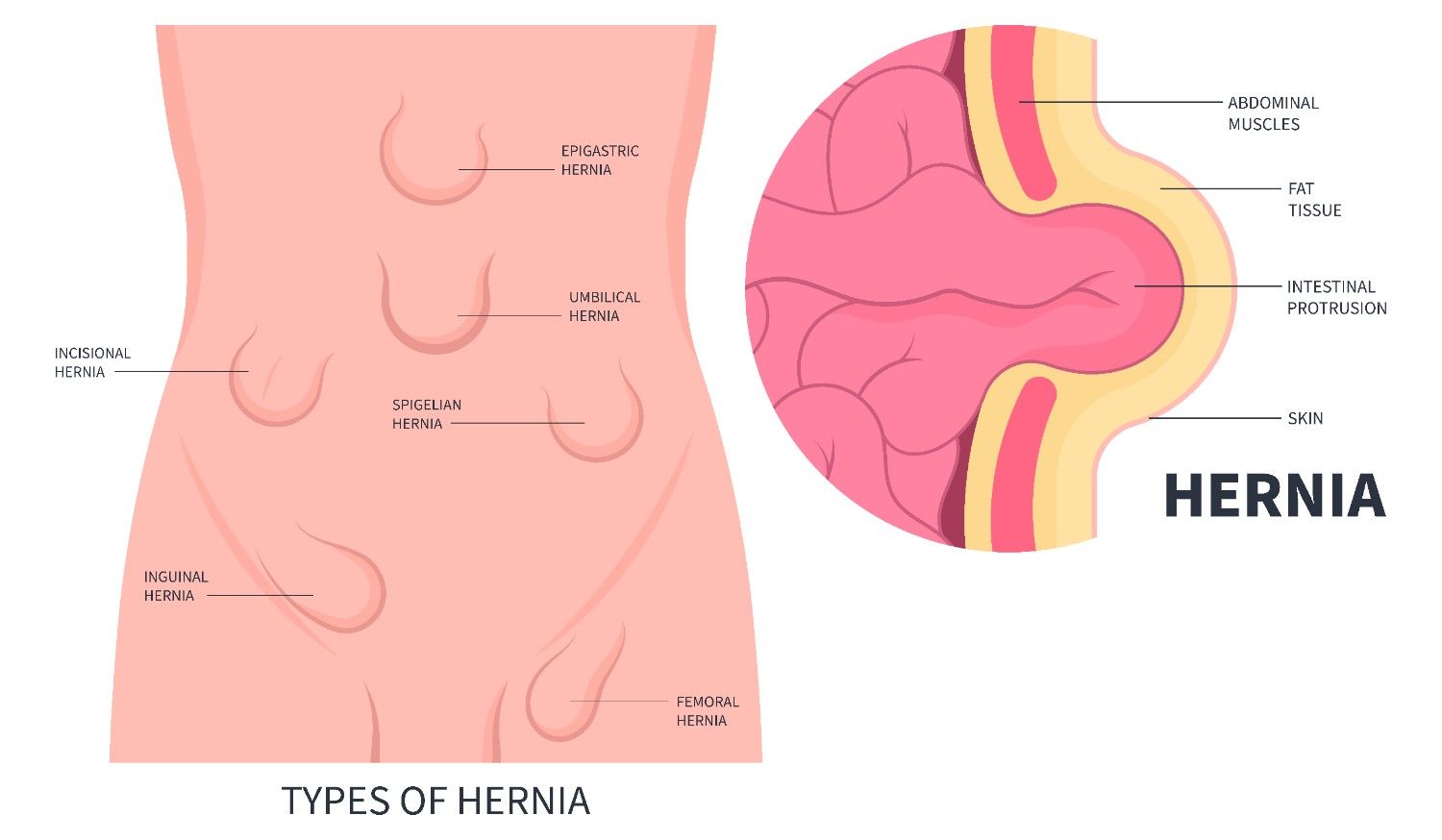
Hernias can form in different parts of the body. The most common types include:
Appears in the groin area when part of the intestine or bladder pushes through the abdominal wall. Itâs more common in men.
It develops when the intestine pushes through weak abdominal muscles. Itâs common in infants but can also develop in adults.
When part of the stomach bulges up through the diaphragm into the chest.
Appears in the upper thigh near the femoral artery. Itâs more common in women. It may cause pain or discomfort after physical activity.
It occurs at or near a previous surgical scar. The muscles there have weakened over time.
Other types of hernia include,
Hernias often cause discomfort, pain, and a visible bulge in the affected area. They can be left untreated initially, but need to be monitored properly. However, if the condition worsens, surgical repair is essential to alleviate symptoms.
It is a minimally invasive surgical technique. The surgeon makes a few tiny incisions and inserts a laparoscope. Laparoscope helps in viewing the hernia on a monitor. The surgeon repairs the weak area using special instruments. The doctor reinforces it with a surgical mesh for added strength.
Key Benefits of Laparoscopic Hernia Surgery
Not everyone is an ideal candidate for laparoscopic surgery. It may not be recommended if you have:

Diet & Lifestyle Consultation

Post-Surgery Recovery Follow up

Free Cab Facility

24*7 Patient Support
Certain health and lifestyle factors significantly increase the likelihood of hernia formation:
Depending on the severity of the patient’s condition, the doctors recommend a suitable treatment.
A single incision is made to access and repair the hernia. This method is usually preferred for large or complicated hernias.
The surgery uses tiny incisions to insert a laparoscope. A camera and fine instruments help the surgeon. This allows quicker recovery and less discomfort.
It is an advanced variation of laparoscopic surgery. It uses robotic precision for highly complex cases.
Step-by-Step Procedure of Laparoscopic Hernia Surgery
It uses enhanced imaging tools and advanced surgical techniques to minimize tissue disruption. Surgeons use thin instruments and a high-resolution camera. The doctors access the affected region through minor cuts. This approach supports faster tissue recovery and a lower risk of postoperative adhesions. It is mostly selected for bilateral or recurrent cases due to reduced discomfort and hospital stay.
What Happens During Hernia Surgery?
 Step 1 · 30-60 mins
Hospital Admission
 The patient arrives at the hospital on the scheduled day of surgery.
Registration and admission formalities are completed.
Vital signs such as blood pressure, pulse, temperature, and oxygen levels are checked.
Pre-operative reports and investigations are reviewed.
The patient arrives at the hospital on the scheduled day of surgery.
Registration and admission formalities are completed.
Vital signs such as blood pressure, pulse, temperature, and oxygen levels are checked.
Pre-operative reports and investigations are reviewed.
 Step 2 · 20-40 mins
Pre-surgery Preparation
The surgeon reviews the patient's medical history and confirms the type and location of the hernia.
The anesthetist performs a final pre-anesthesia assessment.
Consent forms are signed after discussing the procedure, benefits, and possible risks.
The surgical area is cleaned and prepared.
An IV line is started for fluids, antibiotics, and medications.
 Step 3 · 10-15 mins
Anesthesia Administration
The patient is taken to the operation theatre.
General, spinal, or local anesthesia is administered depending on the type of hernia and surgical approach.
The patient becomes pain-free and comfortable before surgery begins.
 Step 4 · 30-90 mins
Hernia Repair Procedure Begins
The surgeon makes a small incision or performs laparoscopic (keyhole) surgery to access the hernia.
The protruding tissue or organ is carefully returned to its normal position.
The weakened abdominal wall is repaired.
A surgical mesh is commonly placed to reinforce the repair and reduce the risk of recurrence.
The incision is closed with sutures or surgical staples, and the area is checked for bleeding.
 Step 5 · 1-2 hours
Recovery Room Observation
The patient is shifted to the recovery room for monitoring.
Nurses monitor blood pressure, pulse, oxygen levels, and pain control.
The patient is encouraged to start walking as advised to promote recovery.
The medical team ensures the patient is stable before discharge.
 Step 6 · Same Day or Within 24 Hours
Discharge
Most patients return home on the same day or within 24 hours, depending on the type of surgery and overall recovery.
Pain relief medicines and antibiotics (if prescribed) are provided.
Detailed instructions regarding wound care, diet, activity restrictions, and lifting heavy objects are explained.
Follow-up appointments are scheduled to monitor healing and ensure a successful recovery.
Most patients can gradually resume normal daily activities within a few weeks, as advised by their surgeon.
A structured comparison of open, laparoscopic, and robotic hernia repair methods highlights key differences in outcomes, recovery, and suitability.
| Technique | Key Benefits | Limitations / Considerations |
| Open Surgery |
|
|
| Laparoscopic Surgery |
|
|
| Robotic Surgery |
|
|
| Phase | Key Actions |
| Preoperative Assessment | Includes blood analysis, imaging (such as CT or ultrasound), and anaesthesia review. Final consent and risk discussion occur at this stage. |
| Administration of Anaesthesia | General, regional, or local anaesthesia(based on the patientâs condition and method). |
| Reduced symptoms | Herniated tissue is repositioned into the original cavity. |
| Reinforcement of Defect | The weakened area is reinforced using sutures or a synthetic mesh patch. |
| Closure and Monitoring | Incisions are sealed with sutures or clips. The doctor observes vital signs, pain control, and wound stability. |
Postoperative care, including mobility guidance and wound management, is essential for successful outcomes. Most patients are able to resume normal activities within a few weeks.
| Stage | Milestones and Care Instructions |
| Day 0â1 | Monitoring of vital signs. Light activity encouraged. Treatment for discomfort was administered. |
| Days 1â3 | Mild soreness and slight swelling. Gentle walking is encouraged. Most patients are discharged within a day. |
| Week 1â2 | Pain reduces significantly. You can resume light work or driving with your doctorâs approval. |
| Week 3â4 | Light household tasks are resumed. Activity restrictions remain for strenuous movements and lifting. |
| Week 5â6 | Most physical activities are restored. Healing of the incision and reduction in swelling are expected. |
| After 6 weeks | Most people return to full activity with complete healing. |
The average cost of laparoscopic hernia surgery in India is â¹60,000 to â¹1,20,000. It varies by city, hospital, and case complexity.
Estimated Cost by City
Factors Affecting the Cost
You should consult a doctor if you notice:
If youâre experiencing hernia symptoms, donât ignore them. Consult our specialists at Pristyn Care for a personalised treatment plan. Book your Discounted consultation today.
In rare cases where infection or implant-related complications arise, mesh may need surgical removal. Laparoscopic mesh infection rates are around 1.5% for ventral repairs and are significantly lower than those of open procedures.
Metaâanalyses indicate a lower incidence of wound infection and hematoma following laparoscopic repair. However, perioperative morbidity may be slightly higher in laparoscopic cases compared to open repair.
Laparoscopic methods are associated with a roughly 34â¯percent reduction in chronic groin pain compared to open mesh procedures.
Operating time is generally longer with laparoscopic instruments. However, hospitals report average reductions in hospital stay by around three days compared with open surgery.
 A large observational study found that laparoscopic repair had nearly double the hazard of reoperation for recurrence compared to open methods (hazard ratio ~1.83).
For repairs using intraperitoneal onlay mesh, laparoscopic techniques achieved similar longâterm recurrence rates (about 20â¯percent at ~5 years) with lower complication rates and shorter stays.
Network reviews demonstrate that laparoscopic repair reduces the risk of surgical site infections by approximately 78â¯percent compared to open repair methods.
Urinary retention occurs at similar rates between laparoscopic and open methods and is more often related to anaesthetic agents than surgical approach.
Visualization of the entire groin region allows simultaneous repair of multiple defects during laparoscopic surgery, potentially reducing future hernias in adjacent regions.
Among over 100,000 hernia operations, the risk of mesh explantation due to infection within five years was notably higher following ventral procedures, with open repairs carrying greater odds than laparoscopic ones.
Hernias in women commonly result from pregnancy-related abdominal wall weakening, hormonal changes affecting tissue elasticity, and increased intra-abdominal pressure. Postpartum diastasis recti, chronic coughing, heavy lifting, straining, obesity, and previous abdominal or cesarean surgery are significant risk factors. Women should consult a surgeon if experiencing persistent bulging, pain during activity, or discomfort to determine if hernia surgery is appropriate.
Most health insurance plans in India cover hernia repair surgery, including laparoscopic procedures, when deemed medically necessary. Coverage typically includes surgeon fees, hospital charges, anesthesia, and mesh implant costs. It is advisable to check your policy’s terms regarding pre-existing conditions and waiting periods. Pristyn Care’s team can assist with insurance verification and cashless claim processing at empanelled hospitals.
The cost of hernia repair in India varies based on the type of hernia, surgical approach (laparoscopic or open), hospital tier, and city. Laparoscopic procedures generally involve higher upfront costs but may result in shorter hospital stays and faster return to work. A detailed cost estimate is provided during your pre-surgical consultation after evaluating your specific condition.
V Satyanarayana Setty

 Recommends
Doctor clarified all our queries and removes the stiched pins. Had very good experience.
Seema
Recommends
Excellent treatment and care by Dr. Rahul Chaskar sir. I would like to recommend everyone to consult Dr. Rahul Chaskar sir for any specific surgery or consultation. Thank you.
Ramachandran
Recommends
Doctor was very patient to know my symptoms and examined physically and then diagnosed that I have a inguinal hernia and recommended necessary scans to confirm it
Drishti Kapani
Recommends
You don't get good doctors in todays world we live in. I think he is a gentlemen. Listens to the problem patiently. You can freely ask as many questions you want. He will reply with his full ability. Wonderful experience we had.
Ayyappan S
Recommends
Thanks sir pain relief and recovery
.svg)










.svg)
.svg)